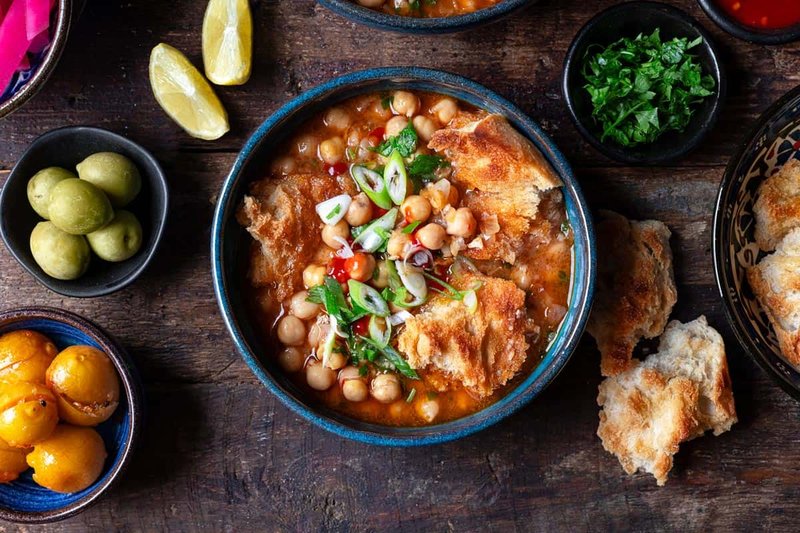
Lablabi
Tunisia's market-stall breakfast: hot chickpea broth poured over stale baguette, finished with poached egg, harissa, lemon and capers.
Overview
Chickpeas (pre-soaked overnight and slow-cooked, OR tinned for speed) simmer in their cooking water with crushed garlic, cumin, salt and a spoon of harissa for 20 minutes. The broth thickens slightly as a few chickpeas break down. Deep bowls are loaded with torn stale baguette. The hot broth ladles over to soften the bread. Each bowl is topped with a soft-poached or soft-boiled egg, a drizzle of olive oil, lemon juice, a fresh spoon of harissa, a heap of canned tuna, olives, capers and a sprinkle of cumin.
Ingredients
Broth
- 400 g cooked chickpeas (about 200 g dried, soaked overnight and simmered 1 hour until tender - OR 2 x 400 g tins drained and rinsed) plus 700 ml of their cooking liquid (or 700 ml water + 1 stock cube)
- 6 garlic cloves (crushed to a paste with ½ teaspoon salt)
- 2 teaspoons ground cumin
- 1 tablespoon harissa paste (more for the bolder; less for the timid)
- 2 tablespoons olive oil
- 1 teaspoon salt (to taste)
- ½ teaspoon black pepper
- ½ lemon (juice)
Per bowl (toppings)
- 2 thick slices stale baguette (or country bread), torn into bite pieces
- 1 egg (soft-boiled 6 minutes, or freshly poached)
- 1 teaspoon harissa paste
- 1 tablespoon extra-virgin olive oil
- ½ tablespoon lemon juice
- 2 tablespoons drained canned tuna (in oil - the kind packed in good olive oil)
- 5-6 black olives (pitted)
- 1 teaspoon capers
- A pinch of ground cumin
- A small wedge of fresh lemon
- Optional: 1 teaspoon harissa-and-olive-oil paste; pickled chilli; mint leaves
Method
Stage 1 - Build the broth
- In a heavy pot, combine cooked chickpeas, their cooking water (or water + stock), garlic-salt paste, cumin, harissa, olive oil, salt and pepper.
- Bring to a simmer.
- Cook 20 minutes - a few chickpeas will break down and slightly thicken the broth. Mash a small ladleful against the side of the pot with a fork if you want it slightly thicker.
- Add the lemon juice; taste; adjust salt and harissa.
Stage 2 - Prepare the eggs
- For soft-boiled: lower eggs into simmering water; cook 6 minutes 30 seconds; transfer to cold water; peel.
- For poached: heat 5 cm of water in a wide pan to a bare simmer; add 1 teaspoon vinegar; crack each egg into a cup; slide into the water; cook 3 minutes; lift out with a slotted spoon.
Stage 3 - Assemble each bowl
- Place a generous handful of torn stale bread in the bottom of each deep bowl (the bread should fill about half the bowl).
- Ladle the hot chickpea broth over to come 2 cm above the bread; let stand 30 seconds to soften.
- Place an egg on top.
- Add a teaspoon of harissa to one side of the bowl.
- Drizzle olive oil and lemon juice.
- Pile tuna on the other side.
- Scatter olives, capers and a pinch of cumin.
- Set a lemon wedge on the rim.
Stage 4 - Serve
- Eat immediately. Stir the harissa through the broth before scooping. Break the egg yolk into the broth.
Notes
- Stale bread is the point: Fresh bread turns to mush. Day-old or two-day-old crusty bread, slightly stiff, absorbs the broth without disintegrating. This is the entire technique behind the dish.
- Tuna sounds weird, isn't: In Tunisia, tinned tuna in olive oil is a fundamental pantry staple. Sprinkled on top of lablabi, it adds protein, savouriness and a faintly oily richness. Don't substitute fresh fish.
- Harissa is to taste: Tunisian harissa is fierce. Start with 1 tablespoon in the broth and adjust. A spoon on top at the table lets each diner customise.
Storage
- Make the broth and chickpeas ahead; refrigerate 4 days; reheat and assemble fresh.
- Don't assemble ahead - the bread softens to mush.
- Broth alone freezes 2 months.
More like this
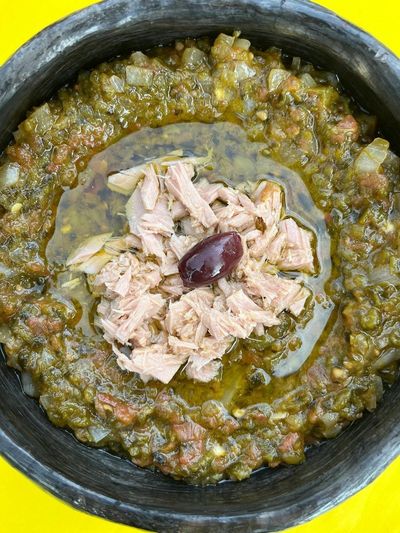
Slata Mechouia
Peppers, tomatoes and chillies char whole on a gas flame (or under a fierce grill) until blackened and collapsed; the skins peel away and the flesh chops to a rough paste. Garlic chars too, mellowing as it does. Lemon, olive oil, capers and salt fold through; tuna and hard-boiled eggs sometimes top.

Pasteis de Bacalhau
These are the little salt-cod fritters you'd order at a marble counter in Lisbon, sitting with a glass of vinho verde while the bartender slides a plate across with no ceremony. The recipe itself is simple, dry mashed potato through flaked bacalhau with onion, garlic, parsley and egg, then a brief fry, but it does start the day before because the salt cod wants 24 to 36 hours of cold water soaks to draw the salt out. That step is the one thing you cannot shortcut. Once the cod is desalted, everything else is an afternoon's work: simmer the cod, flake it through warm potato, shape into the three-sided football "quenelles" that are the Portuguese signature, and fry until amber. Eat them warm with a wedge of lemon and a dish of piri-piri on the side.
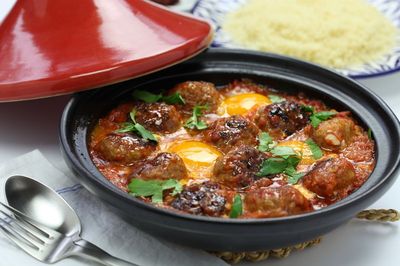
Kefta Tagine
Beef or lamb mince is mixed with grated onion, garlic, fresh parsley and coriander, cumin, paprika, cinnamon, salt and pepper; shaped into small (3 cm) balls. A tomato sauce is built in the tagine: onion sweats in olive oil, garlic, cumin and paprika join, tomato passata and a stock cube simmer for 10 minutes. The meatballs are nestled in; cooked for 12 minutes turning once. Eggs are cracked into wells; lid on; 4 minutes more until the whites are just set. Scattered with parsley and served hot.
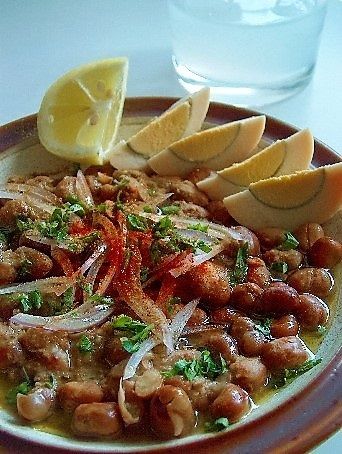
Ful Medames
Whole dried fava beans soak overnight, then simmer slowly until the skins soften and the beans are completely tender, they'll break down on the edges, stay whole at the heart. Garlic, lemon, cumin and salt mash through; a generous pour of olive oil at the end. Tomato, onion, parsley and a hard-boiled egg or two on top.