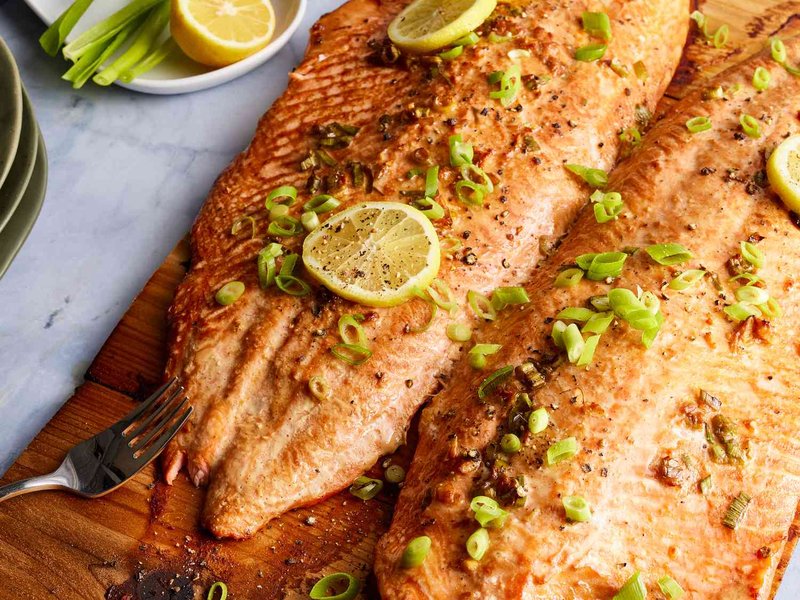
Cedar-Planked Salmon
A Pacific Northwest technique: salmon fillet rested on a soaked cedar plank over high heat, glazed with brown sugar and maple. Smoky and gently sweet.
Overview
A food-safe cedar plank submerges in water for an hour. The salmon (skin on, one side) gets a brief dry cure of brown sugar, salt and crushed juniper. Maple syrup and lemon zest go on at the end of the cure. The hot grill cooks the plank from below while the salmon cooks from the slow heat radiating up, a steam-smoke method, neither pure grilling nor pure baking. The result is a salmon that tastes faintly of forest, cured-cured-not-curried.*
Ingredients
- 1 salmon fillet (large, around 800 g), skin on, pin bones removed
- 1 untreated cedar plank (around 30 x 15 cm)
Cure
- 3 tablespoons light brown sugar
- 1 tablespoon flaky sea salt
- 1 tablespoon crushed juniper berries (around 8 berries)
- 1 teaspoon black pepper
Glaze
- 4 tablespoons pure maple syrup
- 1 lemon (zest)
- 1 teaspoon Dijon mustard
To finish
- A small bunch of dill (chopped)
- Lemon wedges
- Flaky salt
Method
Stage 1 - Soak the plank
- Submerge the cedar plank in cold water; weight with a heavy plate.
- Soak at least 1 hour, ideally 2-4 hours. A dry plank ignites; a soaked one smokes.
Stage 2 - Cure
- Mix the brown sugar, salt, juniper and pepper.
- Pat the salmon dry; rub the cure all over the flesh side (not the skin).
- Cover; refrigerate 30 minutes - the cure draws moisture and tightens the flesh.
Stage 3 - Glaze
- Whisk the maple syrup, lemon zest and mustard.
- Pat any drawn-out moisture off the salmon with kitchen paper.
- Brush the glaze generously over the cured salmon.
Stage 4 - Heat the grill
- Preheat a charcoal or gas barbecue to medium-high (around 200°C).
- Lift the soaked plank out of the water; pat the surface dry.
Stage 5 - Grill
- Lay the plank directly on the grates; close the lid.
- After 3-4 minutes, check the plank - it should be smoking but not flaming. (If flame appears, mist with water from a spray bottle.)
- Lay the salmon skin-side down on the plank; close the lid.
- Cook 14-18 minutes - the salmon is done when the centre is just-set (a knife slides in easily) and the surface is glossy and slightly caramelised.
- The plank may char around the edges; this is desirable.
Stage 6 - Rest and serve
- Lift the entire plank off the grill onto a heatproof board (handle with tongs and a towel; the plank's edges are hot).
- Rest 5 minutes.
- Sprinkle with dill and flaky salt.
- Serve from the plank with lemon wedges. The salmon lifts off the plank in clean pieces, leaving the skin behind.
Notes
- Untreated cedar only: Don't use treated lumber - it leaches chemicals. Buy "grilling planks" (cedar, alder, cherry are all good) at hardware or barbecue stores.
- Soak hard: A plank that hasn't soaked long enough will catch fire. An hour is the minimum.
- Don't overcook: Salmon stays moist when just-set in the centre; overcooked it goes dry and flaky in the wrong way.
Storage
- Best fresh; cooked salmon refrigerates 2 days; eats well cold over salad.
More like this
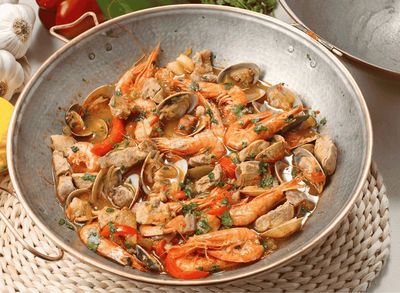
Cataplana de Marisco
A cataplana is a hinged copper clamshell pan, and the seafood stew named after it is one of those dishes where the cookware does the work. You build a base of onions, peppers, sliced chouriço, smoked paprika, tomato and white wine in the bottom of the cataplana, then layer clams, mussels, prawns and chunks of firm white fish on top, clamp the lid shut, and steam it all for less than ten minutes. The lid lifts at the table to release a cloud of paprika-and-wine-scented steam, which is the entire point of the dish. If you do not have a cataplana, any wide pan with a tight lid does the same job. Coriander and lemon at the end, crusty bread for the broth, and vinho verde for everything else.
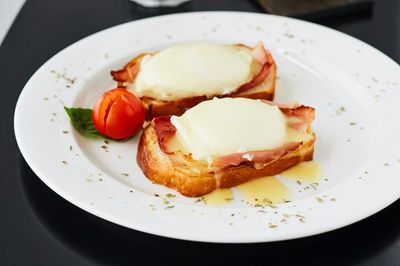
Eggs Benedict
The Sunday brunch icon, and the dish people learn hollandaise for. You build the sauce first, whisking egg yolks with water and lemon over a bain-marie until they ribbon, then drizzling in warm clarified butter while you whisk steady and even until the bowl holds something glossy and thick. The hollandaise will wait for you in a warm spot while you poach the eggs - vinegar in barely-simmering water, a gentle whirlpool, three minutes for a runny yolk - and toast the muffins, and warm the ham. Then everything stacks at speed: muffin, ham, egg, hollandaise spooned generously over, a scatter of chives. You eat immediately, because every component is at its best within a minute of plating and falls off a cliff after five. Looks fancy on a tablecloth; rewards twenty focused minutes of work.
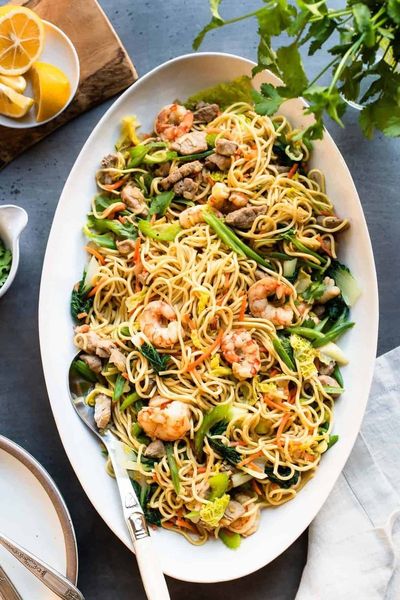
Pancit Canton
Aromatics fry, then chicken and prawns sauté fast. Vegetables and Chinese sausage join. The noodles soak briefly to soften, then go in the wok with sauce and stock to absorb everything in 5 minutes. Lemon or kalamansi at the table.

Pasteis de Bacalhau
These are the little salt-cod fritters you'd order at a marble counter in Lisbon, sitting with a glass of vinho verde while the bartender slides a plate across with no ceremony. The recipe itself is simple, dry mashed potato through flaked bacalhau with onion, garlic, parsley and egg, then a brief fry, but it does start the day before because the salt cod wants 24 to 36 hours of cold water soaks to draw the salt out. That step is the one thing you cannot shortcut. Once the cod is desalted, everything else is an afternoon's work: simmer the cod, flake it through warm potato, shape into the three-sided football "quenelles" that are the Portuguese signature, and fry until amber. Eat them warm with a wedge of lemon and a dish of piri-piri on the side.