
Boortsog
Mongolia's everyday fried dough: slightly sweet biscuits deep-fried golden. Dipped in milk tea or piled high for Tsagaan Sar.
Overview
A simple dough of flour, butter, sugar, milk and an egg rests until smooth. The dough rolls out 5-7 mm thick; cut into rectangles or strips, optionally twisted or scored. Deep-fried in vegetable oil at moderate heat 2-3 minutes per side until uniformly golden. Drained briefly; eaten warm with sweetened milk tea, or cooled and stored in a tin for tea-time later.
Ingredients
- 500 g plain flour
- 80 g caster sugar
- 1 teaspoon salt
- ½ teaspoon baking powder
- 100 g unsalted butter (softened)
- 1 egg (large)
- 200 ml whole milk (warm; plus 50 ml extra if needed)
Frying
- Vegetable oil for deep-frying (about 1 litre)
To finish (optional)
- Caster sugar for dusting (modern variation)
- Or: drizzle of honey
- Or: butter and jam to serve
Method
Stage 1 - Dough
- Whisk the flour, sugar, salt and baking powder in a wide bowl.
- Rub in the softened butter until breadcrumb texture.
- Whisk the egg and warm milk together; pour into the flour.
- Mix to a soft, slightly sticky dough; knead briefly (3-4 minutes) until smooth.
- Cover and rest 30 minutes.
Stage 2 - Roll and shape
- On a lightly floured surface, roll the dough to a 6-7 mm thick rectangle.
- Cut into pieces. Several traditional shapes:
- Rectangles (3 x 6 cm) - easiest.
- Twists: cut a long strip; make a slit lengthwise in the middle; pull one end through the slit to form a twist.
- Discs: roll into balls, flatten, score the top with a fork.
- Lay finished pieces on a tray; rest 10 minutes (gives a slightly puffier result).
Stage 3 - Heat the oil
- Heat the oil to 165-170°C (a piece of dough should bubble vigorously and float without browning instantly).
Stage 4 - Fry
- Add 6-8 boortsog at a time; don't crowd.
- Fry 2-3 minutes per side until uniformly deep gold and slightly puffed.
- Lift onto kitchen paper.
Stage 5 - Finish
- Eat warm or at room temperature.
- Optional: dust with caster sugar while still warm; or drizzle with honey; or split and spread with butter and jam.
Stage 6 - Serve
- Serve with hot sweetened milk tea (or any black tea with milk and a pinch of salt for the proper Mongolian way).
- Pile high on a plate for tea time.
Notes
- Don't overwork the dough: Boortsog should be tender, not chewy. Knead just until smooth, then leave it alone.
- Frying temperature: Hotter than 175°C burns the outside before the inside cooks; cooler than 160°C means oily, dense biscuits. Use a thermometer if you have one.
- Festival stacking: For Tsagaan Sar, boortsog stack like a tiered cake - sometimes called "ul boov" - symbolising prosperity. Domestic versions are eaten more casually, dipped into milk tea.
Storage
- Keeps 2 weeks in an airtight tin at room temperature; eats well stale (dunked in tea).
- Freezes 2 months.
More like this
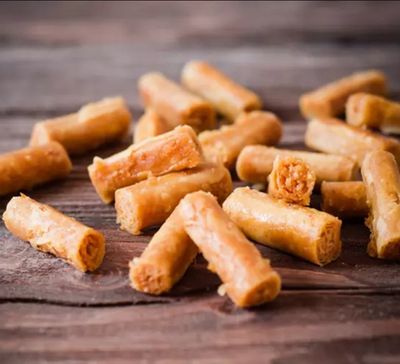
Cigares au Miel (Honey Almond Cigars)
Almond paste: ground almonds, icing sugar, melted butter, cinnamon, orange-flower water, pulses or kneads to a soft pliable paste. Divides into walnut-sized portions; each rolls into a thin cylinder 10 cm long. Warka strips wrap around the cylinder; seal with egg-wash. Fries in moderately hot oil till deep gold. Submerges briefly in warm honey with orange-flower water; lifts; drains; cools.
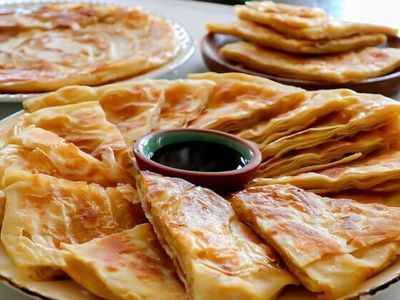
Feteer Meshaltet
A soft elastic dough rests; divides into 2 balls. Each ball stretches paper-thin on a heavily-oiled / ghee-buttered surface (similar to msemen or yufka, translucent dough). Layered with melted ghee between folds: stretch → ghee → fold into thirds → quarter-turn → stretch → ghee → fold. Repeated 3 times per ball. The two folded packets place stacked on top of each other in a buttered round dish (about 24 cm). Baked at 220°C 25-30 minutes until amber, golden, and the layers have separated dramatically. Served warm with honey, soft cheese, or molasses-and-tahini (the Egyptian classic dip).
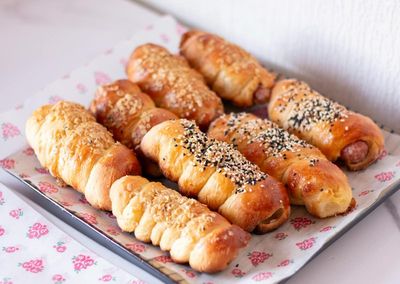
Merguez Rolls
All-butter puff pastry rolls thin; cuts into 4 long strips. Merguez sausages cut into 6 cm lengths. Each pastry strip wraps once around a merguez piece (overlapping seam underneath). Eggwashes; dusts with sesame and nigella seeds. Bakes for 25 minutes at 200°C till the pastry is deep gold and the sausage cooked through.
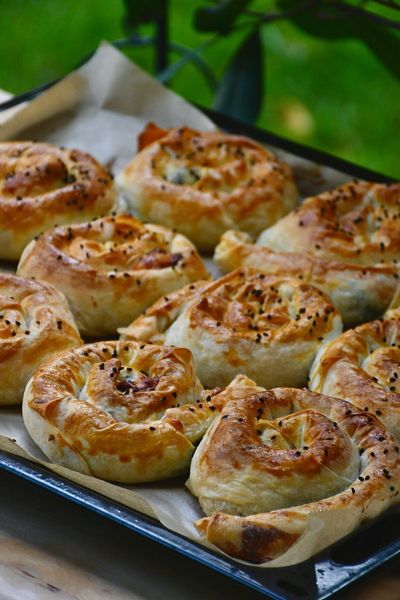
Baked Börek with Khandrajo Filling
Börek are Turkish pastry packages filled with various ingredients: meat, cheese, or vegetables. This vegetarian version uses khandrajo, a concentrated eggplant ragù heavily reduced until jammy and concentrated. Traditional börek-making uses thin, hand-rolled dough (yufka), but modern versions use readily available filo pastry. The key to success is preparing the khandrajo well ahead; it must be completely cool before filling (otherwise it creates soggy börek). The eggplant roasts down to deep mahogany richness through high-heat cooking, creating a sweet-savory filling. Baked börek develop shatteringly crisp exteriors through careful pastry handling and high-temperature baking.