Dholl Puri
Mauritius's street flatbread: thin breads stuffed with seasoned ground yellow split peas, griddled hot and folded around bean curry.
Overview
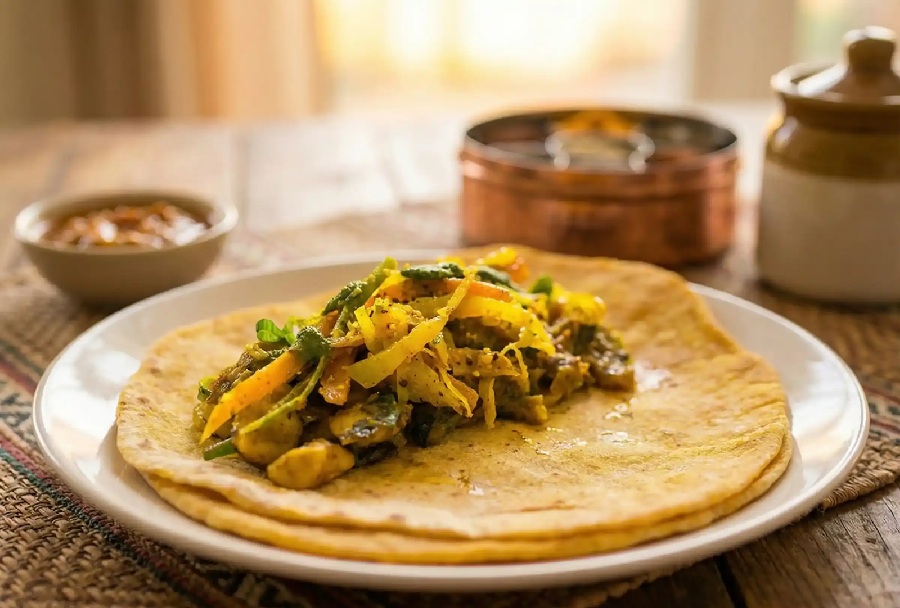
Dholl puri is the bread, not the wrap. What you are making is a soft, lightly elastic flatbread with a stuffing of cooked, drained, finely ground yellow split peas seasoned with turmeric, cumin and a little salt. The dough is wrapped around the filling like a stuffed paratha, then rolled out paper-thin (a real Mauritian dholl puri vendor rolls them so thin you can read newsprint through them) and cooked dry on a hot tawa with just a brush of oil. The challenge is keeping the filling completely dry; any moisture and the dholl ruptures when you roll it. Mauritians eat dholl puri folded in half or quartered around a small spoonful each of cari gros pois (butter bean curry), rougaille (tomato sauce) and either a coriander satini or a fiery mazavaroo chilli paste. This recipe focuses on the flatbreads themselves with a short note on the typical filling so you can put together a proper plate at home. Difficulty is moderate: the dough handling takes practice but it is forgiving and a slightly thicker first attempt still tastes excellent.
Ingredients
Split-pea filling
- 200 g yellow split peas (toor or chana dal also work, but yellow split peas are traditional)
- 1 tsp ground turmeric
- 1 tsp ground cumin
- ¾ tsp salt
- ½ tsp freshly ground black pepper
Dough
- 400 g plain flour, plus extra for dusting
- ½ tsp ground turmeric
- ½ tsp salt
- 2 tbsp neutral oil
- 220 ml warm water (approx, add as needed)
For cooking
- 3-4 tbsp neutral oil, for brushing the tawa
Typical accompaniments (assemble on the side)
- Butter bean curry (cari gros pois)
- Rougaille tomato sauce
- Coriander satini (or mazavaroo chilli paste)
- Wedge of lime
Method
Stage 1 - Cook and dry the split peas
- Rinse the split peas in cold water until the water runs clear. Soak in plenty of cold water for 4 hours (or overnight).
- Drain and put the soaked peas in a saucepan with fresh cold water to cover by 2 cm. Bring to a boil, skim off any foam, and simmer 12-15 minutes until tender but not mushy; the peas should still hold their shape and not break when pressed between thumb and finger.
- Drain very thoroughly. Spread the peas on a tray lined with a clean tea towel and pat them dry. Let them air-dry 10-15 minutes. This is the most important step; wet filling tears the dholl puri.
- Tip the cooled peas into a food processor with the turmeric, cumin, salt and pepper. Pulse to a fine, dry, crumbly powder that just holds together when squeezed. Do not pulse to a paste; if your peas were too wet, the texture will go gluey. Set aside.
Stage 2 - Make the dough
- Mix the flour, turmeric and salt in a wide bowl. Add the 2 tbsp oil and rub through with your fingers.
- Pour in the warm water gradually, mixing as you go, until you have a soft, slightly sticky dough. You may not need all of the water.
- Turn out and knead 6-8 minutes until smooth and elastic. The dough should feel softer than a roti dough, closer to a pizza dough.
- Cover with a damp cloth and rest 20 minutes.
Stage 3 - Stuff and shape
- Divide the dough into 8 equal pieces (around 80 g each). Roll each into a smooth ball.
- Take one ball, flatten it in your palm to a disc about 8 cm across, with the edges slightly thinner than the middle.
- Place 2 heaped tbsp of the split-pea powder in the centre. Gather the edges of the dough up over the filling and pinch firmly to seal into a parcel. Roll it gently between your palms to even it out, then flatten very lightly. Repeat with the rest.
- Rest the stuffed balls under a cloth 10 minutes; this lets the dough relax so it rolls without splitting.
Stage 4 - Roll out
- Dust a clean surface lightly with flour. Place one stuffed ball, sealed-side down, and dust the top.
- Roll out gently from the centre outwards, turning a quarter-turn between each pass, into a thin round about 22-24 cm across. Pressure should be even and light; if filling pokes through, dust a bit of flour over the tear and keep rolling.
- Set the rolled dholl puri on a tray dusted with flour. Do not stack them or they will stick.
Stage 5 - Cook on the tawa
- Heat a flat tawa, crepe pan or large frying pan over medium-high heat for 2 minutes until properly hot.
- Lay a rolled dholl puri onto the dry pan. Cook 30-40 seconds until small bubbles appear on the surface and the underside has light brown spots.
- Flip with a wide spatula. Brush a teaspoon of oil over the cooked surface and around the edge. Cook 30 seconds.
- Flip again, brush the other side with a little oil, and cook a final 20-30 seconds. The dholl puri should be soft, pliable and lightly speckled, never crisp.
- Stack the cooked dholl puris on a plate covered with a clean cloth so they stay soft and warm. Repeat with the rest.
Notes
- Dry filling is everything: any moisture in the split-pea powder is the single most common reason dholl puris tear. Cook the peas just-tender, drain hard, dry on a cloth, and pulse to a powder, not a paste.
- Soft dough, not stiff: a stiff dough resists rolling and tears the filling open. The dough should feel slightly tacky to the hand but not gluey.
- Tawa heat: medium-high is right. Too cool and the bread dries out before colouring; too hot and the outside browns before the inside cooks through.
- Keep them soft after cooking: an upturned bowl or clean tea towel over the stack traps the steam and keeps the dholl puris pliable for serving.
Variations
Chana dal version: Some Mauritian cooks use chana dal (split chickpeas) for a nuttier, slightly coarser filling. Cooking method is the same; soak overnight. Spicier filling: A pinch of ground roasted cumin and a tiny pinch of cayenne in the filling powder gives a sharper edge.
Serving
Lay a warm dholl puri flat on a plate. Spoon a strip of butter bean curry down the centre, a spoon of rougaille, and a small dab of coriander satini or chilli paste. Fold in half or quarter and eat by hand. A wedge of lime on the side cuts through the spice.
Storage
- Best eaten fresh from the pan. Will keep soft 4-5 hours wrapped in a clean cloth at room temperature.
- Refrigerated dholl puris go stiff; reheat 20 seconds per side on a dry tawa to soften back up.
- Freeze cooked and cooled dholl puris stacked between sheets of greaseproof paper for up to 1 month; defrost and reheat on a dry pan.
More like this
Malaysian Dhal Curry
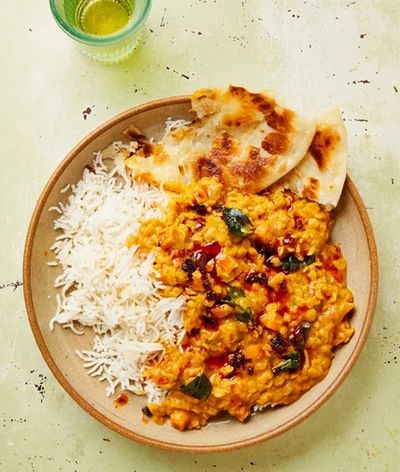
Yellow split peas (chana dal) simmer with onion, turmeric and tomato until very soft. The lentils break down into a thick soup. Right at the end, a tempering of mustard seeds, curry leaves, dried red chillies, garlic and shallots is poured sizzling-hot over the surface. The aromatic oil seeps through; the dish transforms.
Octopus Curry (Cari Ourite)
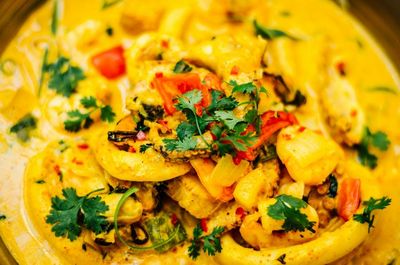
Cari ourite is the dish that turns up at every Mauritian fisherman's Sunday lunch, and at every Creole restaurant on the south coast. The technique is to braise octopus low and slow in a tomato-and-onion masala that leans on fresh thyme and a finishing pinch of garam masala instead of the heavier dried-spice masalas you find in cari boeuf or cari poulet. Octopus has a sweet, slightly mineral flavour that needs space, so the seasoning is restrained: thyme for aroma, tomato for body, ginger and garlic for the base, mild curry powder for depth, garam masala right at the end for top-note warmth. The tentacles cook for around 45 minutes (small octopus) to an hour (larger). The biggest variable is the octopus itself; small frozen octopus, sold cleaned at most fishmongers and many supermarkets, is reliable and the freezing actually helps tenderise the flesh. Difficulty is moderate; the cook is mostly passive once the masala is built. Serve with plain steamed rice and a satini cotomili (coriander chutney) or a spoon of pickled chilli. A simple green salad with vinaigrette on the side keeps it honest.
Dahi Bhalla
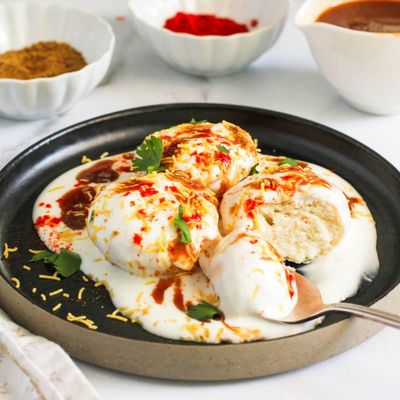
Dried urad dal (white, sometimes labelled "white lentils" or "split urad") soaks overnight, then blends with ginger, green chilli and a small amount of water into a smooth thick batter. Whipped vigorously for 5 minutes to incorporate air (this is what makes the fritters light). Asafoetida and salt season; baking soda activates right before frying. Fritters drop into 175°C oil; fry for 3-4 minutes until amber. Lifted into a wide bowl of lukewarm water; soaked for 10 minutes; squeezed gently between palms to remove most water. Plated in shallow bowls; flooded with sweet salted spiced yogurt; topped with chutneys, chaat masala, pomegranate, fresh coriander, a sprinkle of crushed papri or sev for crunch.
Dal Makhani
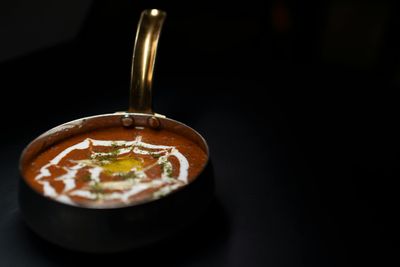
Whole black urad lentils and a small handful of red kidney beans are soaked overnight, then pressure-cooked or simmered until completely tender. A tomato-and-spice masala is built separately with onion, garlic, ginger and a careful hand with the spices. The lentils are folded into the masala and simmered, low and slow, for two hours, while butter and cream are stirred through in the final stage. The lentils break down into a glossy, almost-velvet finish.