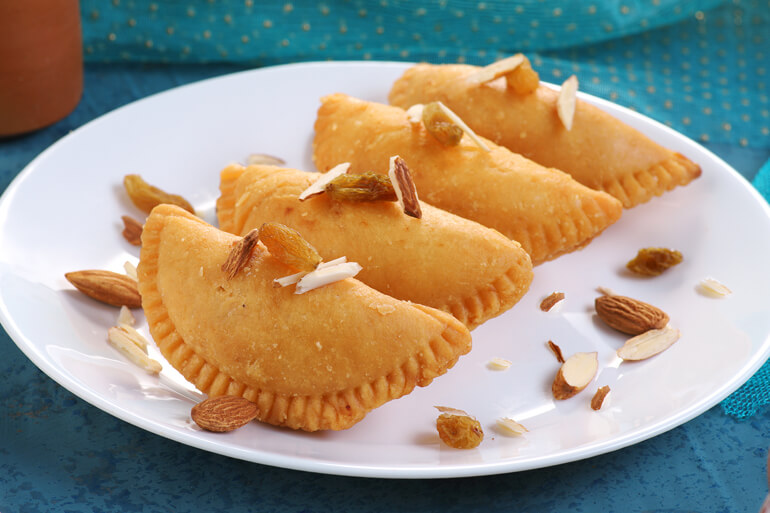
Gujiya
The Holi sweet. Half-moon pastry parcels filled with sweetened khoya, coconut and dried fruit, sealed with a fluted crimp, deep-fried until crisp and dusted with sugar. Eaten by the trayful through the afternoon, crumbs collected on a paper napkin.
Overview
A short, slightly tender dough made with maida, ghee and milk is rolled thin and cut into rounds. Each round is filled with a warmed mixture of khoya (or thickened condensed milk), desiccated coconut, semolina, chopped nuts and cardamom. The edges are sealed with a fluted crimp and the parcels are deep-fried low and slow until pale gold. Dusted with icing sugar while warm.
Ingredients
The dough
- 300 g maida (plain flour)
- 60 g ghee (melted)
- A small pinch of fine sea salt
- About 100 ml whole milk (lukewarm)
The filling
- 200 g khoya (grated)
- 50 g fine semolina (sooji)
- 30 g desiccated coconut
- 100 g caster sugar
- 1 teaspoon ground cardamom
- 30 g cashews (chopped)
- 30 g almonds (chopped)
- 30 g raisins
- 1 tablespoon ghee
- A small pinch of fine sea salt
To finish
- Sunflower or vegetable oil (for deep-frying)
- 30 g icing sugar (for dusting)
Method
Stage 1 - Make the dough
- Tip the maida and salt into a wide bowl. Pour in the melted ghee and rub through with your fingertips for 2-3 minutes. The mixture should feel like damp sand and a fistful should hold together briefly when squeezed. If not, add another tablespoon of ghee.
- Add the warm milk a little at a time, mixing with a spoon, until the dough comes together in a firm, slightly stiff ball. You may not need all the milk.
- Knead for 2 minutes on the worktop, just until smooth. Cover with a damp cloth and rest for 30 minutes.
Stage 2 - Make the filling
- Warm the tablespoon of ghee in a wide pan over a medium-low heat. Add the semolina and toast for 3-4 minutes, stirring, until pale gold and toasty. Tip onto a plate to cool.
- In the same pan, add the grated khoya and stir for 4-5 minutes until it loosens and turns pale and crumbly. Take off the heat.
- Stir in the toasted semolina, coconut, sugar, cardamom, salt, chopped nuts and raisins. Let it cool completely before filling, or the dough goes soggy.
Stage 3 - Shape the gujiya
- Divide the dough into walnut-sized pieces (about 20). Keep them under the damp cloth as you work.
- Roll a piece into a thin round about 10 cm across, lightly flouring as needed. Aim for a 1.5-2 mm thickness.
- Place a generous tablespoon of filling on one half of the round. Brush the edge lightly with water, fold the empty half over, and press to seal.
- Crimp the curved edge: pinch the corner, fold a tiny piece inward, pinch the next, and continue along the seam. This is the gujiya's signature finish and also the seal that keeps the filling in. If your hands are not up for the crimp, press hard with a fork.
- Set on a lightly floured tray, covered with a cloth. Repeat with the rest of the dough.
Stage 4 - Fry and dust
- Heat 5 cm of oil in a deep pan to 150°C (low; a small pinch of dough should sizzle gently). The oil must be moderate; hot oil colours the gujiya before the dough cooks through.
- Slide in 4-5 gujiya at a time, turning them gently, and fry for 6-7 minutes until pale gold all over. Lift out with a slotted spoon and drain on a wire rack.
- While still warm, dust generously with icing sugar.
Notes
- Khoya (mawa) is reduced milk solids; find it in the freezer section of South Asian grocers. To approximate, simmer 400 ml whole milk with 30 ml double cream until it reduces to a sticky paste, then cool.
- The fluted crimp looks intimidating; in practice ten minutes' practice on the first few teaches your fingers the rhythm. A fork-pressed seal works and tastes the same.
- For a sugar-syrup finish (gujiya dunked briefly in one-string syrup), make a syrup with 200 g sugar and 100 ml water boiled to a sticky single thread, and dip each warm fried gujiya in for 30 seconds before lifting onto a rack to set.
Serving
On a tray with chai, between rounds of Holi colour-throwing. A glass of thandai alongside.
Storage
In an airtight tin at room temperature for up to 5 days. Do not refrigerate; the pastry loses its snap.
More like this
Jalebi
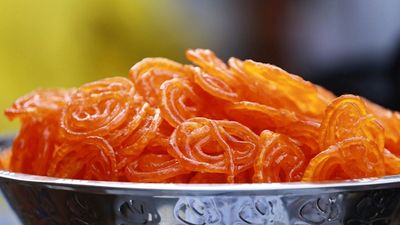
A loose batter of plain flour, gram flour, yoghurt and water ferments 8-12 hours at room temperature (or 24 hours in the fridge), the slight tang from the yoghurt and the bubbles from the fermentation give the characteristic crisp-shattering bite. A 1-thread sugar syrup is scented with saffron, cardamom and a squeeze of lemon. The batter goes into a piping bag (or squeezy bottle); piped into hot oil in spirals from the centre outwards; fried for 30-40 seconds per side; lifted out and dropped straight into warm syrup for 30 seconds; lifted again. Eaten immediately while still hot and crisp.
Rasmalai
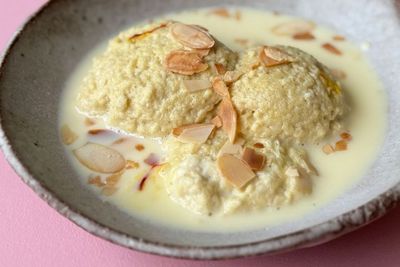
Whole milk boils, then curdles with lemon juice; the curds drain to chhana (fresh paneer). The chhana kneads for 8-10 minutes until smooth and lump-free, this is what gives the dumpling its sponge. Small flattened discs poach gently in sugar syrup; they double in size. A separate pan reduces a second batch of milk by half with cardamom, saffron, almonds and sugar to a rich rabri. The squeezed dumplings float in the cool rabri to absorb the spiced milk overnight.
Thandai
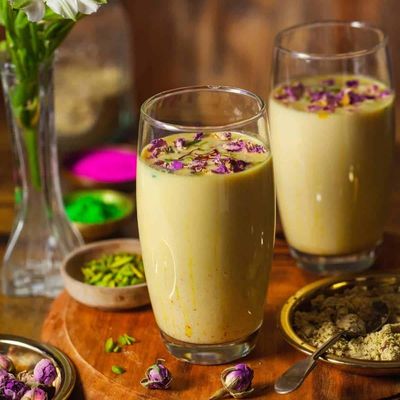
A nut-and-spice paste is the soul of thandai: almonds and cashews soaked soft, ground with green cardamom, fennel, white peppercorns, poppy seeds, dried rose petals and saffron, then whisked into cold sweetened milk. Strained, chilled, poured over ice. The drink reads cool and complex: sweet from the sugar and saffron, perfumed from the rose and cardamom, with a faint warmth from the fennel and pepper.
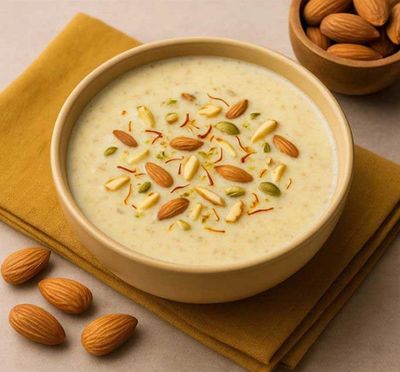
Badam Kheer
Almonds blanched, peeled, ground to a smooth paste, then folded into milk that's been reduced to two-thirds of its volume. Sugar to taste, saffron bloomed in warm milk for the colour, cardamom for the warmth. Simmered gently - never boiled - until the consistency thickens to a pourable cream, then garnished with pistachio slivers and a drift of rose petals.