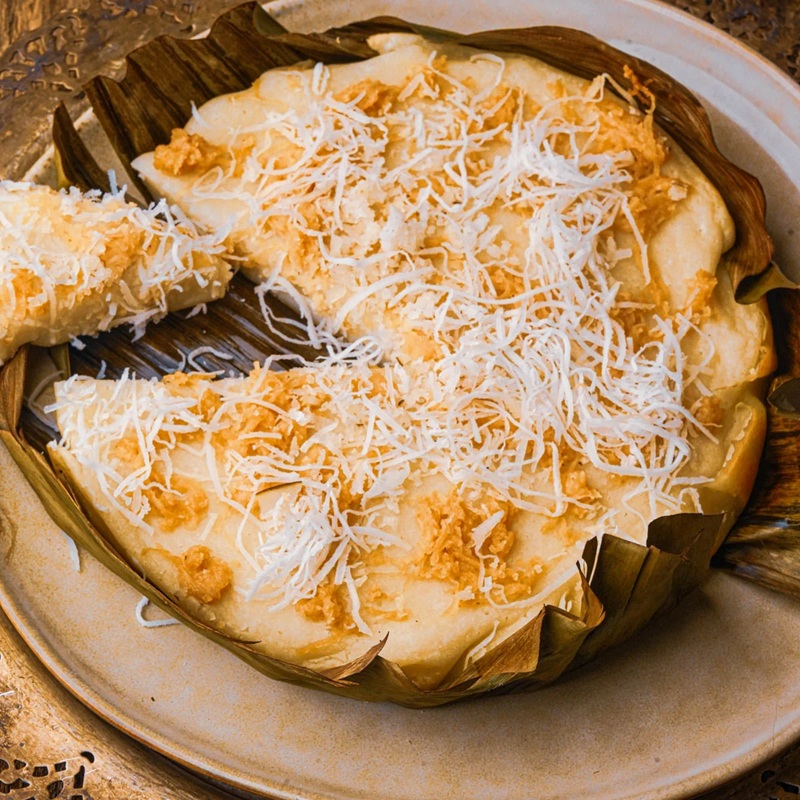
Bibingka
The Philippines' Christmas cake: a springy rice-flour cake baked in banana leaf, topped with salted egg, cheese and grated coconut.
Overview
Rice flour, glutinous rice flour, sugar, baking powder and salt are sifted together. Coconut milk, melted butter and beaten eggs are whisked in until smooth. A banana leaf lines a cake tin (or individual ramekins), brushed with butter. The batter is poured in to 2 cm depth. Baked at 200°C 15 minutes; salted egg slices and grated cheese are pressed on top; baked another 10 minutes. Finished with butter, sugar and a thick layer of fresh grated coconut.
Ingredients
Batter
- 200 g rice flour
- 50 g glutinous rice flour
- 200 g caster sugar
- 2 teaspoons baking powder
- ½ teaspoon salt
- 3 eggs (large)
- 400 ml coconut milk
- 60 g unsalted butter (melted)
- 1 teaspoon vanilla extract
Topping (per bibingka)
- 1 salted duck egg (sliced 5 mm thick, or substitute 1 salted hen egg)
- 50 g kesong puti (or salty white cheese, or substitute mild feta or queso fresco)
- 30 g unsalted butter (extra, for brushing)
- 2 tablespoons caster sugar (for sprinkling)
- 80 g fresh grated coconut (or rehydrated desiccated)
Lining
- Banana leaf (cut to fit the tin or ramekins, pass over a gas flame briefly to soften)
- Butter (for brushing the leaf)
Method
Stage 1 - Prepare the tin
- Heat the oven to 200°C (180°C fan).
- Pass the banana leaf over a low gas flame for a few seconds on each side - it changes colour from matte to shiny and becomes pliable.
- Line a 22 cm round cake tin or 6 ramekins with the banana leaf, brushing with melted butter to help it stick.
- The leaf should come up the sides.
Stage 2 - Batter
- In a wide bowl, whisk both rice flours, sugar, baking powder and salt.
- In a jug, whisk the eggs, coconut milk, melted butter and vanilla.
- Pour wet into dry; whisk until smooth and lump-free.
- Pour the batter into the prepared tin(s) to a depth of 2 cm.
Stage 3 - First bake
- Bake 15 minutes - the batter should be set but pale.
Stage 4 - Top
- Slide the rack out (don't fully remove the bibingka from the oven).
- Arrange salted egg slices over the top.
- Crumble the kesong puti / cheese evenly.
- Slide back in for another 10 minutes - the surface should be lightly golden.
Stage 5 - Finish
- Brush the top of the still-hot bibingka with melted butter.
- Sprinkle with caster sugar.
- Pile fresh grated coconut generously on top.
- Serve warm in wedges or directly in the ramekin.
Notes
- Two rice flours, not one: plain rice flour gives the structure; glutinous rice flour gives the springy chew. Ratio matters - too much glutinous turns sticky, too little gives a crumbly cake.
- Banana leaf isn't optional for authenticity: it imparts a subtle grassy aroma that defines bibingka. Buy frozen banana leaves at any Asian grocery; pass over a flame briefly to release the fragrance and make them flexible. Skip if truly unobtainable; line the tin with parchment.
- Salted egg: small, perfect bricks of savoury. Look for them at Filipino or Chinese groceries; if unavailable, brine a regular hard-boiled egg in heavy salt water overnight.
- Coconut milk, not coconut cream: the cream is too rich and the bibingka turns dense.
Storage
- Best eaten warm the day it's made.
- Keeps 1 day at room temperature in the banana leaf.
- Reheats poorly in a microwave; better to wrap in foil and warm in a 150°C oven 10 minutes.
- The grated coconut topping should be re-applied fresh if reheated.
More like this
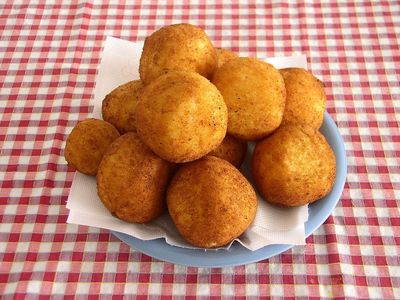
Arancini
Cold risotto (saffron Milanese-style is traditional in arancini "alla Milanese"; plain works too) is mixed with grated parmesan and beaten egg to bind. Filling, a stew of beef-and-pork ragù with peas, OR a cube of mozzarella, sits in the centre of each ball. Hands wet with water shape the rice around the filling into a tight orange-sized ball (or cone, for the Catania style). Each ball is rolled first in flour, then in beaten egg, then in fine breadcrumbs (or in the doubled-up "panata" mix of flour + water for the Sicilian original). Deep-fried at 180°C in 4-5 cm of oil for 4-6 minutes per ball until deep gold. Drained on kitchen paper; eaten warm.
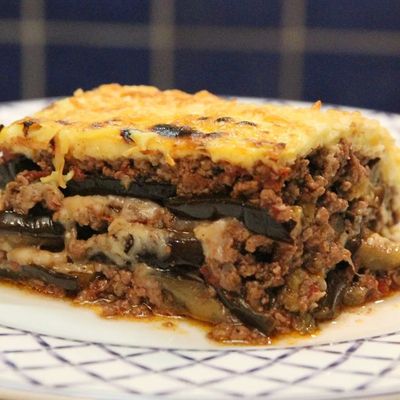
Moussaka
Aubergines and potatoes pan-fry or roast separately. Lamb mince cooks down with onion, garlic, cinnamon and tomato into a rich ragù. The layers go into a deep dish, topped with a cheese-rich béchamel that sets golden in the oven.
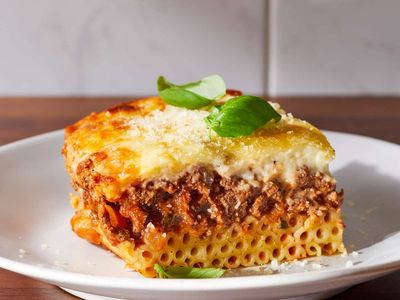
Pastitsio
Pasta tubes get a quick boil and a buttery toss. A beef ragù with cinnamon, allspice and a touch of tomato cooks while the pasta drains. Béchamel, thick, egg-bound, cheese-spiked, pours over the top. Bakes until the surface is mahogany-bronze.
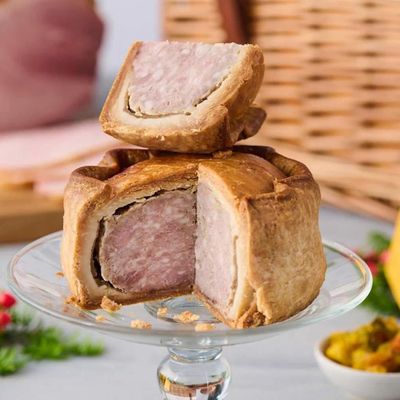
Pork Pie
Pork shoulder (uncured, fatty) and a small amount of bacon are chopped into 5 mm dice (not minced, the texture is key). Mixed with white pepper, mace, sage, salt and a touch of anchovy paste for umami. The hot-water-crust pastry: flour is mixed with hot water-and-lard mixture, kneaded warm into a pliable dough. Two-thirds of the dough lines a tall round tin (or is moulded freestanding around a glass jar); the filling is packed in tight; a lid of remaining dough is laid over the top with a 1 cm steam hole punched. Baked at 200°C for 30 min, then 160°C for another 60-75 min. Left to cool. A rich pork stock (made from trotters or with gelatin sheets) is poured through the steam hole while the pie is still warm. Refrigerated overnight to set the jelly. Sliced and eaten cold.