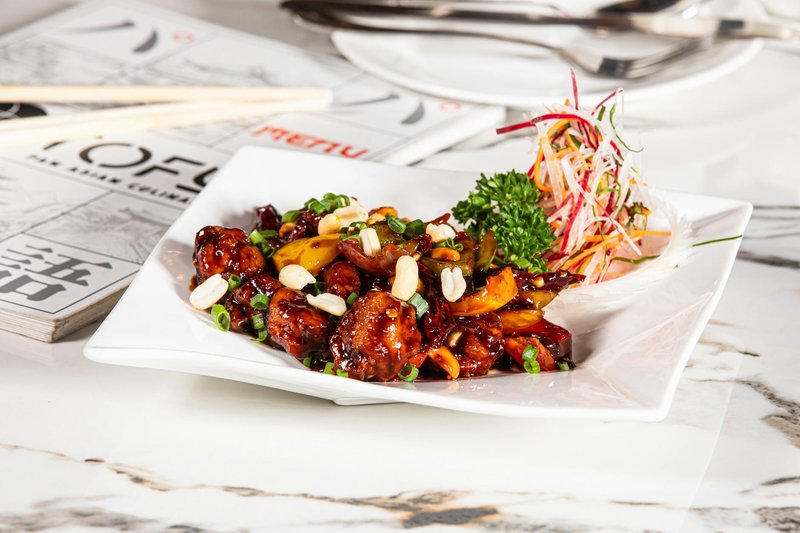
Kung Pao Chicken
Sichuan's Kung Pao chicken: diced chicken stir-fried hot with dried chillies, Sichuan peppercorns, garlic, ginger and roasted peanuts.
Overview
This iconic hot and spicy chicken from western China showcases contrasting flavours, heat from chillies and Sichuan peppercorns balanced with subtle sweetness. The numbing quality of Sichuan peppercorns and the fragrance of slow-braising creates an aromatic dish that is equally delicious served immediately or reheated the next day.
Serves: 4 Prep Time: 10 minutes
Cook Time: 25 minutes
Ingredients
Chicken & Preparation
- 350 grams chicken pieces (with skin)
- ½ teaspoon salt
- 2 spring onions
Cooking
- 150 ml groundnut oil
- 1 teaspoon oil (for final braising)
- 1 dried red chilli (halved length-ways)
- ½ teaspoon fresh ginger (finely chopped)
- ½ teaspoon chilli powder
Braising Sauce
- 300 ml Chinese chicken stock
- ½ teaspoon Sichuan peppercorns (roasted and ground)
- ½ teaspoon sugar
- 2 teaspoons dark soy sauce
Method
Stage 1 - Prepare
- Rub the chicken pieces with salt and let them sit for about 30 minutes.
- Cut the spring onions into 5 cm pieces.
Stage 2 - Infuse Oil & Brown Chicken
- Heat the oil in a wok or large frying pan and add the dried chilli to flavour the oil.
- When the chilli turns black, turn the heat down (you can remove the chilli or leave it in as the Chinese do).
- Slowly brown the chicken pieces, a few at a time, skin side down.
- Turn the chicken over and brown the other side.
- Drain the chicken pieces on kitchen paper and set aside.
Stage 3 - Braise
- Clean the wok and re-heat it.
- Add 1 teaspoon of oil to the wok and add the spring onions, ginger and chilli powder.
- Add the chicken stock, Sichuan peppercorns, sugar and soy sauce.
- Turn the heat down to low and add the chicken pieces.
- Cover and finish cooking the chicken in the sauce, stirring occasionally for 20-30 minutes.
Stage 4 - Finish
- Serve the chicken with the sauce, removing any surface fat.
Notes
- Sichuan peppercorns: Create a distinctive numbing sensation. Roast and grind just before use for maximum fragrance.
- Dried chilli infusion: Darkening the chilli flavours the oil gradually rather than aggressively. Choose your preferred heat level.
- Make-ahead friendly: This dish actually improves after 24 hours as flavours develop. Reheat gently to avoid drying the chicken.
Serving
Serve with: Steamed white rice to balance the heat
Storage
- Keeps 3-4 days refrigerated (flavour improves with age)
- Freezes well up to 2 months
- Remove surface fat before storing to maintain best quality
More like this
Spicy Chicken with Peanuts
This is a classic western Chinese dish better known in China as Gongbao chicken (or Kung Pao chicken). Named after Chinese official Ding Baozhen, Governor of Sichuan province in the nineteenth century, it represents the region's bold approach to flavour: spicy, slightly sour, sweet, and savoury all at once. The combination of roasted peanuts and dried chilli creates an unforgettable sauce.
Cantonese BBQ Chicken
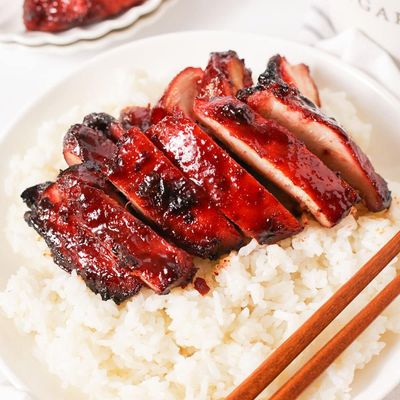
This is summer-BBQ adaptation of the lacquered red roast meats that hang in the windows of Cantonese siu mei shops. The marinade borrows from char siu (hoisin, soy, Shaoxing wine, five-spice, fermented bean curd, garlic, ginger) but pulls back on the sugar slightly because chicken does not need as much sweetness as pork shoulder. Bone-in skin-on thighs are the right cut: they stay juicy on the grill, the skin renders down and crisps, and the bones give the meat shape. A two-stage glaze does the rest. The thighs cook over indirect heat first to render the fat and set the meat, then move directly over the coals for the last few minutes while a honey-maltose mixture is brushed on repeatedly. Every brush of glaze caramelises, blackens slightly at the edges, then gets brushed again. The result is sticky-shiny with a smell that is half five-spice, half woodsmoke. Difficulty is low if you control your heat. A two-zone fire (one side coals piled high, the other side empty) is the only real requirement; on a gas grill, two burners on full and one off does the same job. Serve sliced over plain rice with sliced cucumber and a spoon of chilli oil, or stuffed into bao with hoisin and spring onion.
Guizhou Chili Chicken (Guizhou Lazi Ji)
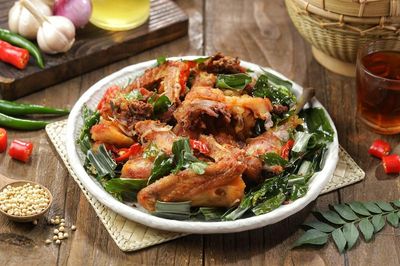
Guizhou lazi ji is the southwest's answer to the Sichuan chongqing lazi ji, but with a fundamentally different character. Where Chongqing's version is a dry, fried, chilli-buried dish, Guizhou's is a wet braise built on ciba lajiao: rehydrated mild dried chillies pounded into a thick red paste with ginger and garlic, then slow-fried in oil until it deepens to a rich, almost jam-like base. The paste is the soul of the dish and the soul of Guizhou cooking more broadly: the province is the first in China where chilli was used as a condiment after its arrival from the Americas, and produces roughly a third of the country's chillies today. Difficulty for a home cook is moderate, the only finicky steps being the chilli soak and the slow-frying of the paste, rush it and the sauce stays harsh; do it right and the flavours bloom into something layered and fragrant. The result is best after an overnight rest, and even better the day after, served over plain rice with the orange chilli oil pooling around the edge. Regional variations across Guizhou tweak the proportions, sometimes adding fermented rice or douchi for extra savoury depth.
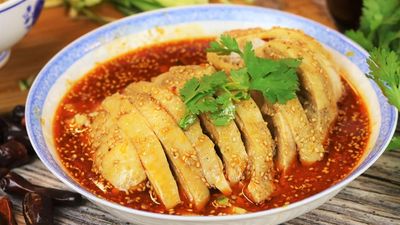
Mouthwatering Chicken (Kou Shui Ji)
Kou shui ji is one of the great cold appetisers of Sichuan cuisine, a benchmark by which any aspiring Sichuanese cook is judged. It belongs to the broader family of cold chicken dishes (liang ban ji) that also includes bobo ji and bang bang ji, but kou shui ji is set apart by its sauce: not just spicy, but a complex layering of mala (numbing-hot) Sichuan pepper oil, fragrant chilli oil with its crisp sediment, deep aged black vinegar, sweet stone-ground sesame paste, and the concentrated chicken essence captured from steaming. The dish is uncooked at the assembly stage, which makes ingredient quality non-negotiable: cheap supermarket chilli oil and tahini will produce a sad, muddy version. Difficulty for a home cook is low if you have the right pantry; the only technical step is the gentle steaming, which yields more flavourful meat and crucial savoury juices than poaching does. The visual is striking, pale chicken slices half-submerged in a pool of red oil, scattered with chopped peanuts, sesame seeds and bright green scallion tops. Serve as a starter, on rice, or over cold noodles; the leftover sauce is too good to waste.