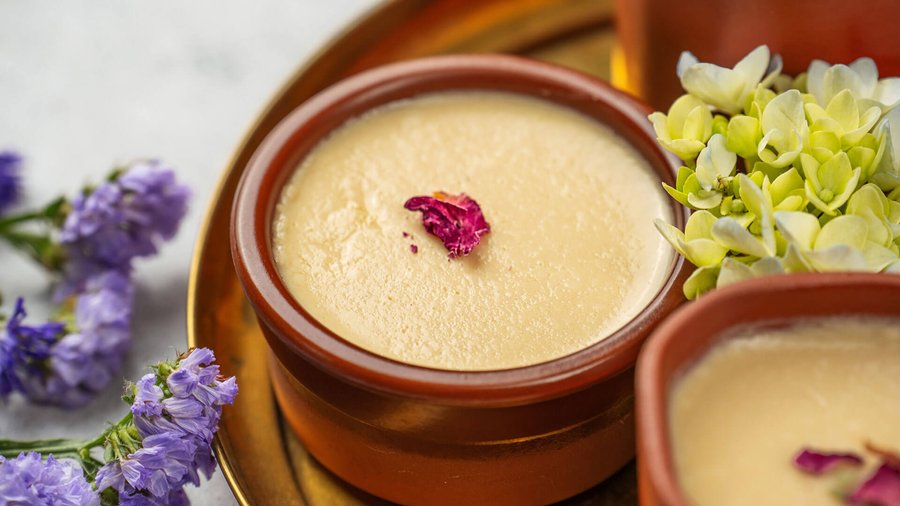
Mishti Doi
Bengal's defining Sunday dessert: thick set yoghurt the colour of pale caramel, sweetened with melted jaggery, served cold in unglazed clay pots.
Overview
Mishti doi (literally "sweet yoghurt") is the great quiet sweet of Bengal: not as showy as rasgulla, not as rich as sandesh, but possibly the most loved of all. The technique is built on three reductions. First, the milk is boiled down by about a third to concentrate its sugars and proteins, which makes the eventual yoghurt thick enough to hold a spoon upright. Second, a portion of jaggery (date palm jaggery, nolen gur, in winter; cane jaggery, akher gur, year-round) is melted and cooked further until it caramelises to a deep amber. This is the move that defines mishti doi, it isn't simply sweetened yoghurt, it is yoghurt sweetened with caramelised jaggery, and the colour, the toffee notes and the depth come entirely from that caramel. Third, the seasoned milk is poured into porous unglazed clay pots (matka or bhar) and inoculated with a spoonful of live yoghurt before being left to set in a warm place for 8-12 hours. The clay pot is not decorative: it absorbs whey through its walls, producing a denser set than a glass or plastic container ever can, and it cools the doi by evaporation so it stays at fridge temperature even on a Kolkata summer afternoon. Mishti doi is the closer to a Bengali feast, after fish, after rice, after rasgulla even, eaten with a small spoon directly from the pot. It is also a winter speciality when made with nolen gur, the fragrant first-tap date palm jaggery that arrives in Bengal markets in December and disappears by February; that version, payesh doi or nolen gurer doi, is one of the great seasonal sweets of the subcontinent.
Ingredients
- 1 ½ litres whole milk (full fat)
- 200 g jaggery (gur), preferably date palm jaggery (nolen gur), broken into pieces
- 50 g sugar (white or palm)
- 3 tbsp live full-fat plain yoghurt (the starter culture; must be fresh and active)
- 2 green cardamom pods (small, lightly crushed, optional)
Method
Stage 1 - Reduce the milk
- Pour the milk into a heavy-bottomed wide pan.
- Bring to a gentle boil over medium heat, then reduce to a steady simmer.
- Cook 25-30 minutes, stirring frequently and scraping the bottom and sides, until the milk is reduced by roughly one-third and has a faint cream colour and a thicker texture. Add the cardamom pods in the last 5 minutes if using.
- Turn off the heat.
Stage 2 - Caramelise the jaggery
- In a small heavy pan combine the jaggery and sugar with 2 tbsp water.
- Melt over low-medium heat, stirring, until the jaggery dissolves into a syrup.
- Continue cooking 3-5 minutes until it darkens noticeably and smells strongly of caramel. Do not let it burn; pull it off the heat as soon as it goes deep amber.
Stage 3 - Combine
- Pour the caramelised jaggery slowly into the warm reduced milk in a thin stream, stirring constantly. The milk should turn a pale toffee colour.
- Strain through a fine sieve into a jug to remove cardamom husks and any caramel solids.
- Let cool until the mixture is just warm to the touch, around 40-45 C. This is critical: hotter and you will kill the yoghurt culture; cooler and the doi will not set.
Stage 4 - Inoculate
- Whisk the live yoghurt smooth in a small bowl.
- Stir 2-3 tbsp of the warm sweetened milk into the yoghurt to thin it, then pour the yoghurt mixture back into the warm milk. Stir gently for 20 seconds.
Stage 5 - Set
- Pour into unglazed terracotta pots (matka), small ramekins or a single shallow earthenware dish.
- Cover with a lid or plate.
- Leave undisturbed in a warm draught-free place for 8-12 hours. In summer 8 hours is usually enough; in winter wrap the pots in a tea towel or place inside an oven (off, with the light on) overnight.
- The doi is set when it holds the impression of a spoon and the surface is just slightly domed.
Stage 6 - Chill and serve
- Refrigerate the set pots for at least 4 hours, ideally overnight.
- Serve very cold, straight from the pot, with a small spoon. The top will be the colour of light coffee; the texture should be like creamy custard.
Notes
- Reduction matters: unreduced milk gives thin, watery doi. The 30-minute simmer is the work that gives mishti doi its body.
- Caramelise the jaggery, don't just melt it: the deep toffee notes come from cooking the syrup past dissolved. Pull it off the moment it darkens to a rich amber; burnt jaggery is bitter.
- Temperature for setting: the warm milk must be around 40-45 C when the starter goes in. Too hot kills the culture; too cool and it won't activate. Roughly: warm enough to be comfortable on the back of your wrist for several seconds.
- Clay pots if you can: unglazed terracotta gives the authentic dense set and the cool finish. Glass or ceramic ramekins will work but the doi will be slightly softer.
- Nolen gur: if you can source date palm jaggery (sometimes labelled "patali gur" in solid form), the winter version is extraordinary. Use it in place of regular jaggery 1:1.
- Live yoghurt: the starter must be live, full fat and recent. Long-life or strained Greek yoghurt often will not work as a starter.
Storage
- Keeps 3-4 days refrigerated. The flavour deepens slightly after the first 24 hours.
- Do not freeze; the texture breaks.
Recipes mentioned here
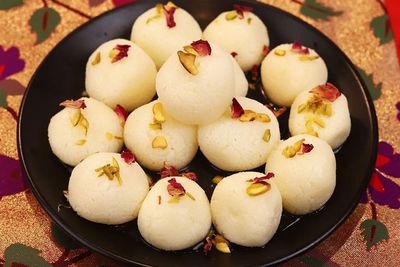
Rasgulla
Rasgulla is one of the great technical sweets of South Asia, and there is no shortcut. Everything depends on the chhena, the fresh, soft curd cheese made by curdling whole milk with an acid (lemon juice or whey from a previous batch), straining off the liquid and gently kneading the curds until they are smooth, supple and just slightly oily. Get the chhena right and the rasgulla will be light, spongy, white, and will double in size when boiled in syrup. Get it wrong and you have dense rubbery balls that sit in sugar water without absorbing it. The rules are unforgiving: use full-fat whole milk (never reduced fat, never UHT), curdle gently with the heat off so the curds stay tender, drain only until the chhena holds together (not bone dry), and knead the chhena thoroughly with the heel of your hand on a clean surface for 8-10 minutes until it transforms from crumbly to silky. The syrup must be light, around the consistency of water with sugar dissolved in it, not a heavy syrup, because the rasgulla needs to drink up syrup as it expands. A wide pan with a lid is essential: the balls need room to puff to twice their size, and the lid traps steam that helps them rise. The result, served chilled with a few strands of saffron or a pinch of cardamom, is the defining Bengali sweet. Origin claims are intensely disputed: Odisha argues the sweet was offered at the Jagannath Temple in Puri for centuries; West Bengal credits Nobin Chandra Das of Bagbazar with inventing the modern spongy form in 1868. Both received Geographical Indication status. Either way, the sweet belongs to the Bengali-speaking world.
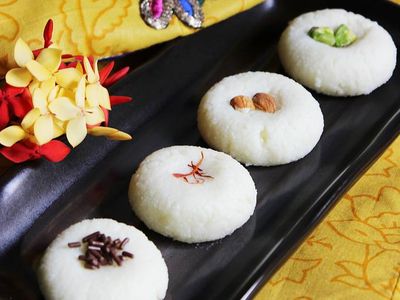
Sandesh
Sandesh is the most refined sweet in the Bengali misti repertoire: where rasgulla is showy and mishti doi is humble, sandesh is poised. It is also the most ancient of the chhena sweets, predating rasgulla by centuries and appearing in Bengali household recipes as far back as the early 1700s. The structure is almost shockingly simple: chhena (fresh curd cheese), sugar (or jaggery in winter), and gentle heat. The technique, however, is exacting. The chhena must be kneaded to perfect smoothness before cooking, and the cooking itself must be brief and well-judged, just enough to bind the chhena and the sugar into a soft, pliable dough, but not so long that the moisture evaporates and the texture turns dry and grainy. There are two main schools. Norom paak ("soft cooking") gives a tender, slightly moist sandesh that melts on the tongue; karaa paak ("hard cooking") cooks longer and yields a firmer, denser sandesh that holds its shape in elaborate moulds. The winter version, made with nolen gur (first-tap date palm jaggery), is one of the seasonal jewels of Bengal: the jaggery's smoky-toffee notes turn the chhena a pale honey colour and give the sweet an almost wine-like depth. Sandesh is traditionally pressed into small carved wooden moulds called sandesh chhaanch, shaped like fish (a Bengali symbol of fortune), conches, lotuses or hearts. At home a simple disc pressed flat with a thumbprint is perfect. Served at room temperature or just slightly chilled, never iced.
More like this
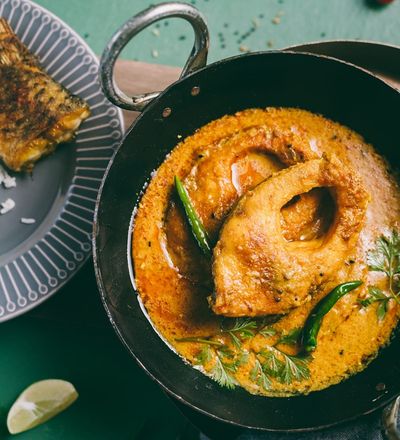
Doi Maach
The celebration-day Bengali fish curry, the one you cook for a Saraswati Puja lunch or a weekend when family are visiting. "Doi" means yoghurt, "maach" means fish, and that's the dish in two words: pieces of firm-fleshed freshwater fish (traditionally rohu, katla or sometimes bhetki) first lightly fried in mustard oil until the skin is taut and gold, then poached gently in a thickened yoghurt sauce. The gravy is pale ivory rather than yellow or red, with the warming whole spices (cardamom, cinnamon, bay) doing the work that chilli powder does in northern curries. The critical move is timing: you whisk the yoghurt smooth and add it off the heat so it doesn't split, then the fish goes back in to finish poaching gently in the silky gravy. A touch more refined than a workaday machher jhol, eaten with steamed gobindobhog rice and a small spoon of ghee melted over the top.
Kosha Mangsho
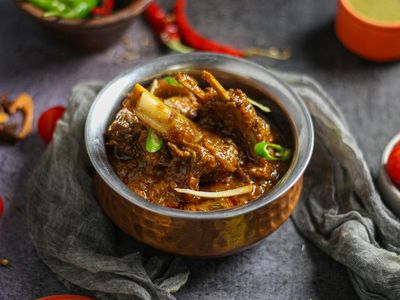
Kosha mangsho takes its name from the verb kosha, which in Bengali means to slow-cook a meat down, stirring patiently as the spices and onions caramelise and the gravy reduces until the oil floats free. There is no water in the early stages, only the meat's own juices, yoghurt and onion paste working under a closed lid. The result is intense, almost jammy, with a deep brown colour that comes not from food colouring but from honest bhuna technique and good mustard oil. In Hindu Bengali homes the dish is made with goat (khashi) on festive Sundays and at pujas; the Bangladeshi version is broadly similar but often uses a touch more garlic and sometimes finishes with a spoon of ghee instead of mustard oil. The cut matters: bone-in shoulder and leg pieces with marrow bones give the gravy its body. Mustard oil heated to smoke point, a whole garam masala tempering, slow-fried onions reduced to a near-paste, and yoghurt added in stages to prevent splitting are the technical demands. It is not difficult for a patient home cook, only long: rushing kosha mangsho is the surest way to ruin it. Serve with luchi (puffed flour breads), basanti pulao (sweet yellow rice with cashews and raisins) or simply steamed gobindobhog rice. A side of kasundi mustard and sliced onion makes it a feast.
Mangshor Jhol
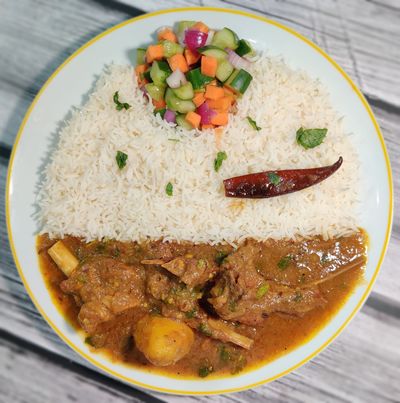
The wet-style mutton counterpart to the drier, slow-bhuna kosha mangsho - and the more everyday of the two. "Jhol" means a thin, soupy gravy and mangshor jhol is exactly that: bone-in goat or mutton cooked low and slow with potatoes in a light, aromatic broth that you ladle generously over rice. You heat mustard oil to smoking to take the raw edge off, temper whole bay and cinnamon in the hot fat, then brown the onions deeply and add a measured hand of turmeric to give the gravy its colour and weight. The bones contribute marrow to the broth as the meat tenderises over an hour or so, and the potatoes go in late enough that they soften without disintegrating. Eaten with a mound of plain steamed rice, a wedge of lime, and a thin slick of mustard oil scattered with raw onion on the side. A Sunday lunch dish for a Bengali household, served from the same pot it was cooked in.
Dolmadakia (Greek Stuffed Vine Leaves)
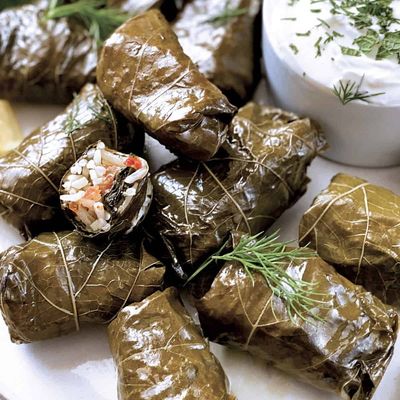
Brined vine leaves are soaked for 20 minutes to leach the brine. Filling: short-grain rice is par-cooked for 10 minutes with onion in olive oil; off heat, dill, mint, parsley, pine nuts, currants and lemon zest are stirred through. Each leaf is given a teaspoon of cool filling and rolled into a tight cigar. The rolls are packed tight in a heavy pot lined with broken / extra leaves. Olive oil, lemon juice and stock are poured in to barely cover. Weighed down with an inverted plate. Slow-simmered for 50-60 minutes. Cooled in the liquid; served at room temperature.