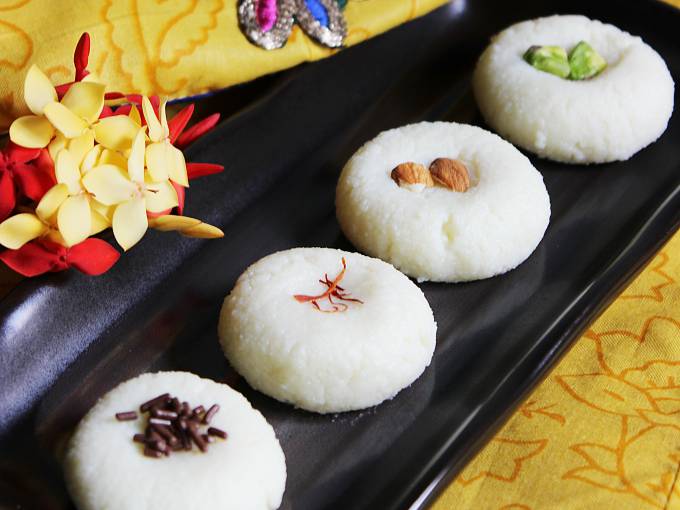
Sandesh
Bengal's most-elegant sweet: fresh chhena cooked gently with sugar (or winter nolen gur) and pressed into carved wooden moulds shaped like fish or flowers.
Overview
Sandesh is the most refined sweet in the Bengali misti repertoire: where rasgulla is showy and mishti doi is humble, sandesh is poised. It is also the most ancient of the chhena sweets, predating rasgulla by centuries and appearing in Bengali household recipes as far back as the early 1700s. The structure is almost shockingly simple: chhena (fresh curd cheese), sugar (or jaggery in winter), and gentle heat. The technique, however, is exacting. The chhena must be kneaded to perfect smoothness before cooking, and the cooking itself must be brief and well-judged, just enough to bind the chhena and the sugar into a soft, pliable dough, but not so long that the moisture evaporates and the texture turns dry and grainy. There are two main schools. Norom paak ("soft cooking") gives a tender, slightly moist sandesh that melts on the tongue; karaa paak ("hard cooking") cooks longer and yields a firmer, denser sandesh that holds its shape in elaborate moulds. The winter version, made with nolen gur (first-tap date palm jaggery), is one of the seasonal jewels of Bengal: the jaggery's smoky-toffee notes turn the chhena a pale honey colour and give the sweet an almost wine-like depth. Sandesh is traditionally pressed into small carved wooden moulds called sandesh chhaanch, shaped like fish (a Bengali symbol of fortune), conches, lotuses or hearts. At home a simple disc pressed flat with a thumbprint is perfect. Served at room temperature or just slightly chilled, never iced.
Ingredients
Chhena
- 1 ½ litres whole milk (full fat, fresh, not UHT)
- 2 tbsp lemon juice (or 2 tbsp white vinegar)
- Ice cubes (a small handful)
To finish
- 100 g caster sugar, or 110 g jaggery (gur), preferably nolen gur for winter sandesh
- 4 green cardamom pods (seeds ground to a fine powder)
- A few strands saffron (optional)
- 8-10 pistachios (slivered, to decorate)
Method
Stage 1 - Make the chhena
- Bring the milk to a gentle boil in a heavy-bottomed pan, stirring occasionally.
- As soon as it boils, turn off the heat and wait 1 minute.
- Add the lemon juice 1 tbsp at a time, stirring gently, until the milk fully splits into white curds and pale whey.
- Drop in a small handful of ice cubes to stop the cooking and keep the chhena tender.
- Pour into a muslin-lined sieve.
- Gather the muslin and rinse the chhena gently under cold running water for 30 seconds.
- Twist and squeeze gently to expel most of the whey, but leave the chhena moist (not bone dry). Hang the bundle for 25-30 minutes to drip.
Stage 2 - Knead
- Tip the chhena onto a clean dry worktop.
- Knead with the heel of your hand for 8-10 minutes, pushing and folding, until the chhena transforms from crumbly to silky-smooth and a faint sheen of fat appears on your palm. This is the foundation; do not rush.
Stage 3 - Cook the sandesh
- If using jaggery, grate or finely chop it first.
- Transfer the kneaded chhena to a heavy non-stick pan over low heat.
- Add the sugar (or jaggery).
- Cook gently, stirring and folding continuously with a spatula, for 5-8 minutes. The sugar will melt and the chhena will loosen and become creamy; keep stirring as it gradually tightens. The mixture is ready when it pulls away from the sides of the pan in a soft mass and leaves a faint film on the base. For norom paak (soft) stop here; for karaa paak (firm) cook another 2 minutes.
- Stir in the cardamom powder (and saffron if using).
- Turn out onto a plate and let cool for 5 minutes until just warm.
Stage 4 - Shape
- While still warm and pliable, knead briefly on the plate to smooth out any lumps.
- Divide into 12 equal pieces (around 30 g each).
- Roll each between the palms into a smooth ball.
- Flatten gently to a thick disc and press a thumbprint into the centre, or press into a buttered carved mould and tap out. Place a sliver of pistachio in each thumbprint.
Stage 5 - Set
- Arrange on a plate and let cool to room temperature so the sandesh firm up.
- Serve at room temperature, or chill briefly. Sandesh should not be served ice-cold.
Notes
- The chhena makes the sweet: as with rasgulla, everything depends on tender, well-kneaded chhena. Old milk, UHT milk or over-pressed chhena will give grainy, dry sandesh.
- Low heat throughout: sandesh is cooked at the lowest steady heat you can manage. High heat scorches the milk solids and toughens the texture.
- Know when to stop: the cooked mass should still feel soft and slightly tacky when you turn it out. If it has gone stiff in the pan, you have overcooked it - it will be crumbly. A few seconds before "looks done" is the right moment.
- Nolen gur if you can: the winter version with date palm jaggery (sometimes sold solid as patali gur) is exceptional. Use the same weight in place of sugar.
- Moulds: traditional Bengali sandesh moulds are small carved wooden blocks, often fish-shaped. Lightly butter the cavity, press in a piece of warm sandesh, level the back, then tap out. Silicone chocolate moulds work as a modern substitute.
- Norom vs karaa: for gifting and elaborate moulded shapes, cook a little longer (karaa paak). For eating fresh at home, stop early (norom paak) for a softer, melting texture.
Storage
- Best on the day they are made. Will keep 2 days in a sealed container in the fridge; bring back to room temperature before eating.
- Do not freeze.
More like this
Brevas Con Arequipe
Whole brown figs simmer slowly in a syrup of brown sugar, water, cinnamon and cloves until they're tender and the syrup has thickened to glossy. Off the heat, each fig gets cut almost through and stuffed with a generous spoonful of arequipe. Served warm or chilled, with extra syrup spooned over.
Eton Mess
Strawberries are hulled and quartered (or sliced thick). Half are macerated in a wide bowl with sugar and a splash of balsamic vinegar (or lemon juice) for 30 minutes, they release a glossy pink syrup. The other half stay whole-ish and crisp. Cream is whipped with vanilla and icing sugar to soft peaks (not stiff peaks, too firm and the mess loses its silkiness). Ready-made meringue nests (or homemade) are crushed into rough pieces. At the moment of serving: cream goes into a wide bowl or glasses, the macerated strawberries and their syrup are folded through with broken strokes (leaving streaks, not blended); the unmacerated berries are scattered over; the meringue is crushed in last; everything assembles in messy layers. Eaten within 10 minutes, meringue softens fast.
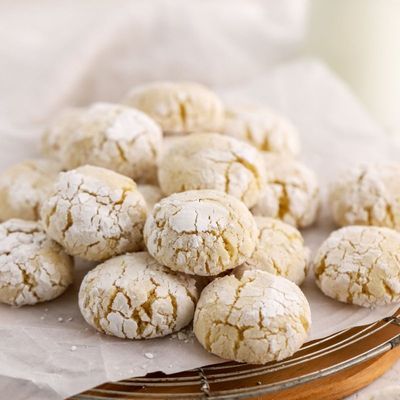
Ghriba (Moroccan Almond Shortbread)
Ground almonds, icing sugar, salt mix together. Beaten eggs, orange-flower water and a touch of melted butter bind. Dough chills for 30 minutes (the egg sets up; the dough firms enough to handle). Rolls into walnut-sized balls; each ball coats heavily in icing sugar (no half measures); places on a parchment-lined tray. Bakes at 170°C 12-15 minutes, the bake is gentle; ghriba shouldn't brown, just dry and crack on top.
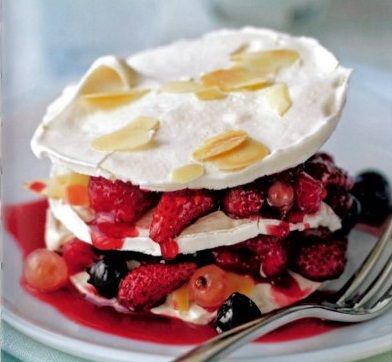
Meringue and Red Berry Layers
An impressive three-layer dessert built with crispy French meringue rounds interspersed with poached berries and their brilliant ruby coulis. This sophisticated construction offers multiple textural contrasts and celebratory visual appeal, perfect for special occasions when simple elegance impresses most.