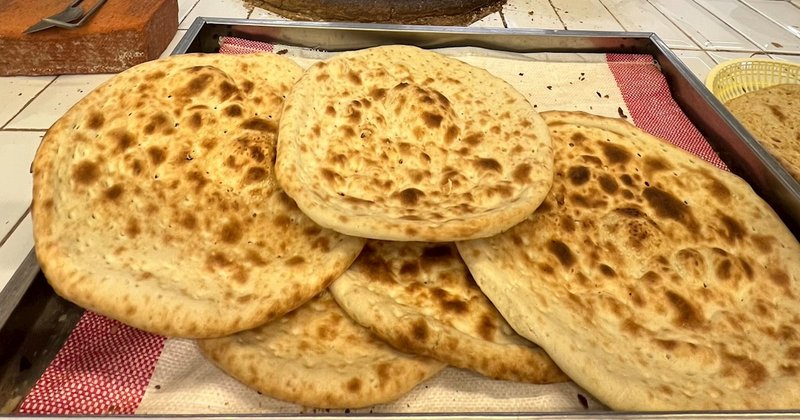
Khubz Tameez
A Saudi tandoor-style flatbread: baked at high heat against the side of a clay oven till blistered and golden. Thicker than roti, more pliable than naan.
Overview
The thick, soft flatbread that turns up on every Saudi table: the bread you tear to scoop foul, sop kabsa juices and wrap around grilled meat. You make a simple yeasted dough with plain flour, fast-action yeast, salt, sugar, olive oil and warm water, knead it briefly, let it rise, divide into balls and shape into thick rounds about the size of a side plate. Onto a screaming-hot baking stone or steel for four or five minutes per side, which is what gives you the puffed centre, the dark blisters across the top, and the soft pliable inside. Traditionally baked against the side of a clay tannur, which is where the name comes from and which gives the bread its deeper char; a stone or steel in a home oven gets you nearly all the way there. Eat warm from the oven, wrapped in a tea towel to keep the moisture in.
Ingredients
- 500 g plain flour (or replace 100 g with wholemeal for the traditional darker version)
- 1 sachet (7 g) fast-action yeast
- 1 ½ teaspoons salt
- 1 tablespoon caster sugar
- 2 tablespoons olive oil
- 320 ml warm water
- 1 teaspoon black sesame (or nigella seeds, optional, for the top)
Method
Stage 1 - Dough
- Whisk flour, yeast, salt and sugar in a bowl.
- Add olive oil and warm water; mix to a soft dough.
- Knead 8-10 minutes until smooth and elastic.
- Cover; rise 1 hour until doubled.
Stage 2 - Heat the oven
- Place a baking stone, steel or upturned heavy baking tray on the top rack.
- Heat the oven to 250°C (or as hot as it goes) for at least 30 minutes.
Stage 3 - Shape
- Knock back; divide into 6 equal balls.
- Cover; rest 15 minutes.
- Press or roll each into a 18 cm round, about 8 mm thick (thicker than a flatbread, thinner than a focaccia).
- Press a fingertip pattern across the top of each (the traditional indent).
- Sprinkle with sesame or nigella seeds.
Stage 4 - Bake
- Slide breads onto the hot stone using a peel or back of a tray (2 at a time).
- Bake 3-4 minutes - the bottom should be deep gold and the top should puff and blister.
- If your oven has a grill, hit the top with 60 seconds under the grill to colour the surface.
Stage 5 - Stack
- Stack the breads under a clean tea towel as they come out - the steam keeps them soft.
Stage 6 - Serve
- Eat warm. They keep all day in a tea towel; reheat in a dry pan or 200°C oven.
Notes
- Hot stone is essential: Without it, the bottom doesn't crisp and the top doesn't puff. Pre-heat for at least 30 minutes; longer is better.
- Thickness: 8 mm is right. Thinner and you've made a pita; thicker and the middle stays raw.
- Fingertip dimples: Help control the puff and give the bread its characteristic look. Press all the way to the surface but not through.
Storage
- Best fresh, eaten warm. Will keep wrapped in foil at room temperature 24 hours.
- Freezes 1 month.
More like this
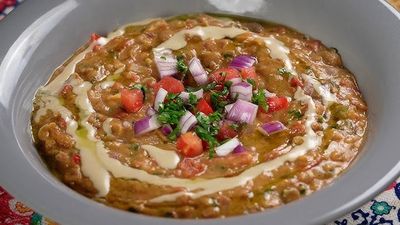
Foul Saudi
The Saudi take on foul medames, somewhere between the Egyptian original and the Yemeni daal-like versions. You soak dried fava beans overnight, then simmer them with a chickpea or two and a garlic clove for six hours low and slow (or pressure-cook for forty-five minutes if you don't have the day) until they're so soft they fall apart at a glance. Once drained, the beans go back into a hot pan with olive oil and garlic, cumin and a hit of chilli; you crush them roughly with a fork (chunky, not smooth) and finish with lemon and a handful of chopped parsley. Eaten warm for breakfast across the Gulf, scooped with flatbread, with a side of pickles or salata hara, and a glass of mint tea.
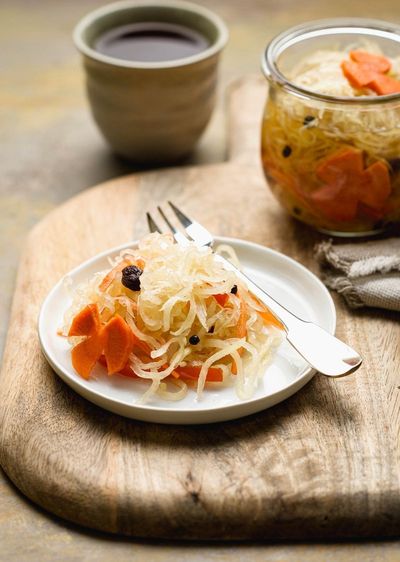
Atchara
Green papaya is peeled, seeded and shredded on a coarse grater. Carrot, ginger, garlic, red pepper, onion and raisins are all prepared in matching shreds. The vegetables are salted and rested for 1 hour to draw water; rinsed and squeezed dry. A syrup of cane vinegar, sugar and whole peppercorns simmers for 5 minutes. Hot syrup is poured over the vegetables in a sterilised jar. The jar is sealed, cooled and refrigerated overnight before eating. Improves over the following week.
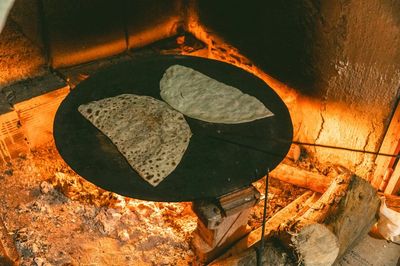
Aysh Baladi
A simple dough of half plain flour and half wholemeal, yeast, salt and warm water. Rises for 1 hour. Divides into 6 portions; rolls into thin 18 cm discs; rests for 20 minutes. Baked at maximum heat on a hot baking stone for 3-4 minutes, they puff dramatically and fall flat as they cool, leaving a hollow pocket.
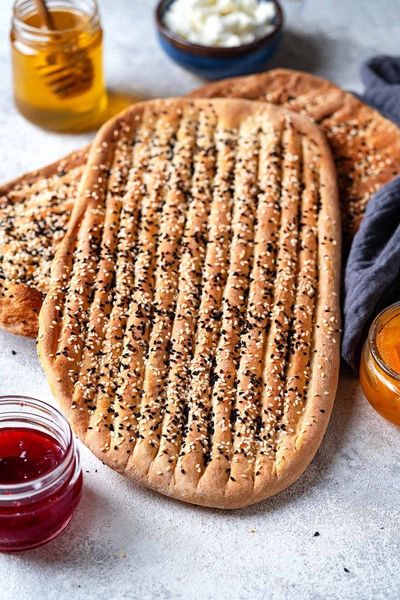
Barbari
A wet yeasted dough, high hydration (75%) of strong flour, yeast, salt, water and a touch of oil. Long first rise. Two portions; each stretches to a 40-50 cm long oval on an oiled work surface. A flour-water paste (roomal) brushes over the top, this gives the signature glossy crust. Deep parallel ridges press down with fingertips. Sesame and nigella seeds scatter. Baked at maximum heat 5-7 minutes on a screaming-hot stone.