Broccoli-Bacon Salad

Broccoli-Bacon Salad

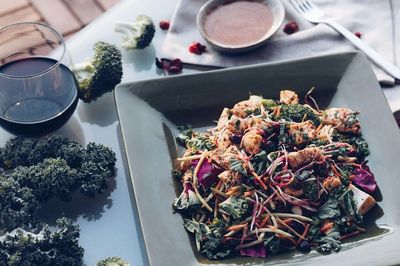
Broccoli-bacon salad is a fixture of American potlucks, summer cookouts, and church suppers, especially across the Midwest and South where it earned the affectionate nickname "broccoli crunch". Its origins sit somewhere in 1980s home cooking, when raw vegetable salads bound in creamy dressings became a casserole-era staple, and it has stuck around because the formula is so satisfying. Broccoli is treated like a salad leaf here rather than a hot vegetable, broken into bite-sized florets that stay assertively crunchy and grassy under the dressing. Crisp bacon adds smoke and salt, red onion brings a clean sharpness, sunflower seeds contribute a nutty crunch, and dried cranberries (or raisins, in older versions) drop little pockets of chewy sweetness across the bowl. The dressing is the secret. A glossy emulsion of mayonnaise, cider vinegar, and just enough sugar to round things out, it coats every floret without weighing them down. The salad is genuinely simple to make and improves with a short rest in the fridge, where the broccoli softens just slightly and absorbs the flavours of the dressing. It pairs wonderfully with grilled chicken, pulled pork, hamburgers, or a baked ham. Once you have made it, you understand why every American family seems to claim a version as their own.
Sides 30 minutes Serves6
Deviled Eggs

Deviled Eggs

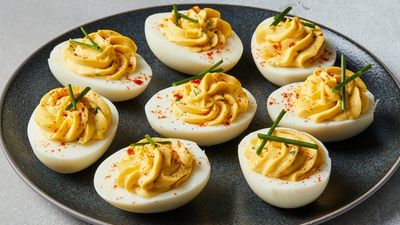
Deviled eggs are one of America's most enduring party foods, a fixture of Easter brunches, Thanksgiving tables, summer barbecues, and Sunday potlucks from coast to coast. The dish itself is much older than its American identity. Stuffed eggs flavoured with mustard, vinegar, and spices appear in Roman writings and remained popular across medieval Europe, but the term "deviled", meaning seasoned hot and spicy, took hold in eighteenth-century England and crossed the Atlantic with Anglo settlers. By the twentieth century, the American version had crystallised into the formula we recognise today: hard-boiled eggs split lengthwise, yolks scooped out and whipped smooth with mayonnaise, mustard, and a splash of vinegar, then piped or spooned back into the whites and finished with a dusting of paprika. The taste is luxurious in its simplicity. Creamy and rich, with a gentle tang and just enough mustard heat to justify the name, set against the cool, slightly springy bite of the white. Difficulty is genuinely low, but two details lift them from good to memorable: cooking the eggs just enough so the yolks are fully set but never grey-ringed, and seasoning the filling assertively, since cold dulls flavour. They are best made the day they will be eaten, although the eggs themselves can be boiled and peeled a day ahead.

Sides 25 minutes Serves6
Grilled Jerk Chicken Thighs

Grilled Jerk Chicken Thighs

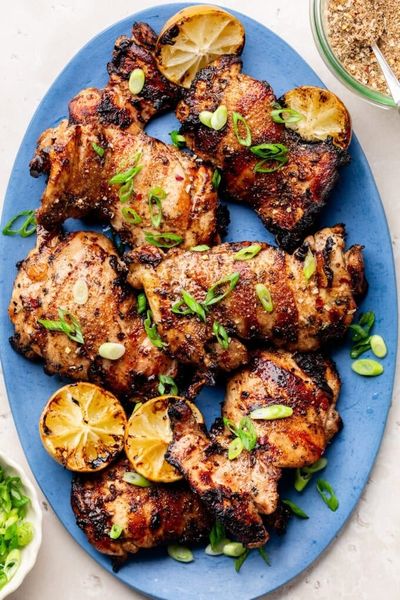
The dish lives or dies on the jerk marinade and on whether the chicken takes a proper char without drying out. The marinade here is jerk seasoning (homemade or Walkerswood, which is the canonical bottled brand) thinned with full-fat coconut milk and brightened with lime; the coconut milk is the technical move, it tames the heat, lubricates the meat, and helps the surface caramelise rather than blacken. Flavour is warm-piney from thyme and allspice, fiery from Scotch bonnet, slightly sweet from the browning sauce, deeply savoury once it hits high heat. Smell is unmistakable jerk: allspice smoke and pepper. Quick to cook once the marinade has done its work overnight, 15 minutes on a hot grill, 5 minutes rest. Originated on the eastern end of Jamaica (Boston Bay in Portland) where the Maroons, descendants of escaped enslaved Africans, developed a dry-rub-and-slow-smoke method over pimento wood; the modern grilled version is the home-kitchen adaptation that doesn't require a pimento-wood pit.

Jamaican 30 minutes Serves6
Pan Kabap

Pan Kabap

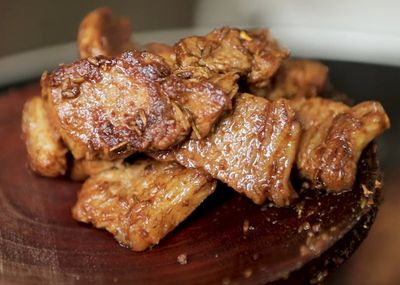
The dish is essentially a stripped-back tonur kebab: thin slices of fatty lamb, cumin, sweet chilli pepper powder, salt, no marinade and no skewer. The pleasure is in what you don't add. Cumin coats the slices in layered passes (two or three small sprinkles rather than one large dump), so the spice toasts gently into the rendering fat instead of scorching. The result is meat that tastes intensely of cumin and lamb fat with a deep gold sear on the edges. Smell carries across a flat: cumin and animal fat at high heat is one of the most evocative aromas in Central Asian cooking. Genuinely fast and forgiving as long as you respect two rules: the lamb must have fat on it, and the pan must already be smoking when the meat goes in. The home-kitchen version of a tradition that's centuries old across Xinjiang, the Hexi Corridor and into Kazakhstan, whenever a household couldn't fire up a clay oven for skewers, this is what they cooked instead.

Uyghur 20 minutes Serves1-2
Smashburger

Smashburger

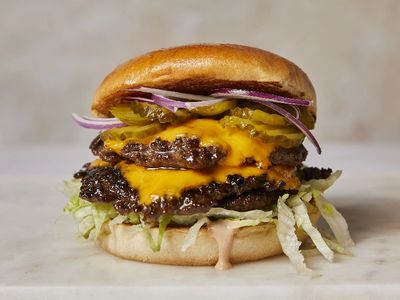
The smashburger is the American griddle cook's answer to a thick pub patty: take a loose ball of fatty ground beef, slap it onto a ripping hot flat-top, and press it paper thin so every square millimetre of meat hits the steel. What you get back is a patty with a brittle, almost potato-chip-like crust on the underside and a juicy, just-cooked interior, all in the space of ninety seconds. The technique came out of small Midwestern diners in the mid-twentieth century, but the modern revival is often credited to George Motz and the wave of regional burger documentation that followed. The Maillard reaction is the entire point here. A thick patty cooked rare on the inside has a thin band of seared flavour; a smashed patty is almost all crust. Pair that with cheap, salty American cheese that melts into the crags, a pillowy potato bun toasted in beef fat, and a sharp pickle, and you have one of the most satisfying things you can cook at home in under twenty minutes. Difficulty is low, but two details matter: the pan must be properly hot before the beef touches it, and you must only press once, in the first ten seconds. Anything more and you squeeze out the juices you worked to keep.

American 25 minutes Serves4
Tandoori Chicken Tikka

Tandoori Chicken Tikka

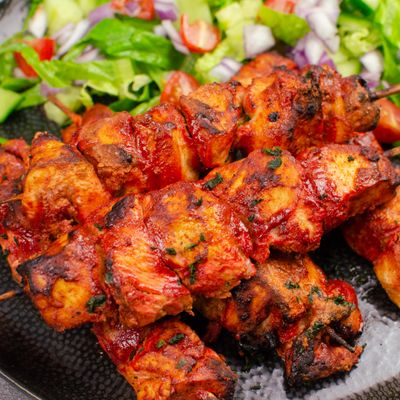
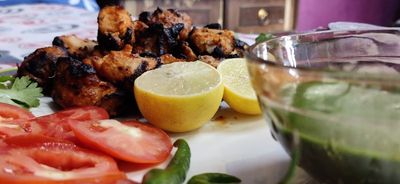
Tandoori Chicken Tikka is restaurant-quality barbecue, sophisticated yet accessible. The chicken undergoes a two-stage marinade: first, a quick acid and spice bath to begin tenderizing; second, a rich yoghurt-based marinade infused with warming spices, fresh herbs, and umami-rich Parmesan. The extended marination (up to 48 hours) allows deep flavor penetration and tenderness. The result is succulent, fragrant, lightly charred chicken with a burnished exterior and a creamy, spiced crust. Serve with lemon and fresh coriander.

Sides 5 minutes Serves4