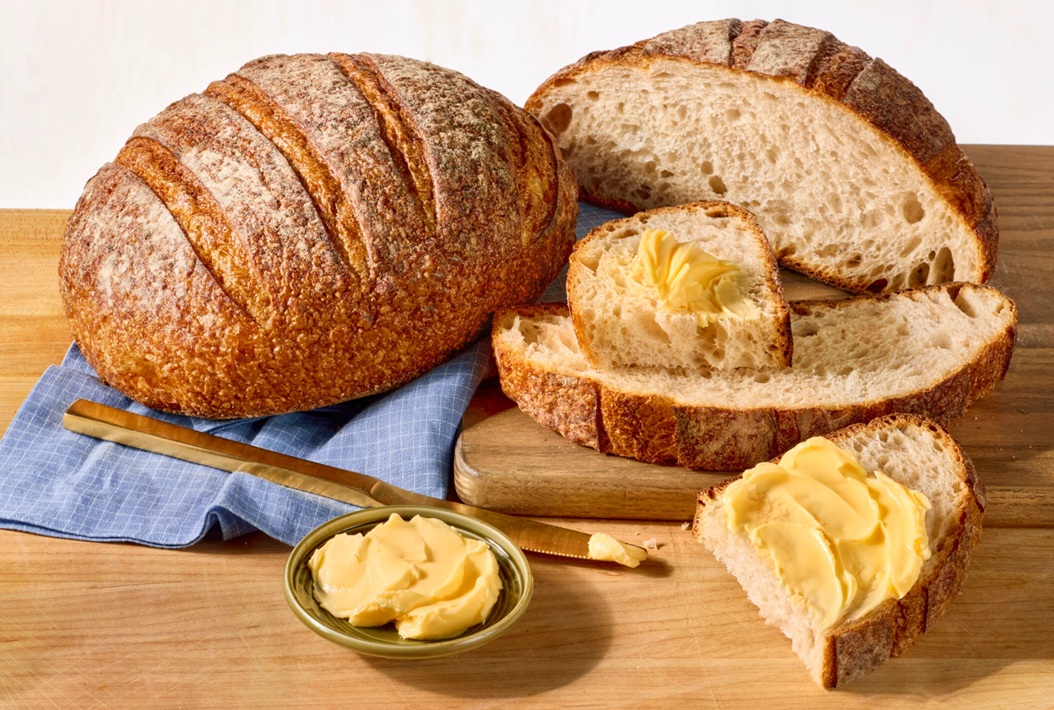
Sourdough Basics
Sourdough has a reputation for being complicated, and honestly it's more about patience than skill. You're keeping a tiny ecosystem alive in a jar, feeding it once or twice a week, and letting it do most of the work for you. This page covers how to start one, how to keep it happy, and how to fit a sourdough bake around the rest of your life.
Overview
A sourdough loaf has the same four ingredients as any other bread (flour, water, salt, leaven), but the leaven is different. Instead of a teaspoon of dried yeast, you build it from a wild-yeast starter that you maintain in a jar on your counter. The starter contains its own wild yeasts and lactic-acid bacteria. The yeasts make the dough rise; the bacteria produce the acids that give sourdough its characteristic tang.
Sourdough is slower than yeasted bread (a 24-36 hour timeline, mostly hands-off), more flavourful, longer-keeping, and easier on digestion for some people. The trade is that you need to keep the starter alive.
The Starter
A sourdough starter is a living colony of wild yeast and bacteria. Once established, it lives in a jar in your kitchen, eats roughly equal weights of flour and water at each feeding, and doubles in size between feeds when it is healthy.
Building a Starter from Scratch
Takes 7-14 days. Most starters fail in the first week, not in execution but in patience.
Day 1: In a clean jar, combine 50 g wholemeal flour and 50 g water (room temperature, non-chlorinated). Stir to a thick paste. Cover loosely (a lid resting on top, not screwed down) so gases can escape. Leave at room temperature.
Day 2: Look for any sign of bubbles. There may be none. Add another 25 g flour and 25 g water, stir.
Day 3: More bubbles, sometimes a foul smell. This is normal. The first colony of bacteria to bloom is not the one you want, but it dies off in a few days as conditions become more acidic. Add 25 g flour and 25 g water.
Day 4-6: Discard half the starter, add 50 g flour and 50 g water. Repeat once a day. The smell shifts from unpleasant to yogurty to bready.
Day 7-10: The starter should double in size between feeds and smell pleasantly tangy. When it doubles consistently in 4-6 hours after a feed, it is ready to bake with.
If it never doubles, the temperature is probably too cold. Move to a warmer spot (top of the fridge, on a stand mixer that has been on briefly). If it smells like nail polish remover, it is hungry; feed more often or use less starter per feed.
Keeping a Mature Starter
Once established, the starter is robust. Two options for maintenance:
Counter (active): Feed once or twice a day. The starter is always ready to bake. Use this if you bake more than twice a week.
Fridge (dormant): Feed once a week. The starter is slow but alive. Wake it up 24-48 hours before baking with 2-3 feeds at room temperature. Use this if you bake less often.
A typical fridge-stored starter recovery:
- Morning of day -2: take starter out, discard most, feed 50 g flour + 50 g water. Leave on counter.
- Evening of day -2: discard most, feed again.
- Morning of day -1: discard most, feed again. By evening it should be doubling and ready.
- Evening of day -1: build the levain (see below).
- Morning of day 0: mix the dough. Bake the same day or the next.
The Levain
The levain (also called the starter dough or pre-ferment) is a portion of refreshed starter used to leaven the final dough. You build a levain from your maintenance starter rather than dumping the whole jar into the bread, because:
- The maintenance starter is a small amount; you need more to leaven a loaf.
- The levain is timed to peak (double in volume) right when you mix the dough.
- The maintenance starter is preserved (you only used a spoonful).
Standard levain build:
- 20 g active starter
- 80 g flour (white, or 50/50 white/wholemeal for more flavour)
- 80 g water (lukewarm)
Mix, cover, leave at room temperature. Ready in 4-8 hours depending on temperature. The levain is ready when it has doubled, the surface is domed and bubbly, and a small piece floats in a glass of water.
The Dough
A basic sourdough loaf:
- 500 g strong bread flour
- 350 g water (70% hydration)
- 10 g salt
- 100 g active levain
The schedule:
Hour 0 - Mix (5 minutes). Combine flour and water in a bowl. Mix briefly, no kneading. Cover. Rest 1 hour. This is the autolyse.
Hour 1 - Add levain and salt (5 minutes). Pour the levain over the dough, sprinkle the salt, work them in with wet hands. The dough comes together quickly.
Hour 1-5 - Bulk ferment with folds. Leave the dough covered at room temperature. Every 30 minutes for the first 2 hours, do one round of stretch-and-fold in the bowl (see Hydration). After the first 2 hours, leave it alone. Bulk is done at hour 4-5 (or when the dough has visibly risen 50-75%).
Hour 5 - Shape (5 minutes). Turn dough onto a lightly floured bench. Pre-shape into a loose round, rest 30 minutes uncovered. Final-shape into a tighter ball or oval, place seam-side up in a floured banneton.
Hour 5.5 - Cold prove (12-18 hours). Cover the banneton with cling film, refrigerate overnight. The cold prove is what develops the deep sourdough flavour.
Hour 18+ - Bake. See the Bake section below.
The total time from mix to oven is about 18-24 hours. Active time is maybe 90 minutes.
The Bake
Sourdough loaves are baked at very high heat with steam for the first 15-20 minutes, then dry heat to finish. The traditional home approach is a Dutch oven (a cast-iron pot with a lid), which traps the steam released by the dough itself.
- Preheat the oven to 240°C with a Dutch oven inside for 45 minutes.
- Remove the cold loaf from the banneton, invert onto a piece of baking paper.
- Score the top with a sharp blade (see Scoring).
- Carefully drop the loaf (on the paper) into the hot Dutch oven, cover with the lid.
- Bake 20 minutes covered.
- Remove lid, reduce heat to 220°C, bake another 20-25 minutes until deeply golden.
- Cool completely on a wire rack (at least 1 hour) before slicing.
Internal temperature at the end should be at least 95°C. The crust should crackle audibly as it cools.
Common Mistakes
The starter never doubles. Too cold. Move somewhere warmer (24-26°C is ideal). Use bottled or filtered water if your tap water is chlorinated.
The dough is dense and gummy. Under-fermented. Either the levain was not active enough, or the bulk-ferment was too short. The dough should have visibly risen and look airy before shaping.
The loaf is flat and pancake-shaped. Over-fermented. The gluten broke down before the bake. Reduce bulk-ferment time, or reduce cold-prove time.
The crust is pale. Oven temperature too low, or not enough steam in the first 20 minutes. The Dutch oven approach is the most reliable.
The crumb has tunnels and giant holes around a dense base. Under-shaped. The pre-shape did not build enough surface tension. Practise the shaping technique on the shape gallery.
The bread is too sour. Over-fermented or too acidic starter. Shorten the cold-prove (8-12 hours instead of 18-24), or feed the starter twice a day for a few days before baking.
The bread is not sour enough. Under-fermented or too cold a cold-prove. Lengthen the cold-prove, or do a longer bulk at room temperature.
Where Next
- Hydration: sourdoughs are wetter than yeasted bread.
- Gluten: how stretch-and-fold develops gluten in wet doughs.
- Proving: the cold prove is the sourdough secret.
- Scoring: sourdoughs are scored deeply, more dramatically than yeasted loaves.
- Shape Gallery: the boule and the oval batard are the classic sourdough shapes.
More like this

Acar Timun
Cucumber, carrot, shallot, chilli prep into thin slices or matchsticks. Salt rests for 10 minutes to draw moisture, drains. A simple dressing of vinegar, sugar, water and ginger whisks together. Vegetables toss with the dressing; rest for 1 hour at room temperature. Eats cool, never refrigerated cold; the texture suffers.
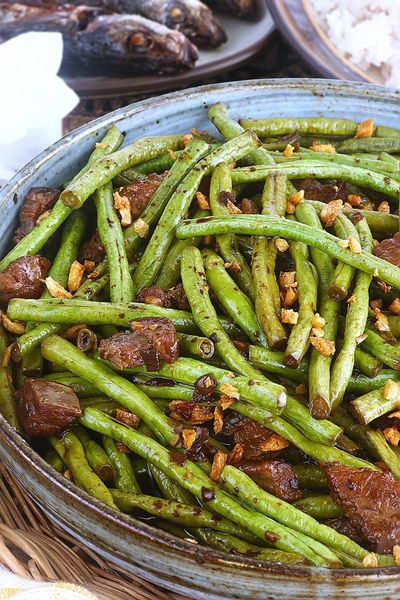
Adobong Sitaw
Garlic browns in oil; long beans toss in to colour briefly. Soy and vinegar pour in with bay and peppercorns; the beans braise covered until tender. Lid off; the liquid reduces to a glaze. Salt at the end, not the start, since soy is salty enough.
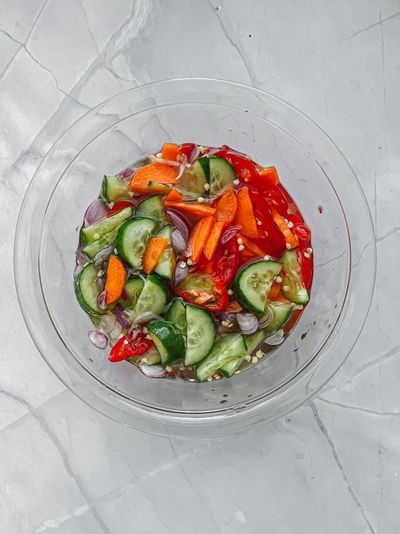
Ajad
A simple syrup of rice vinegar, palm sugar, water and salt is brought to a gentle simmer to dissolve the sugar, then cooled. Cucumber, shallot and chilli are sliced thin and combined in a small bowl. The cooled syrup is poured over. Rested for 10-15 minutes for the vegetables to wilt slightly into the dressing. Served in small individual ramekins as a dip, OR in a larger bowl as a side, with peanuts sprinkled on top.

Atchara
Green papaya is peeled, seeded and shredded on a coarse grater. Carrot, ginger, garlic, red pepper, onion and raisins are all prepared in matching shreds. The vegetables are salted and rested for 1 hour to draw water; rinsed and squeezed dry. A syrup of cane vinegar, sugar and whole peppercorns simmers for 5 minutes. Hot syrup is poured over the vegetables in a sterilised jar. The jar is sealed, cooled and refrigerated overnight before eating. Improves over the following week.