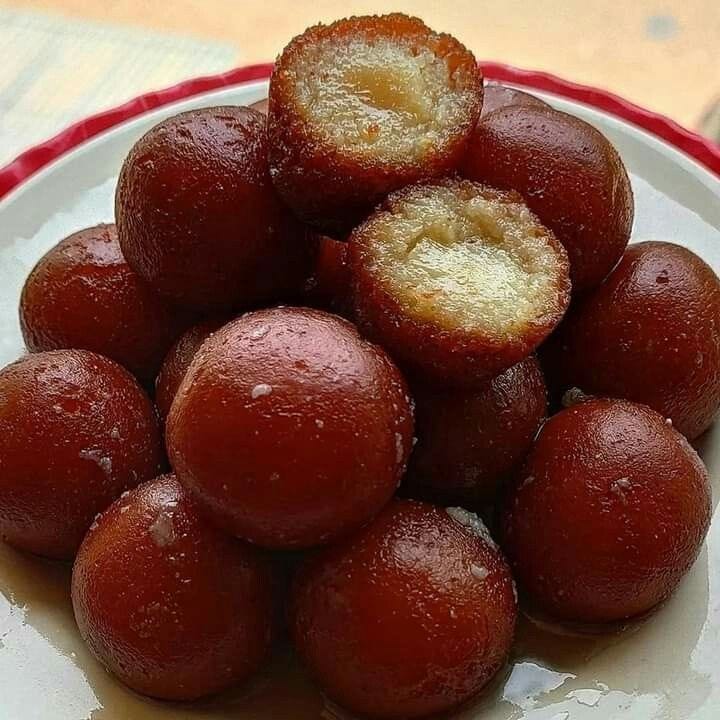
Gulab Jamun
Pakistan and India's most-loved sweet: fried dough balls of khoya drowned warm in cardamom-rose syrup. Chewy outside, melt-on-the-tongue inside.
Overview
Khoya (or a milk-powder shortcut) blends with a small amount of plain flour, semolina, baking powder and ghee to a smooth, soft dough. Small balls fry slowly in low-temperature oil until uniformly deep gold. They drop straight into warm rose-cardamom syrup and soak 30+ minutes, the whole point is the soaked, syrup-heavy bite.
Ingredients
Dough
- 200 g khoya (or 200 g full-fat milk powder + 60 ml warm milk)
- 60 g plain flour
- 1 tablespoon fine semolina
- ½ teaspoon baking powder
- A pinch of salt
- ½ teaspoon ground cardamom
- 1 tablespoon ghee (softened)
- 60-90 ml whole milk (as needed to bring the dough together)
Syrup
- 400 g caster sugar
- 400 ml water
- 1 teaspoon rosewater
- 1 teaspoon ground cardamom
- A pinch of saffron threads (optional)
- 1 tablespoon lemon juice
Frying
- Vegetable oil (or ghee, about 800 ml; for deep-frying)
To garnish
- A few pistachios (chopped) and rose petals
Method
Stage 1 - Syrup
- Combine the sugar, water and lemon juice in a wide pan.
- Bring to the boil; simmer 6-8 minutes until very slightly thickened (one-string consistency - a drop between fingers should form a thin string).
- Off the heat, stir in the rosewater, cardamom and saffron.
- Keep warm but not bubbling.
Stage 2 - Dough
- If using khoya: grate or crumble it into a wide bowl.
- If using milk powder: combine with the warm milk and knead briefly to a soft mass.
- Add the flour, semolina, baking powder, salt, cardamom and ghee.
- Knead gently - too much kneading makes them dense; you want just enough to bring it together. Add splashes of milk as needed to make a soft, slightly sticky dough.
- Cover and rest 10 minutes.
Stage 3 - Shape
- Divide the dough into 18-20 small balls (about the size of a small walnut).
- Roll each between your palms until completely smooth - any cracks open in the oil and the gulab jamun won't be uniform.
Stage 4 - Fry low and slow
- Heat the oil in a heavy deep pan to a low 140-150°C - much cooler than typical deep-frying. The temperature is the secret.
- Add 5-6 balls at a time. Don't move them for 30 seconds.
- After they rise to the surface, gently swirl the pan or push them with the back of a slotted spoon so they roll and colour evenly.
- Fry 8-10 minutes total, gradually increasing the heat slightly, until they're deep mahogany brown and feel slightly springy.
Stage 5 - Soak
- Lift out and drop straight into the warm syrup.
- Soak at least 30 minutes, ideally 1-2 hours. The gulab jamun double in size as they absorb syrup.
Stage 6 - Serve
- Serve warm with 2-3 per person, generous syrup spooned over.
- Top with chopped pistachios and rose petals.
Notes
- Low and slow frying is essential: Hot oil burns the outside before the inside cooks; the result is a hard skin and raw centre. Low heat for a long time is the trick.
- No cracks on the surface: Crack-free balls puff evenly and absorb syrup uniformly. Take time on the rolling.
- Khoya vs milk powder: Khoya (Indian/Pakistani grocers, refrigerated section) is traditional. Milk powder is the home-cook shortcut and works very well.
Storage
- Keep refrigerated in their syrup, in a covered container, up to 5 days. Bring back to room temperature or warm gently before serving.
More like this

Samosa Pakistani
Pastry dough: plain flour, ghee, salt, ajwain seeds, and warm water are kneaded into a stiff oil-rich dough; rests for 30 min. Filling: ground beef (or lamb) sautées with onion, garlic, ginger, green chilli and a Pakistani spice blend (garam masala, cumin, coriander, chilli powder, turmeric). Frozen peas join; the mixture simmers dry; cooled fully. Dough divides into 10 balls; each rolls into a thin oval, cut in half to make 2 half-moons. Each half-moon forms a cone (one flat edge becomes the seam, sealed with flour paste). Cone fills with cooled filling. Top edge of cone seals with flour paste. Deep-fried 175°C 3-4 minutes per side until amber-crisp.
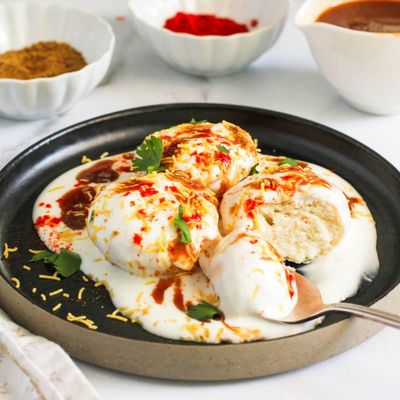
Dahi Bhalla
Dried urad dal (white, sometimes labelled "white lentils" or "split urad") soaks overnight, then blends with ginger, green chilli and a small amount of water into a smooth thick batter. Whipped vigorously for 5 minutes to incorporate air (this is what makes the fritters light). Asafoetida and salt season; baking soda activates right before frying. Fritters drop into 175°C oil; fry for 3-4 minutes until amber. Lifted into a wide bowl of lukewarm water; soaked for 10 minutes; squeezed gently between palms to remove most water. Plated in shallow bowls; flooded with sweet salted spiced yogurt; topped with chutneys, chaat masala, pomegranate, fresh coriander, a sprinkle of crushed papri or sev for crunch.
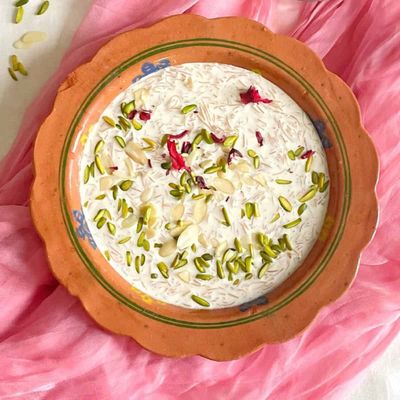
Sheer Khurma
Vermicelli (the thin Indian "sevaiyan") broken into short lengths and toasted in ghee until deep golden. Whole milk reduced slowly with cardamom and saffron, then the vermicelli folded in and simmered until soft but not collapsed. Dates (medjool, sliced) and a generous mix of nuts go in at the end. Served warm into small bowls - or chilled and ladled the next day with thicker, almost set, dessert spoons.
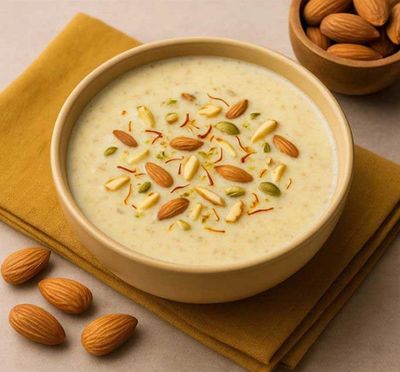
Badam Kheer
Almonds blanched, peeled, ground to a smooth paste, then folded into milk that's been reduced to two-thirds of its volume. Sugar to taste, saffron bloomed in warm milk for the colour, cardamom for the warmth. Simmered gently - never boiled - until the consistency thickens to a pourable cream, then garnished with pistachio slivers and a drift of rose petals.