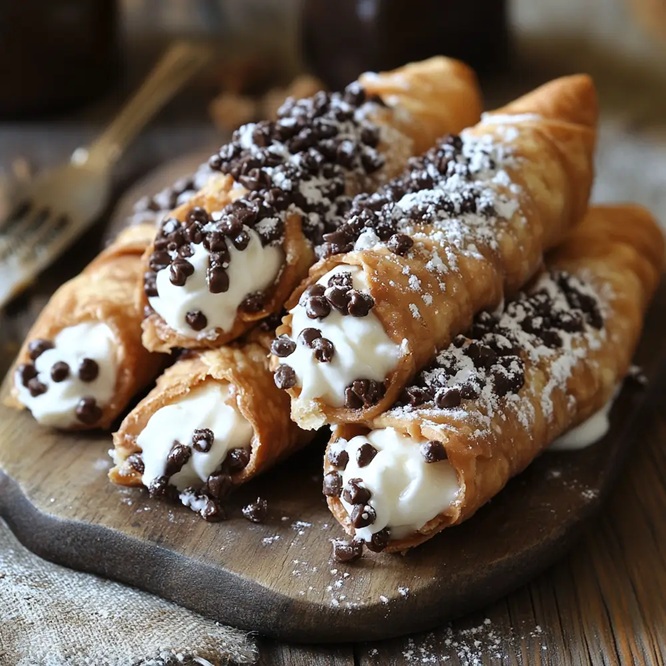
Cannoli Siciliani
Sicily's signature pastry: deep-fried Marsala-spiked dough tubes filled to order with sweetened ricotta, candied peel and pistachio.
Overview
Ricotta is drained in muslin for at least 4 hours (overnight ideal) to lose the wet whey. A pastry dough of plain flour, sugar, cocoa, cinnamon, Marsala, vinegar, butter and egg yolk is mixed, kneaded smooth, rested for 30 minutes, then rolled out very thin (pasta-thin). Discs (12 cm) cut; wrapped around oiled metal cannoli forms; egg-wash sealed; deep-fried at 180°C for 90 seconds until amber and crackling. Cooled, the shells lift off the moulds. The drained ricotta sweetens with icing sugar, vanilla and orange zest; chocolate chips and chopped candied peel fold through. Piped into the shells at the moment of serving; ends dipped in chopped pistachio or chocolate; dusted with icing sugar.
Ingredients
Pastry dough
- 250 g plain flour
- 2 tablespoons caster sugar
- 1 tablespoon unsweetened cocoa powder
- ½ teaspoon ground cinnamon
- ¼ teaspoon salt
- 30 g unsalted butter (cold, cubed)
- 1 egg yolk (large)
- 80 ml sweet Marsala (or sweet sherry, or dry white wine + 1 tablespoon sugar)
- 1 tablespoon white wine vinegar
To fry
- 1 litre sunflower oil (or vegetable oil)
- 1 egg white (for sealing the dough around the forms)
- 12 metal cannoli forms (cylinders 13 cm long; widely sold at Italian shops and online)
Ricotta filling
- 600 g whole-ricotta (drain overnight in muslin in the fridge - see Stage 1)
- 120 g icing sugar (sifted)
- 1 teaspoon vanilla extract
- 1 orange (zest)
- 60 g dark chocolate chips (or finely chopped dark chocolate)
- 30 g candied orange peel (finely chopped)
- 30 g candied citron (optional - sold at Italian / cake-decorating shops)
To finish
- 50 g shelled unsalted pistachios (finely chopped)
- 50 g dark chocolate (grated or finely chopped, optional)
- 30 g icing sugar (for dusting)
- 12 maraschino cherries (optional)
Method
Stage 1 - Drain the ricotta
- Line a sieve with muslin or a clean tea towel; set over a bowl.
- Tip the ricotta in; tie up the corners of the cloth; weight with a small plate.
- Refrigerate at least 4 hours, ideally overnight. The ricotta should be firm and almost pasta-thick.
Stage 2 - Dough
- In a wide bowl, whisk flour, sugar, cocoa, cinnamon and salt.
- Rub in the cold cubed butter with fingertips until the mixture resembles fine breadcrumbs.
- Make a well; add egg yolk, Marsala and vinegar.
- Mix with a fork, then by hand, to a stiff but pliable dough.
- Knead on a floured surface for 6-8 minutes - the dough should be smooth and elastic.
- Wrap in cling film; rest 30 minutes at room temperature.
Stage 3 - Roll and cut
- Roll the dough on a lightly floured surface to a thin sheet - ideally pasta-thin, around 2 mm thick. Use a pasta machine if you have one, taking it down to setting 5 or 6.
- Cut out 12 cm discs (or 12 x 8 cm oval shapes - the traditional shape).
- Re-roll scraps once.
Stage 4 - Form
- Brush each metal cannoli form lightly with oil.
- Wrap a disc of dough around each form (lengthwise), overlapping the edges by 2 cm.
- Brush the overlap with egg white; press firmly to seal.
Stage 5 - Fry
- Heat oil to 180°C in a deep pot.
- Lower 3-4 cannoli (still on their forms) into the oil with tongs.
- Fry 90 seconds to 2 minutes, turning, until deep amber and blistered.
- Lift onto kitchen paper.
- Once cool enough to handle (about 5 minutes), gently slide each shell off its form. The metal will be hot - use a tea towel.
- Re-oil the forms between batches.
Stage 6 - Make the filling
- In a bowl, mix the drained ricotta, icing sugar, vanilla extract and orange zest until smooth.
- Fold in chocolate chips and candied peel.
- Taste; the filling should be sweet but not cloying.
- If you want a smoother texture, press the ricotta through a fine sieve before mixing.
Stage 7 - Prep finishing components
- Spread chopped pistachios on a small plate.
- Spread grated chocolate on another plate (if using).
Stage 8 - Fill (at the moment of serving)
- Transfer the filling to a piping bag fitted with a 1 ½ cm plain or star nozzle (or use a freezer bag with the corner snipped).
- Pipe the filling into each shell from both ends, working from the centre outward, until the shell is generously full and the filling protrudes slightly from each end.
- Press one end into chopped pistachios; the other end into chopped chocolate (or both ends in pistachios).
- Optional: press a maraschino cherry into one end.
Stage 9 - Serve
- Dust with icing sugar at the table.
- Eat within 30 minutes of filling - beyond that, the shell softens.
Notes
- Drain the ricotta - really drain it: Wet ricotta makes the cannoli filling sloppy and the shell soft within minutes. Overnight in muslin is ideal. The drained whey can be discarded or used in bread / smoothies.
- Fill at the last second: This is the cardinal rule of cannoli. Pre-filled cannoli in a bakery window are sad; the shells go soft from the wet filling. Real Sicilian pasticcerie fill them as you order. At home: fry the shells in advance, store airtight, fill when serving.
- No cannoli forms?: Cut foil into rectangles, fold and roll around cylindrical objects (like a thick pen wrapped in foil) for a homemade form. Or skip the tubes entirely and make "cannoli scoops" - break shells into shards, pile filling on a plate, scatter chocolate chips and pistachios.
Storage
- Fried shells, unfilled: keep airtight at room temperature 1 week.
- Filling: refrigerate 2 days (eat sooner; ricotta is perishable).
- Filled cannoli: don't store. Eat within 30 minutes.
More like this
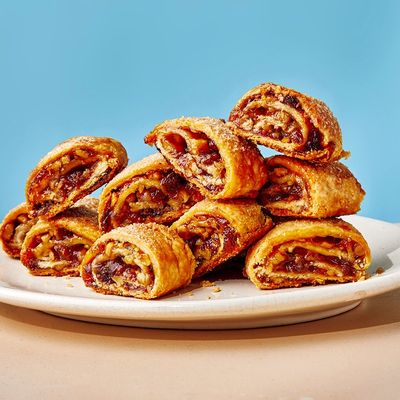
Rugelach
Rugelach dough: equal weights butter and cream cheese, beaten together, with flour and salt, like a cream-cheese shortcrust. Chills for 2 hours. Filling (chocolate version): cocoa, sugar, butter, sometimes chopped chocolate. Dough divides into 4 portions; each rolls into a circle 28 cm across; spreads with filling; cuts into 8 triangular wedges like a pizza. Each wedge rolls up from the wide edge toward the point. Brushes with egg wash; dusts with sugar. Bakes for 22 minutes at 180°C.
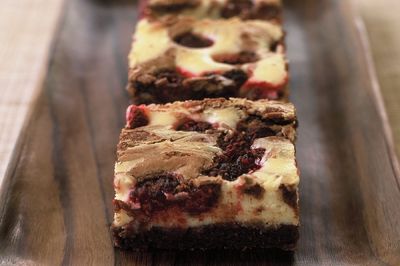
Cheesecake Brownies
Two mixtures, one tin. The brownie batter goes in first: dark chocolate and butter melted, sugar and eggs whisked light, folded together with flour and cocoa. The cheesecake topping is full-fat cream cheese beaten with sugar, an egg yolk, vanilla and a squeeze of lemon - the lemon keeps the white layer bright against the brown. Spooned over the brownie in dollops, then dragged through with a knife to make figure-eight ribbons. Baked low and slow so the cheesecake sets without browning much; cooled fully before slicing.
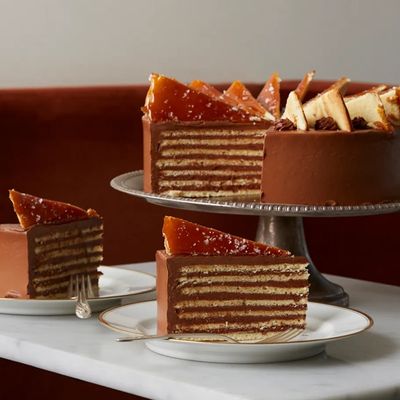
Dobos Torte
Six thin sponge discs are baked separately at high heat for 6-8 minutes each. Five are layered with a French-style chocolate buttercream made from a hot sugar syrup whipped into yolks then enriched with butter and melted dark chocolate. The sixth disc gets glazed with hard caramel while still warm, marked into twelve wedges before it sets, and crowns the cake. Sides masked with more buttercream and dusted with toasted chopped hazelnuts.
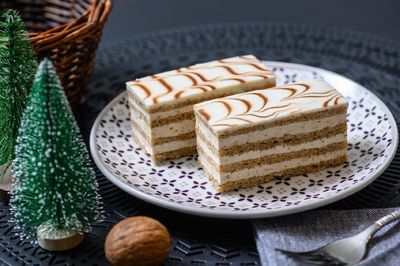
Eszterházy Torte
Five thin discs of almond-meringue (a French dacquoise) bake low and slow. They sandwich with a cognac and vanilla French-style buttercream (a pâte à bombe enriched with butter). The top is sealed with a thin layer of buttercream then iced with white fondant; melted dark chocolate is piped in concentric circles into the wet fondant and pulled into a spider-web with a skewer. Sides masked with toasted flaked almonds.