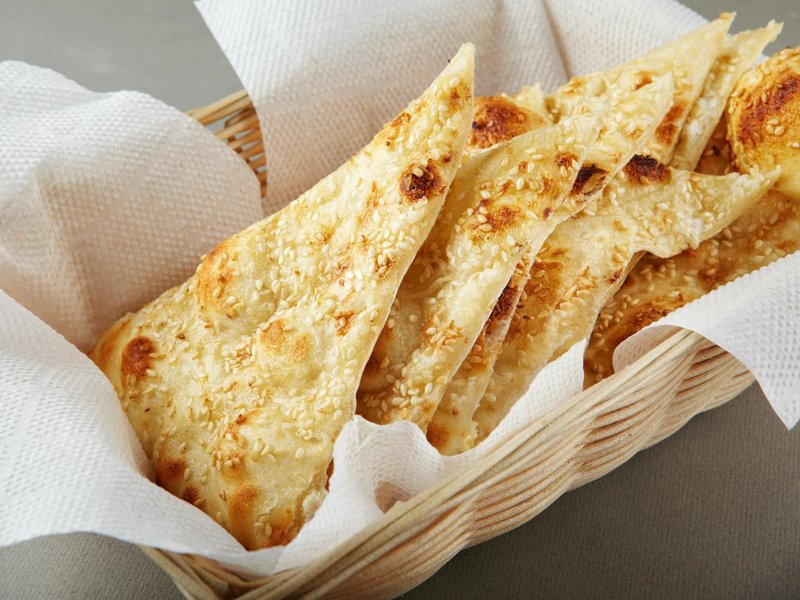
Sangak
Iran's most ancient bread: a long whole-wheat flatbread traditionally baked on a bed of hot pebbles. Slightly tangy, deeply chewy, nutty. Eaten with feta.
Overview
A wholemeal-heavy dough (70% wholemeal, 30% white) with a long ferment, 3-4 hours room temp or overnight in the fridge. Stretches into a 40-50 cm long oval, ~5 mm thick. Pressed onto a hot baking tray scattered with small smooth pebbles (or stones from the garden, well-washed). Baked at maximum heat 6-8 minutes, the dough conforms to the pebbles, giving the dimpled bottom that defines sangak.
Ingredients
- 350 g wholemeal flour
- 150 g plain white flour
- 1 sachet (7 g) fast-action yeast (or 5 g for slower ferment)
- 1 ½ teaspoons salt
- 1 tablespoon olive oil
- 380 ml warm water
- 500 g small smooth river pebbles (washed, oven-safe - see Notes)
- Cornmeal (or extra flour, for dusting)
Method
Stage 1 - Dough
- Whisk wholemeal flour, white flour, yeast, salt.
- Add olive oil and warm water; mix to a wet sticky dough.
- Knead 8 minutes in a stand mixer.
- Cover; rise 3-4 hours at room temperature (or overnight in the fridge) until doubled.
Stage 2 - Prep pebbles
- Spread pebbles on a sturdy heavy baking tray in a single layer.
- Place in the oven; heat oven to maximum (250°C+) for 30-40 minutes to thoroughly heat the pebbles.
Stage 3 - Shape
- Tip the dough onto a generously floured surface.
- Divide in half.
- Press the first half into a long oval; stretch by hand to a 40-50 cm long, 15 cm wide flat - about 5 mm thick.
- Slide carefully onto a peel (or upturned tray) dusted with cornmeal.
Stage 4 - Bake
- Open the oven; carefully slide the dough onto the hot pebble bed (the pebbles press into the dough from below, creating the signature dimpled bottom).
- Bake 6-8 minutes until deep gold.
Stage 5 - Lift
- Lift the bread off the pebbles with tongs and a metal spatula (the pebbles stay on the tray).
- Shake off any pebbles that stuck (rare if the surface is well-floured).
Stage 6 - Second loaf
- Repeat with the second half of dough. The pebbles are still hot.
Stage 7 - Serve
- Eat warm with feta, walnuts, fresh mint and basil, and a glass of black tea.
Notes
- Pebbles: Use small, smooth, oven-safe river stones - washed, dried. Pottery beads, baking weights, or coarse rock salt also work. Don't use pea gravel (too sharp).
- Don't have pebbles? Bake on a hot stone or steel - you'll get a flat (not dimpled) sangak. Still delicious; just not the traditional shape.
- Long ferment: The flavour depth comes from a long rise. Overnight in the fridge gives the best sourdough-like character.
Storage
- Best fresh, eaten warm.
- Wrapped in foil at room temperature 24 hours.
- Freeze 1 month.
More like this
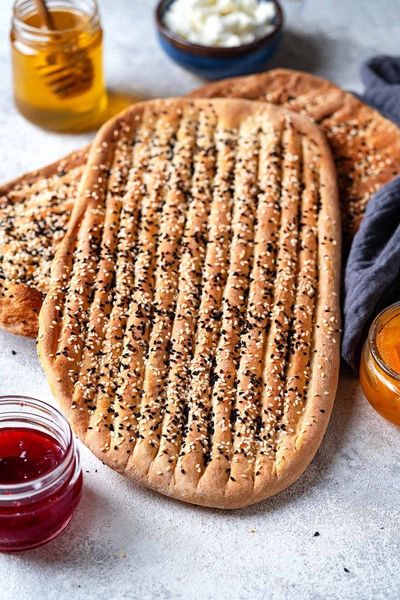
Barbari
A wet yeasted dough, high hydration (75%) of strong flour, yeast, salt, water and a touch of oil. Long first rise. Two portions; each stretches to a 40-50 cm long oval on an oiled work surface. A flour-water paste (roomal) brushes over the top, this gives the signature glossy crust. Deep parallel ridges press down with fingertips. Sesame and nigella seeds scatter. Baked at maximum heat 5-7 minutes on a screaming-hot stone.
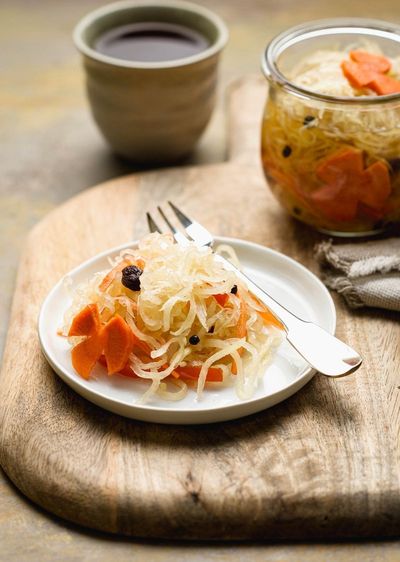
Atchara
Green papaya is peeled, seeded and shredded on a coarse grater. Carrot, ginger, garlic, red pepper, onion and raisins are all prepared in matching shreds. The vegetables are salted and rested for 1 hour to draw water; rinsed and squeezed dry. A syrup of cane vinegar, sugar and whole peppercorns simmers for 5 minutes. Hot syrup is poured over the vegetables in a sterilised jar. The jar is sealed, cooled and refrigerated overnight before eating. Improves over the following week.
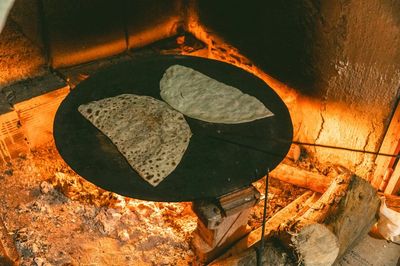
Aysh Baladi
A simple dough of half plain flour and half wholemeal, yeast, salt and warm water. Rises for 1 hour. Divides into 6 portions; rolls into thin 18 cm discs; rests for 20 minutes. Baked at maximum heat on a hot baking stone for 3-4 minutes, they puff dramatically and fall flat as they cool, leaving a hollow pocket.
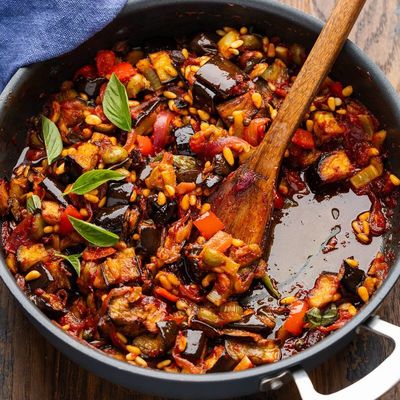
Caponata
Aubergine cubes are salted to weep, fried hard in olive oil to deep gold, and reserved. A separate pan is used to soften diced onion and sliced celery in olive oil; garlic joins briefly; chopped tomatoes simmer with red wine vinegar and sugar to make the agrodolce base. Green olives, capers, sultanas (optional) and toasted pine nuts are stirred in. The fried aubergine is returned and simmers for 10 minutes to meld. Off heat, fresh basil is scattered. Rested at least 2 hours (ideally overnight) before serving at room temperature.