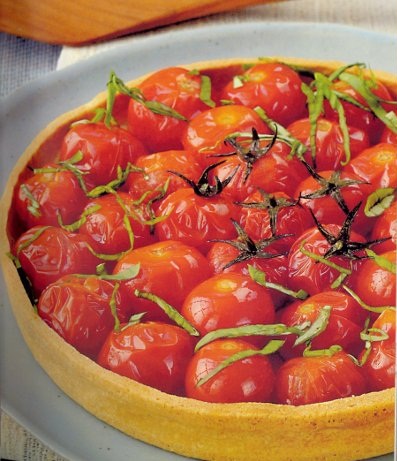
Semi-Confit Cherry Tomato Tart
The cherry tomatoes need to be lightly confit, in order to preserve their fresh fruity taste. To fully appreciate the flavour, serve at room temperature, never straight from the fridge.
Overview
A rustic yet sophisticated tart featuring slowly roasted cherry tomatoes with fragrant basil and garlic on a crisp pastry base. The semi-confit technique concentrates tomato sweetness while preserving brightness. A summer-perfect vegetarian tart celebrating tomatoes at their peak.
Ingredients
Pastry
- 260 g shortcrust pastry
Base
- 4 tbsp white rice
- 3 tbsp strong Dijon mustard
- 2 tbsp double cream (lightly whipped)
- salt
- pepper
Topping
- 500 g semi-confit cherry tomatoes
- 6 basil leaves (snipped)
Method
To make the tart case
- Roll out the pastry to a round, 3 mm thick, and use to line a 20 cm diameter (3 ½ cm deep) flan ring and chill in the refrigerator for at least 20 minutes.
- Preheat the oven to 190°C.
- Prick the pastry bases with a fork.
- Line the pastry case with greaseproof paper, and fill with a layer of baking beans.
- Bake the case blind in the oven for 40 minutes until it is completely cooked.
- Lower the oven temperature to 170°C.
- Remove the paper and the beans and return the pastry case to the oven for 15 minutes.
- Set the pastry aside to cool.
- Lift off the flan ring and transfer the pastry case to a wire rack and leave to cool.
To make the filling
- In the meantime, cook the rice in boiling salted water for 18 minutes.
- Refresh the rice under cold running water and drain thoroughly.
- Tip the cooked rice into a bowl and mix with the mustard then the whipped cream.
- Season and spread the rice mixture in the pastry case.
- Arrange the cherry tomatoes on the rice, placing those still with stalks in the centre.
- Scatter over the snipped basil and serve at room temperature.
Notes
- Semi-confit tomatoes: Slowly cooked at low temperature preserves bright flavour while concentrating sweetness; this differs from fully confit preparations.
- Rice layer: Absorbs moisture from tomatoes, preventing a soggy pastry base.
- Dijon mustard: Strong version provides foundation flavour; balance carefully against tomato sweetness.
- Room temperature serving: Essential for full flavour; cold temperatures mute tomato taste and basil aromatics.
Serving
Serve at room temperature as a vegetarian main course or elegant side dish. Pairs beautifully with fresh chèvre or mozzarella and a crisp sauvignon blanc.
Storage
- Best eaten the day of serving; do not refrigerate as cold temperatures diminish flavour significantly.
- Leftovers keep 1 day at room temperature, covered.
- Do not freeze; the texture and fresh flavour will be compromised.
More like this
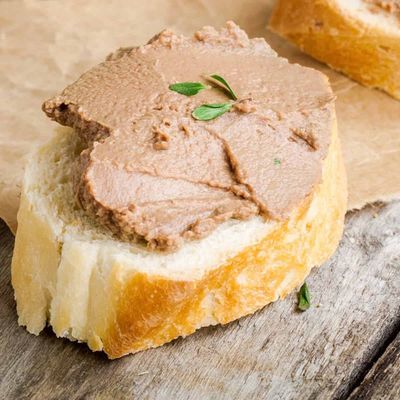
Chicken Liver Pâté
Chicken livers fry briefly with shallot and garlic, deglaze with brandy, finish with thyme and a splash of cream. The hot mixture blends with cubed cold butter into a silky paste, presses into a terrine, and sets cold under a layer of clarified butter. Eats best after a day in the fridge.
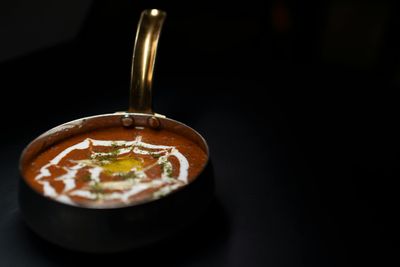
Dal Makhani
Whole black urad lentils and a small handful of red kidney beans are soaked overnight, then pressure-cooked or simmered until completely tender. A tomato-and-spice masala is built separately with onion, garlic, ginger and a careful hand with the spices. The lentils are folded into the masala and simmered, low and slow, for two hours, while butter and cream are stirred through in the final stage. The lentils break down into a glossy, almost-velvet finish.
Jhal Muri
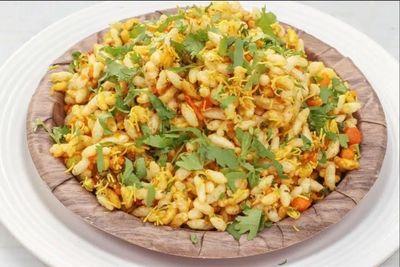
Jhal muri (literally "spicy puffed rice") is the most democratic snack in Bengal: assembled in seconds from a tin trunk by a muriwala, tipped into a rolled-newspaper cone, and eaten standing on a pavement for the price of a few rupees. The base is muri (puffed rice), and everything else is built around the principle of contrast. Raw mustard oil is the soul of the dish, sharp and nasal and slightly bitter; without it you have a salad, not jhal muri. The vegetables stay raw and crunchy, onion, green chilli, cucumber, tomato, chopped into tiny dice so each spoonful gets one of each. Peanuts and chana chur (or sev) add fat and crunch; black salt and chaat masala add the funky-tangy depth that makes Indian street snacks addictive. The lime goes in last so the puffs don't soften. This is a dish where technique matters less than ingredient quality: muri must be crisp (refresh in a dry pan if it's gone soft), mustard oil must be the proper pungent kind, and the lime must be fresh. It is everywhere in Bengal, tea-time at home, train platforms, the Maidan on a winter afternoon, and there is no recipe in any cookbook that quite captures the feel of it being mixed in front of you in a paper cone.
Palak Paneer
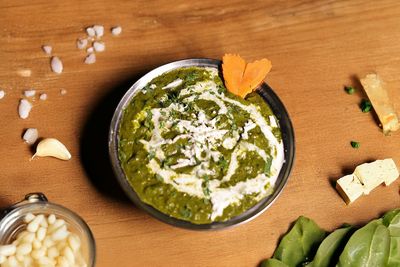
Spinach is blanched for one minute then plunged into iced water (a step that locks the colour bright green). The drained spinach is blended with green chilli into a smooth puree. A masala of onion, ginger, garlic and tomato is built and the puree stirred in. Cubes of paneer, lightly pan-fried, are added at the end so they sit on top of the gravy rather than dissolving into it. Finished with cream and kasuri methi.