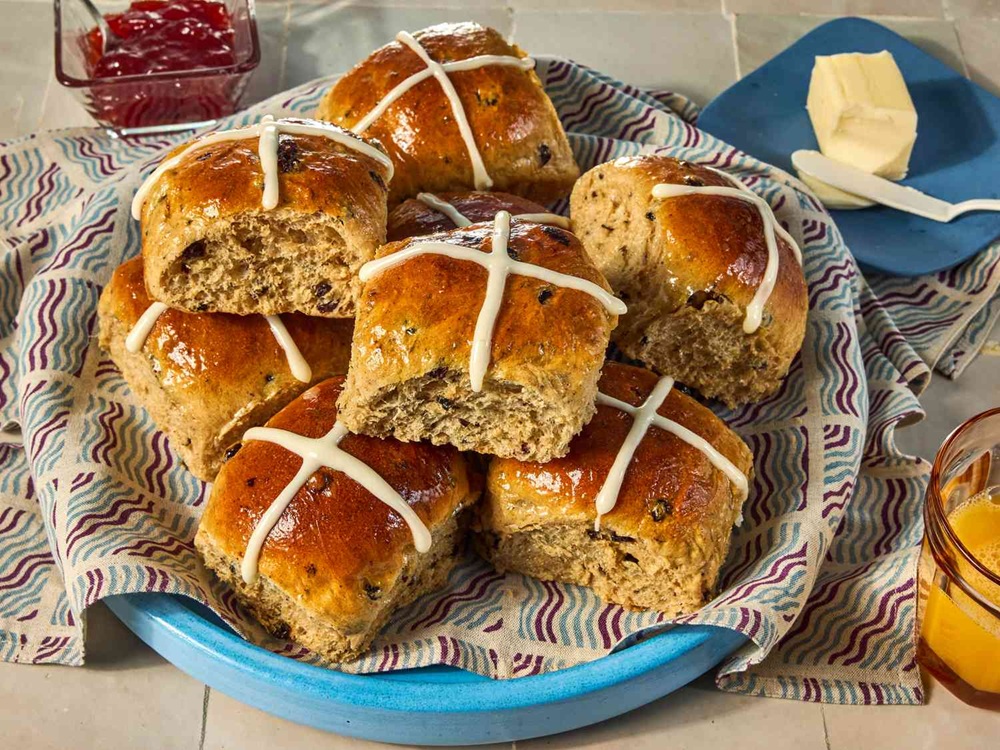
Hot Cross Buns
The Easter bake. Soft enriched dough scented with cinnamon, nutmeg and orange zest, studded with currants and chopped peel, marked with a flour-paste cross, glazed sticky with a sugar wash. Split warm, slathered with cold salty butter.
Overview
A yeasted dough enriched with milk, butter, an egg and a little sugar, spiced with cinnamon, nutmeg and mixed spice, scented with orange and lemon zest. Currants and chopped mixed peel folded in. Two rises (one in the bowl, one on the tray as 12 close-packed buns), a cross piped on with a flour-and-water paste, baked to deep gold, brushed with warm sugar glaze straight from the oven. Eaten warm or split and toasted.
Ingredients
The dough
- 500 g strong white bread flour (plus extra for dusting)
- 60 g caster sugar
- 1 ½ teaspoons fine sea salt
- 7 g instant yeast (1 sachet)
- 2 teaspoons ground cinnamon
- 1 teaspoon ground nutmeg
- 1 teaspoon mixed spice
- The zest of 1 orange
- The zest of 1 lemon
- 280 ml whole milk (lukewarm)
- 60 g unsalted butter (softened)
- 1 large egg
- 150 g currants
- 50 g chopped mixed peel
The cross
- 50 g plain flour
- 50 ml cold water
The glaze
- 50 g caster sugar
- 50 ml water
Method
Stage 1 - Mix the dough
- In a large bowl, combine the flour, sugar, salt, yeast, cinnamon, nutmeg, mixed spice, orange zest and lemon zest. Whisk to distribute the yeast evenly.
- Make a well in the centre. Pour in the lukewarm milk, add the softened butter and the egg. Mix with a wooden spoon, then turn out onto a worktop and knead for 8-10 minutes until smooth, elastic and a little tacky.
- Knead in the currants and mixed peel - the fruit will want to escape; press it in firmly.
- Place in a lightly oiled bowl, cover, and leave to rise in a warm place for 1 ½ hours, until doubled.
Stage 2 - Shape
- Knock back gently and divide into 12 equal pieces (about 90 g each). Roll each into a smooth tight ball.
- Place the balls close together on a baking-paper-lined tray in a 3 x 4 grid, leaving a 2 cm gap between them - they will rise into each other.
- Cover loosely and leave to rise for another 45-60 minutes, until puffy and the buns are touching at the sides.
Stage 3 - Bake
- Heat the oven to 200°C fan / 220°C / 425°F.
- Whisk the flour and water for the cross to a smooth thick paste, the consistency of toothpaste. Spoon into a piping bag or a sandwich bag with one corner snipped off.
- Pipe a cross over each bun, running long lines all the way across the rows so the cross extends from bun to bun.
- Bake for 18-22 minutes, until deep golden and hollow-sounding when tapped underneath. If they are browning fast, tent loosely with foil for the last 5 minutes.
Stage 4 - Glaze
- While the buns bake, combine the sugar and water in a small pan. Bring to a simmer for 2 minutes until syrupy.
- As soon as the buns come out of the oven, brush all over with the warm glaze. Give them two coats: the first soaks in, the second sets shiny.
- Cool on the tray for 10 minutes, then pull apart at the joining edges.
Notes
- Skipping the second rise gives dense buns; the warmth must produce a real puff before they go in the oven. If your kitchen is cold, switch on the oven light and let the buns rise inside with the door closed.
- For a darker, more festival bun, use half white and half wholemeal flour and increase the sugar by 20 g.
- Hot cross buns made on Good Friday are said to keep without spoiling - the tradition has more to do with the high sugar and the crucifix mark than scientific reality. They still keep well.
Serving
Warm from the oven, split and spread with cold salted butter. Toasted the next morning with butter and marmalade. With strong tea, beside the Easter morning post.
Storage
In a sealed tin at room temperature for 3-4 days. Refresh by splitting and toasting under the grill. Freeze whole for up to 2 months; thaw at room temperature, then warm briefly in a low oven.
More like this
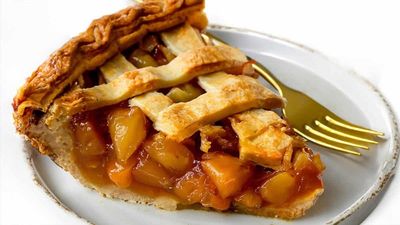
British Apple Pie
Buttery shortcrust rests then rolls; one disc lines a pie dish, fills with sliced spiced apples, the second disc tops it. Egg-washed, sugared, vented, baked golden. The juices thicken with cornflour as they cook so the bottom doesn't go soggy.
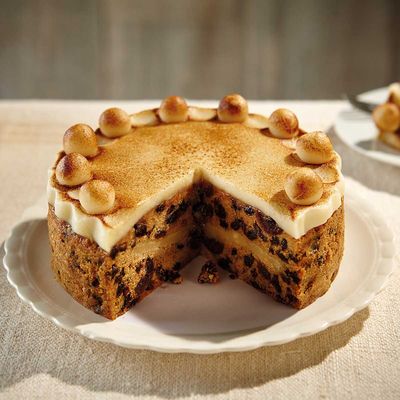
Simnel Cake
A relatively light fruit cake (less dense than Christmas cake) flavoured with mixed peel, currants, sultanas, glace cherries and a generous spoon of mixed spice. Half the batter goes into the lined tin, then a disc of rolled marzipan, then the rest of the batter. Baked low and slow so the marzipan layer melts slightly and the cake bakes through evenly. Once cool, the top is brushed with warm apricot jam, a second marzipan disc is laid on, and eleven small balls of marzipan are arranged around the rim. The top is flashed under a hot grill to colour the marzipan amber.
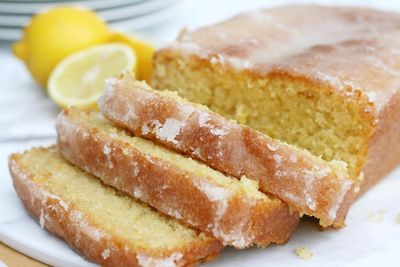
Lemon Cake
Moist and fragrant lemon cakes with a tender crumb, brushed with rum syrup and topped with a shimmering lemon icing glaze. These elegant loaves showcase brightness and simplicity, making them perfect for elegant entertaining or afternoon tea service, best sliced thin and served with fresh tea.
Treacle Tart
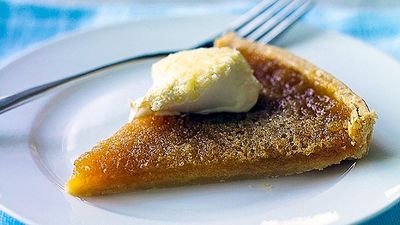
Sweet shortcrust pastry: plain flour rubs with cold butter to breadcrumb texture; icing sugar adds sweetness; an egg yolk binds with a splash of water. Rests in the fridge 1 hour. The pastry is rolled, lined into a 22 cm fluted tart tin, pricked, chilled again, and blind-baked with baking beans for 15 min, then 5 more min uncovered. Filling: warm golden syrup, lemon zest and juice, fresh breadcrumbs from a day-old loaf, a beaten egg and a small pinch of ginger / cinnamon. Stirred together; poured into the blind-baked case. Baked at 180°C 25-30 min until set with a slight wobble. Cooled to warm; served with cold clotted cream.