Aushak
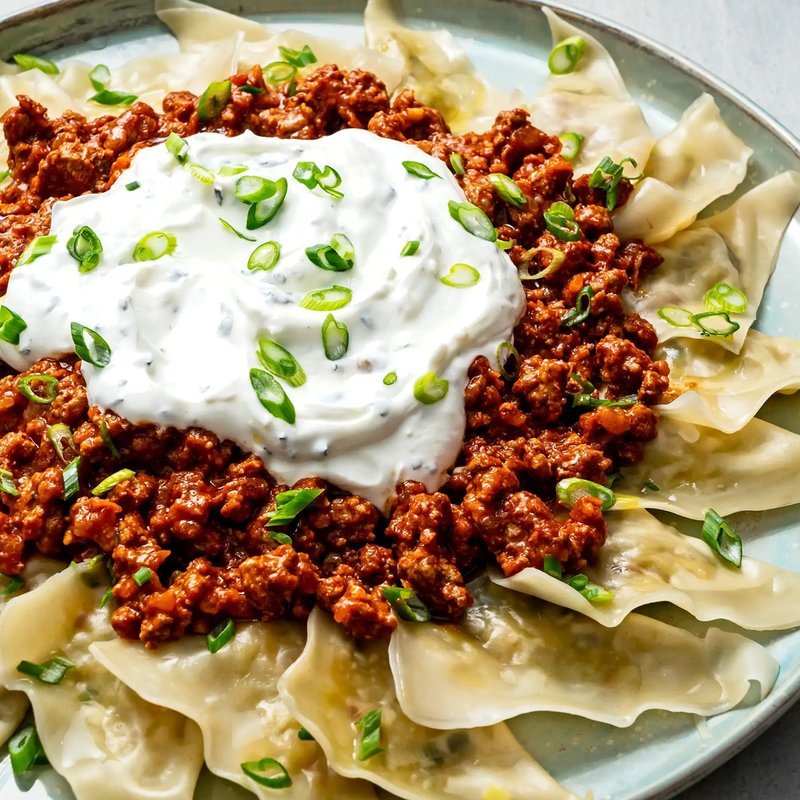
Afghanistan's leek dumplings: wonton wrappers folded around chopped leek, boiled, then served under garlicky yogurt and a spiced meat sauce.
Overview
Aushak are the Afghan leek-and-mint dumplings that share their plating shape with mantu: a smear of garlic yogurt under, dumplings boiled and fanned over, a thick lamb meat sauce ladled across the top, dried mint and chilli to finish. The filling is just leeks (or scallions), salted briefly to draw the water out, squeezed dry, then mixed with fresh mint, ground coriander and pepper. Wonton wrappers (or homemade dough) seal around a teaspoon of filling pinched into half-moons or triangles. While the dumplings boil, you make the topping: ground beef or lamb fried with onion, garlic, tomato paste and dried mint, simmered into a thick savoury sauce. The yogurt sauce is just chaka with garlic. Plate together while everything is still warm.
Ingredients
Filling
- 400 g leeks (white and pale green only, very finely chopped) OR 6 large bunches scallions
- 1 teaspoon salt (to weep the leeks)
- 2 tablespoons fresh mint (chopped fine)
- 1 teaspoon ground coriander
- ½ teaspoon ground black pepper
- 1 tablespoon olive oil
Wrappers
- 30 square wonton wrappers
Meat sauce
- 2 tablespoons sunflower oil
- 1 onion (small, finely diced)
- 3 garlic cloves (crushed)
- 300 g ground beef (or lamb, 20% fat)
- 1 tablespoon tomato paste
- 1 teaspoon ground cumin
- 1 teaspoon ground coriander
- 1 teaspoon dried mint
- ½ teaspoon dried red chilli flakes
- 1 teaspoon salt
- 100 ml water
Yogurt sauce
- 500 g full-fat Greek yogurt
- 3 garlic cloves (crushed to a paste with ½ teaspoon salt)
- 2 tablespoons cold water (to loosen)
To finish
- 1 tablespoon dried mint
- ½ teaspoon paprika
- 2 tablespoons fresh coriander (chopped)
Method
Stage 1 - Filling
- Toss chopped leeks with 1 teaspoon salt in a colander; rest 20 minutes.
- Squeeze hard in a clean tea towel to remove excess water.
- Mix with fresh mint, coriander, pepper and 1 tablespoon olive oil.
Stage 2 - Wrap
- Place 1 teaspoon of filling in the centre of each wonton wrapper.
- Wet two edges with water; fold over into a triangle or half-moon; press to seal.
- Set on a floured tray.
Stage 3 - Meat sauce
- Heat oil in a wide pan over medium heat.
- Sauté onion 5 minutes; add garlic; cook 1 minute.
- Add the mince; brown 6 minutes, breaking up.
- Stir in tomato paste, cumin, coriander, dried mint, chilli flakes and salt; cook 1 minute.
- Add water; simmer 8 minutes until thick.
Stage 4 - Yogurt
- Whisk yogurt with garlic-salt paste and cold water to a pourable but thick consistency.
Stage 5 - Boil dumplings
- Bring a wide pot of salted water to a boil.
- Cook dumplings in batches of 10 for 3-4 minutes until they float and the wrappers are translucent.
- Lift onto a plate with a slotted spoon.
Stage 6 - Plate
- Spread half the yogurt sauce on a wide warmed platter.
- Arrange the dumplings over the yogurt.
- Spoon over the remaining yogurt.
- Top with hot meat sauce.
- Sprinkle dried mint, paprika pepper and fresh coriander.
Notes
- Squeeze the leeks dry: Wet leeks make a soggy filling that bursts the dumpling. The 20-minute salt-and-squeeze is essential.
- Don't pre-cool the dumplings: Aushak loses its appeal when the wrappers cool and stiffen. Boil, plate, serve immediately.
- Yogurt warm, not hot: Don't heat the yogurt sauce - Afghan tradition keeps it room-temperature so it stays loose and cool against the hot meat.
Storage
- Best fresh.
- Filled raw dumplings freeze 2 months on a tray, then bag; boil from frozen, adding 2 minutes.
- Components keep separately 3 days; assemble at serving.
Recipes mentioned here
Mantu
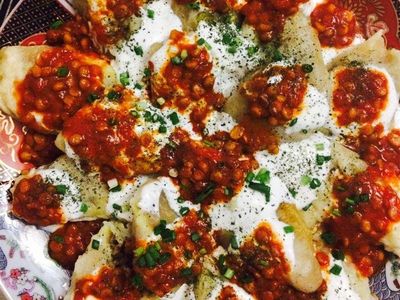
Mantu are the steamed lamb dumplings that Afghanistan shares with the rest of Central Asia, plated under garlic yogurt and topped with a thick split-pea-and-tomato sauce. The filling is straightforward: lamb mince fried with onion and spices, then cooled completely before it goes into the wrappers (warm filling makes the dough soggy). A plain flour-and-water dough rolls thin, gets cut into 8 cm squares, and each square gets a teaspoon of filling pinched closed at all four corners. Steam for twenty minutes. While they are steaming you whisk the chaka (yogurt with garlic and salt) and cook a quick qorma of yellow split peas with tomato and dried mint. Plate stacked: yogurt under, mantu in the middle, qorma over the top, dried mint and a sprinkle of chilli powder to finish. A whole platter goes to the centre of the table to share.
Mantu
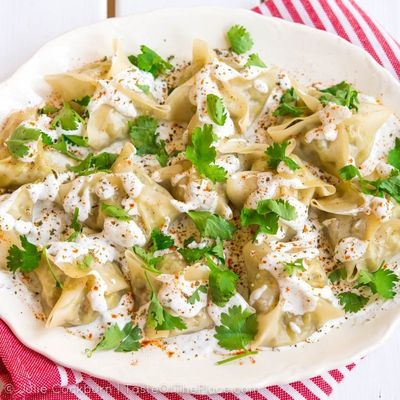
This is the small-plate version of mantu, folded into a four-pointed flower with the meat visible at the top, plated for a starter or a shared snack rather than the full main-course platter. The filling is ground lamb with grated onion (squeezed dry first, otherwise the parcel goes soggy), garlic, ground coriander, cumin, cinnamon, salt and pepper. The fold is the interesting bit. Take a wonton wrapper, drop a teaspoon of filling in the centre, pull all four corners up over the centre, and pinch them together in pairs to make an X-shape with four small triangles of meat showing at the top, like an opened flower. Steam in a bamboo basket eighteen to twenty minutes over boiling water. Two sauces alongside: a chana-dal-tomato-and-mint sauce stewed thick, and chaka yogurt with garlic. Plate as you would aushak: yogurt base, dumplings on top, lentil-tomato sauce ladled across, dried mint scattered last.
More like this
Mantu
This is the small-plate version of mantu, folded into a four-pointed flower with the meat visible at the top, plated for a starter or a shared snack rather than the full main-course platter. The filling is ground lamb with grated onion (squeezed dry first, otherwise the parcel goes soggy), garlic, ground coriander, cumin, cinnamon, salt and pepper. The fold is the interesting bit. Take a wonton wrapper, drop a teaspoon of filling in the centre, pull all four corners up over the centre, and pinch them together in pairs to make an X-shape with four small triangles of meat showing at the top, like an opened flower. Steam in a bamboo basket eighteen to twenty minutes over boiling water. Two sauces alongside: a chana-dal-tomato-and-mint sauce stewed thick, and chaka yogurt with garlic. Plate as you would aushak: yogurt base, dumplings on top, lentil-tomato sauce ladled across, dried mint scattered last.
Aroog
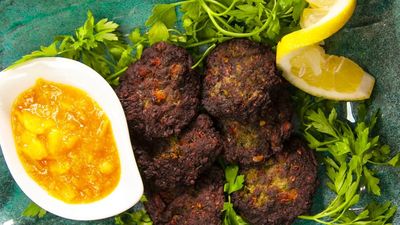
Fine bulgur (#1 grade) soaks in hot water until soft and fluffy. Lamb or beef mince mixes with the bulgur, grated onion, lots of chopped parsley and coriander, ground baharat, cumin and a pinch of cinnamon. The mixture should be soft enough to spread, if it's too dry the aroog crumble. Small portions press onto a hot oiled pan and flatten to 1 cm thick discs; cook for 4-5 minutes per side over medium heat until deeply browned and the meat is just cooked through. Lift, drain briefly, eat hot with lemon and yoghurt.

Samosa Pakistani
Pastry dough: plain flour, ghee, salt, ajwain seeds, and warm water are kneaded into a stiff oil-rich dough; rests for 30 min. Filling: ground beef (or lamb) sautées with onion, garlic, ginger, green chilli and a Pakistani spice blend (garam masala, cumin, coriander, chilli powder, turmeric). Frozen peas join; the mixture simmers dry; cooled fully. Dough divides into 10 balls; each rolls into a thin oval, cut in half to make 2 half-moons. Each half-moon forms a cone (one flat edge becomes the seam, sealed with flour paste). Cone fills with cooled filling. Top edge of cone seals with flour paste. Deep-fried 175°C 3-4 minutes per side until amber-crisp.
Mutabbaq
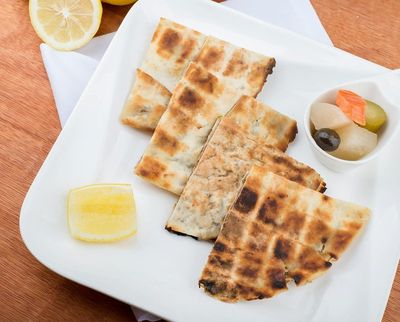
The Saudi street snack that almost every food court and roadside griddle in the kingdom has running through service. You make a stretchy oil-rich dough and let it rest for a full hour so it develops the pliability that mutabbaq depends on (the trick is that the dough has to stretch translucent without tearing). While it rests you cook a filling of ground beef or lamb with onion, leek, garlic and baharat, cool it, then mix in beaten eggs and chopped parsley just before folding. The eggs go in raw and cook inside the pastry as it griddles. Each dough ball gets oiled heavily and pulled by hand on an oiled surface into a 35 cm square thin enough to see through, with the filling spread in a 15 cm square in the centre. The edges fold in to enclose, and the whole parcel griddles on a hot pan with a glug of oil for two or three minutes per side until it's amber-crisp on the outside and the egg has set inside. Cut into quarters, eaten warm at the counter or carried home wrapped in paper.