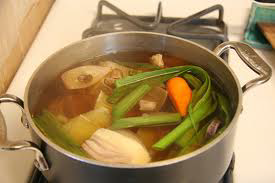
Vegetable Stock
Clean and versatile, vegetable stock provides a foundation for vegetarian preparations, light sauces, and elegant vegetable dishes, delivering subtle flavor without overpowering delicate ingredients.
Overview
Vegetable stock (fond de légumes) is the cornerstone of vegetarian cooking and provides a neutral, delicate base for light sauces and vegetable-based preparations. Unlike meat stocks that develop flavor through long simmering, vegetable stock relies on careful vegetable selection and precise timing (45 minutes, not longer) to extract balanced flavor without bitterness. The inclusion of fennel (subtle anise character), white wine reduction (acidity), and aromatics (garlic, shallot, leek) creates depth without overpowering herbaceous flavors. Success depends on cutting vegetables uniformly (for even cooking), maintaining a bare simmer throughout (rolling boil causes cloudiness and bitterness), and precise cooking duration (45 minutes exactly, overcooking produces bitter stock). The finished stock should be pale golden, clear, and gently aromatic with vegetable sweetness.
Ingredients
Primary Aromatics & Vegetables
- 300 grams carrots (cut into thin rounds, approximately ½ centimeter thick)
- 2 leeks (white parts only, rinsed thoroughly, halved lengthwise and sliced to approximately 1 centimeter)
- 100 grams celery stalks (thinly sliced, approximately ½ centimeter)
- 50 grams fennel bulb (very thinly sliced, approximately 0.3 centimeter)
- 150 grams shallots (thinly sliced, approximately ½ centimeter)
- 100 grams onion (thinly sliced, approximately ½ centimeter)
- 2 cloves garlic (unpeeled, lightly crushed)
Aromatics & Liquid
- 1 Bouquet Garni
- 250 millilitres dry white wine
- 2 litres cold water
Seasoning
- 10 white peppercorns (crushed and tied in muslin)
Method
Stage 1 - Prepare Vegetables
- Prepare all vegetables: wash carrots and celery, peel onions and shallots, wash leeks thoroughly, trim fennel.
- All vegetables should be sliced uniformly to approximately ½-1 centimeter thickness.
- Leave garlic cloves unpeeled; crush slightly.
- Place all prepared vegetables, garlic, and bouquet garni in a large saucepan.
Stage 2 - Add Liquid & White Wine
- Add 2 litres cold water to the saucepan.
- Add 250 millilitres dry white wine.
- Place over high heat and bring to a rolling boil (approximately 10-15 minutes).
Stage 3 - Initial Skimming
- As soon as the liquid reaches a full boil, immediately lower the heat to very low.
- The surface should show a bare simmer.
- Using a large, flat spoon, skim any foam or impurities.
- This initial skimming prevents cloudiness.
Stage 4 - Simmer & Monitor
- Maintain a bare simmer (surface barely trembling).
- Simmer gently, uncovered, for exactly 45 minutes.
- Do not stir the stock.
- Skim occasionally if necessary (every 10-15 minutes).
Stage 5 - Add Peppercorns
- After 35 minutes of simmering, add the muslin-wrapped 10 white peppercorns.
- Stir gently to distribute.
- Continue simmering until exactly 45 minutes total cooking time.
Stage 6 - Strain
- Place a fine-meshed sieve over a clean bowl.
- Carefully ladle the stock through the strainer.
- Allow the liquid to drain naturally by gravity.
- Discard all vegetable solids.
Stage 7 - Cool Over Ice
- Allow strained stock to cool to room temperature (approximately 15-20 minutes).
- Prepare a large bowl of ice water.
- Place the bowl with warm stock into the ice bath.
- Cool completely (approximately 20 minutes).
Stage 8 - Final Storage Preparation
- The cooled stock should be clear and pale golden.
- Unlike meat stocks, vegetable stock will not gel when cold (no gelatin from vegetables).
- Decant into storage containers.
Notes
- Vegetable Selection Balanced: Equal emphasis on root vegetables, leaf bases, and aromatics.
- Fennel Sweetness: Provides subtle anise character and natural sweetness. Do not omit.
- Cooking Duration Critical: 45 minutes is exact. Longer cooking produces bitter flavors.
- Never Boil: Rolling boil causes impurities to incorporate, creating cloudiness.
- Leek Washing Essential: Sand hides between leek layers; wash thoroughly.
- White Wine Acidity: Provides balance and prevents herbaceous/bland flavors.
- Stock Clarity: Clear, pale golden stock indicates proper technique.
Variations
- With Fresh Herbs: Add 2-3 sprigs fresh tarragon or thyme.
- Asian Variation: Add 2-3 slices fresh ginger and 2 star anise.
- Richer Variation: Double the shallot and onion quantities.
- Mushroom Addition: Add 100 grams sliced mushrooms for umami depth.
Serving
- Primary Use: Base for vegetarian sauces
- Secondary Use: Braising liquid for vegetables, soup base
- Temperature: Reheat gently to steaming (90°C); do not boil
- Pairing: Delicate vegetables, vegetarian preparations, elegant soups
Storage
- Refrigeration: 4-5 days in covered container
- Freezing: Up to 3 months
- No Fat Layer: Vegetable stock will not develop a solidified fat layer
- No Gelatin: Stock will not gel when cold. This is normal.
- Reheating: Thaw in refrigerator, then reheat gently
More like this
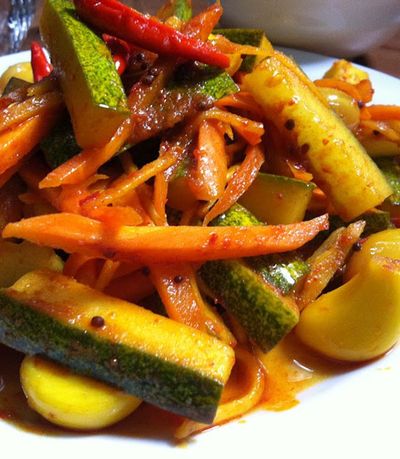
Acar Timun
Cucumber, carrot, shallot, chilli prep into thin slices or matchsticks. Salt rests for 10 minutes to draw moisture, drains. A simple dressing of vinegar, sugar, water and ginger whisks together. Vegetables toss with the dressing; rest for 1 hour at room temperature. Eats cool, never refrigerated cold; the texture suffers.
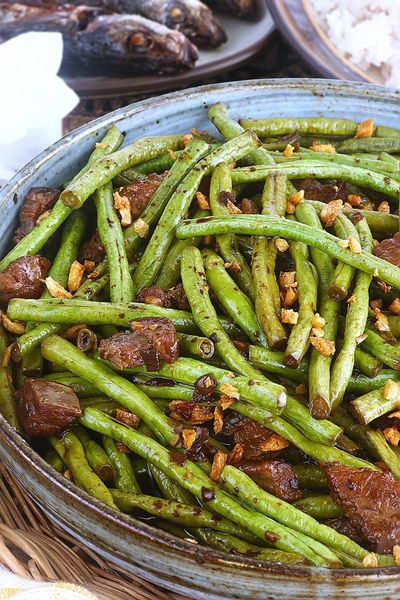
Adobong Sitaw
Garlic browns in oil; long beans toss in to colour briefly. Soy and vinegar pour in with bay and peppercorns; the beans braise covered until tender. Lid off; the liquid reduces to a glaze. Salt at the end, not the start, since soy is salty enough.
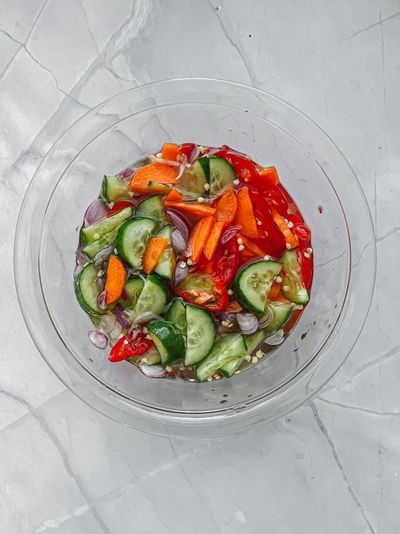
Ajad
A simple syrup of rice vinegar, palm sugar, water and salt is brought to a gentle simmer to dissolve the sugar, then cooled. Cucumber, shallot and chilli are sliced thin and combined in a small bowl. The cooled syrup is poured over. Rested for 10-15 minutes for the vegetables to wilt slightly into the dressing. Served in small individual ramekins as a dip, OR in a larger bowl as a side, with peanuts sprinkled on top.

Akara
Dried black-eyed beans soak briefly to loosen the skins; the skins rub off (this is the key step, skin-on akara is bitter and grey). The peeled beans go into a blender with onion, Scotch bonnet and just enough water to make a thick batter (not a paste). The batter is whipped by hand or with a wooden spoon for 5 minutes until light and aerated, this is what makes akara fluffy rather than dense. Spoonfuls drop into 175°C oil and fry for 3-4 minutes per side until golden. Drained on paper. Eaten hot.