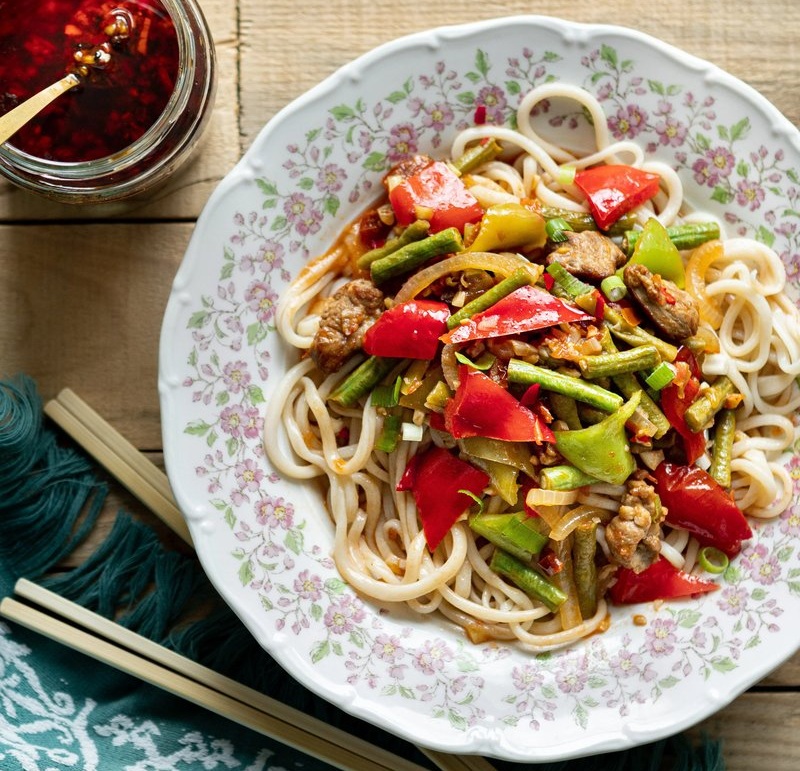
Laghman
The Uyghur hand-pulled noodle: a single rope of dough stretched into long springy strands, served under a wok-fried lamb, tomato and pepper sauce.
Overview
Two distinct elements that meet at the bowl: long, springy hand-pulled noodles with the chew of fresh ramen, and a brothy lamb-and-tomato topping that's somewhere between a stir-fry and a stew. The topping reads bright and savoury more than spicy, fresh tomato and sundried tomato together giving sweetness and depth, peppers and yardlong beans for crunch, cumin and white pepper for warmth, with a single fresh chilli for gentle heat. Smell-wise it's lamb fat hitting hot oil, then tomato vines, then cumin. The noodles are the difficulty: pulling a coiled rope of rested dough into long even strands takes practice, and your first few attempts will tear. The reward is a noodle nothing like the dried equivalent, thicker, glossier, with proper pull. A signature dish across the entire Uyghur world, eaten from Kashgar to Almaty to Toronto, with each family making minor variations on the topping; the noodle technique itself is shared with the lamian tradition of Lanzhou further east, which laghman is etymologically related to.
Ingredients
Dough
- 250 g plain flour
- 110 ml cold water
- 2 g salt
- 50 ml olive oil (for lubricating the resting rope)
Topping
- 110 g lamb (sliced into coin-sized pieces)
- 100 ml olive oil
- 1 spring onion (finely chopped)
- 25 g ginger (finely chopped)
- ½ bulb garlic (finely chopped)
- 1 fresh red chilli (finely chopped)
- 3 dried tomatoes (or sundried tomatoes, finely chopped)
- 3 fresh tomatoes (cut into small pieces)
- 1 white onion (sliced)
- 2 mild green peppers (cut into triangles)
- 1 red sweet pepper (cut into triangles)
- 13-15 yardlong beans (or 200 g green beans, cut into 3-4 cm pieces)
- 7 g salt
- 1 g ground black pepper
- 2 g ground white pepper
- 3-4 g ground cumin
- 500 ml water
Method
Stage 1 - Dough
- Combine flour, water and salt; knead 5-10 minutes until smooth.
- Cover with a damp cloth; rest 15-20 minutes.
- Roll the dough into a long rope; coil into a spiral; oil generously.
- Cover with foil or cling film; rest another 15-20 minutes.
Stage 2 - Topping
- Heat the 100 ml of olive oil in a wok over high heat until lightly smoking.
- Add the lamb; brown 2-3 minutes.
- Add ginger, garlic, fresh chilli, dried tomato, onion and fresh tomato. Stir-fry 2-3 minutes.
- Add the beans, peppers, spring onion, salt, black and white pepper, and cumin. Stir-fry 3-4 minutes.
- Pour in the water; bring to a boil, then reduce to the lowest simmer.
Stage 3 - Stretch the noodles
- Bring a wide pot of water to a rolling boil.
- Lift one end of the coiled dough rope; loosen ~30 cm above the work surface.
- Hold the rope lightly between thumb and forefinger of both hands.
- Move your arms outward, stretching the dough thinner as it slides between your hands.
- Continue working your way along the coil, thinning the rope to ~5 mm thickness.
- Once stretched, lift the rope and let it bounce gently on the worktop a few times to elongate further. Some breakage is normal.
Stage 4 - Cook and serve
- Drop the noodles into the boiling water; stir immediately to prevent sticking.
- Cook 2-3 minutes until just-tender.
- Drain; rinse briefly with cold water to stop cooking; shake dry.
- Divide the noodles between deep bowls.
- Ladle the lamb-and-vegetable topping over.
- Eat immediately, stirring the topping into the noodles at the table.
Notes
- Rest the dough properly: rushed dough won't stretch - it'll snap. Two rest stages with oiling between is the technique that allows hand-pulling.
- Don't rip: the noodle thins by pulling, not pinching. Long, smooth, slow movements.
- The "dance": the bounce on the tabletop is more than theatre; it elongates and aerates the dough. Some breakage is expected.
- Topping is wet, not dry: Uyghur laghman has a brothy sauce around the noodles, not a stir-fry glaze. Water at the end is correct.
Storage
- Noodles best fresh; reheat by refreshing briefly in boiling water.
- Topping keeps 3 days refrigerated; reheats well.
More like this
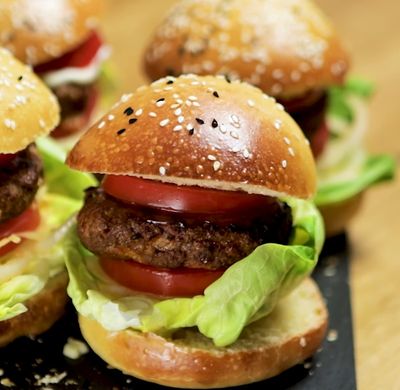
Uyghur Kebab Burger
A burger that tastes like a Kashgar street kebab rather than a Western quarter-pounder. Cumin is the dominant note (Uyghur cooking uses it the way the rest of China uses Sichuan pepper); behind it sits sweet chilli powder for warmth without burn, and the lamb fat that catches a deep gold sear on the outside. The patty stays loose and juicy because the mix is bound with a single egg and a spoon of flour rather than pressed dense like a beef burger. Smell-wise: charred fat, cumin, and the sweet onion folded into the meat. Easy enough that you can do it on a weeknight as long as the mix has had its 3-hour rest in the fridge; the resting time is what makes the difference between a flat-tasting patty and one that eats like the real tonur version. The dish is a clear modern adaptation of the classic Uyghur cumin lamb kebab, scaled down for households without access to a clay tandoor, and increasingly common in cafés across Xinjiang and the Uyghur diaspora.
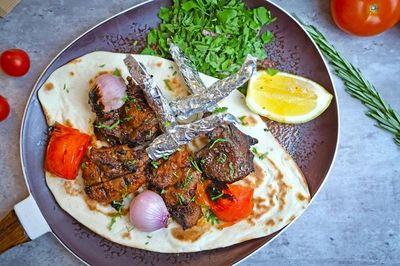
Chapli Kebab
Chapli kebabs are the spiced beef patties sizzling on a wide flat tawa at any roadside grill from Peshawar to Kabul, big enough to wrap a hand around and seasoned with the unusual punch of dried pomegranate seeds and coriander. The mince mixes with grated onion, chopped fresh tomato, ginger, garlic, beaten egg and a little gram flour to bind, plus the signature Afghan spice blend (coriander seed, pomegranate seeds, chilli flakes, cumin and garam masala). A thirty-minute rest lets the gram flour absorb the moisture and the spices marry. Pat thin and wide (the word chapli means "flat" or "slipper-shaped"), then fry hard in oil three or four minutes a side until darkly crusted. Eat hot from the pan, wrapped in fresh naan with sliced raw onion and a green chutney.
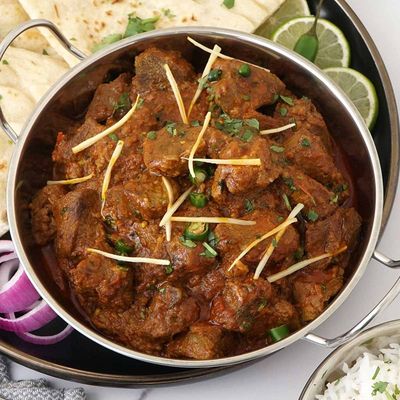
Lamb Karahi (Afghan Style)
This is the Afghan take on a karahi, slow-cooked rather than the fast Pakistani version: lamb shoulder browned hard, then braised low for an hour and a half until the meat is tender enough to cut with a spoon. Onions cook deep brown alongside the lamb. Ginger, garlic, cumin, coriander and turmeric toast briefly in the rendered fat; tomato cooks down to a jammy base; the lamb returns with stock and disappears under a lid for ninety minutes. At the end the lid comes off, julienned green chillies and fresh ginger drop in, the gravy reduces and the cooking fat rises to the surface in a thin amber slick (that slick is the visual sign the meat is ready). Eat with naan or chalow rice, and a bowl of sliced raw onion and lemon on the side.
Saltah
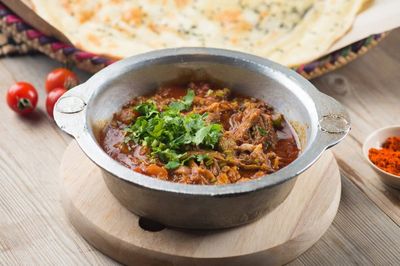
Lamb (or beef) is slow-cooked in a Yemeni tomato-onion-spice stew (called maraq) for two hours. Just before serving, the stew is transferred to a flameproof clay or stone pot, brought to a violent boil on direct heat. Whipped hulba (overnight-soaked fenugreek seeds, blended with lemon and a little water into a snowy froth) is spooned on top. The pot is brought to the table boiling. Sahawiq adds heat.