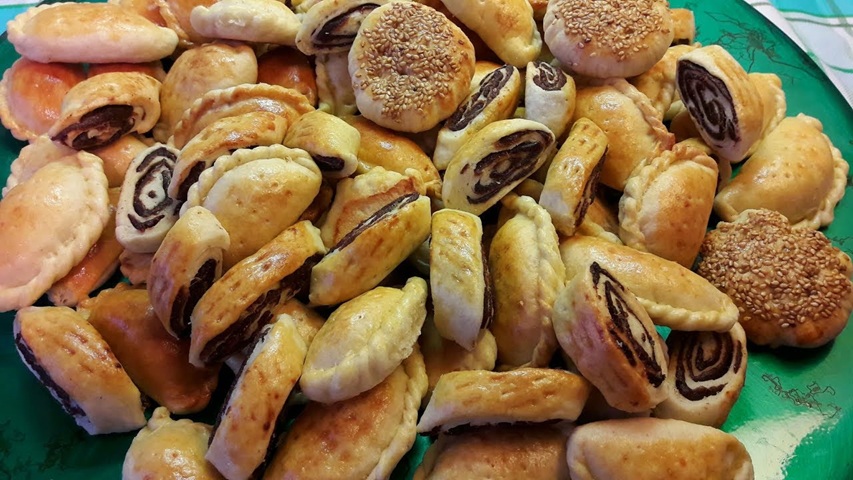
Klicha
Iraq's national cookie: a cardamom-scented dough wrapped around a spiced date paste, scored or moulded and baked pale gold.
Overview
A buttery cardamom-and-nigella dough enriched with milk and a touch of yeast (yeast gives a tender bite, not a rise) wraps around a soft date paste cooked down with butter, cardamom, cloves and cinnamon. Walnut-sized balls flatten, fill, fold and press into a klaicha mould (or score the top with the back of a fork in a herringbone pattern). Brushed with egg yolk and sprinkled with sesame seeds. Baked at 180°C until pale gold (not brown, Iraqi klicha stay light, almost biscuit-coloured).
Ingredients
Dough
- 500 g plain flour
- 200 g unsalted butter (softened)
- 100 g caster sugar
- 1 teaspoon ground cardamom
- ½ teaspoon ground nigella seeds (optional but classic)
- 1 teaspoon active dry yeast
- 200 ml whole milk (warm)
- 1 egg (large)
- ¼ teaspoon salt
Date filling
- 400 g pitted dates (Iraqi or Medjool; chopped)
- 50 g unsalted butter
- 1 teaspoon ground cardamom
- ½ teaspoon ground cloves
- ½ teaspoon ground cinnamon
- 2 tablespoons sesame seeds (optional)
Glaze
- 1 egg yolk (large, beaten with 1 tablespoon milk)
- 1 tablespoon sesame seeds (white or mixed white and black)
Method
Stage 1 - Date filling
- Combine the dates, butter, cardamom, cloves and cinnamon in a small heavy pan over low heat.
- Cook 5-8 minutes, mashing with a fork, until the dates are soft and the mixture is a smooth, thick paste.
- Stir in the sesame seeds (if using). Cool.
Stage 2 - Dough
- Whisk the warm milk with the yeast and a pinch of the sugar; rest 5 minutes until frothy.
- Cream the butter with the rest of the sugar in a large bowl until light.
- Add the cardamom, nigella, salt and egg; beat to combine.
- Pour in the milk-yeast mixture; stir.
- Add the flour gradually, mixing to a soft, smooth dough (don't over-knead; just bring it together).
- Cover; rest 30 minutes at warm room temperature.
Stage 3 - Shape
- Heat the oven to 180°C (160°C fan).
- Divide the dough into 30 walnut-sized balls.
- On a lightly floured surface, flatten each ball into a 7-8 cm disc.
- Place a teaspoon of cooled date paste in the centre.
- Bring the edges up and over the filling; pinch closed; smooth the seam.
- Roll back into a ball; flatten gently to a 4 cm thick disc.
- Press a klaicha mould onto the smooth side, or score the top in a herringbone pattern with the back of a fork or a small knife.
Stage 4 - Bake
- Place on lined baking sheets, 3 cm apart.
- Brush the patterned tops with the egg-yolk glaze; sprinkle with sesame seeds.
- Bake 18-22 minutes until pale gold (not browned; Iraqi klicha should look just-cooked, not deep amber).
- Cool on the tray 5 minutes; transfer to a wire rack.
Stage 5 - Serve
- Eat warm or at room temperature with tea, coffee or a glass of cold milk.
Notes
- Date paste consistency: Should be soft and spreadable, not stiff or crumbly. If the dates are dry, add a splash of milk while cooking.
- Pale, not golden: Klicha are baked light. Deep golden tops mean overbaked, dry cookies. The pattern is what catches the eye, not the colour.
- Yeast not for rise: The teaspoon of yeast tenderises the crumb; the cookie doesn't rise visibly. Don't skip it; the texture is markedly different without.
- Mould or fork: A traditional wooden klaicha mould gives the iconic Iraqi pattern; failing that, a small knife scoring a herringbone or grid pattern is the home alternative.
Variations
Walnut filling (klicha bil-jouz): Replace dates with 200 g finely chopped walnuts, 100 g sugar, 1 teaspoon cardamom and 1 tablespoon rose water. Festival version. Coconut filling: 200 g desiccated coconut, 100 g sugar, 4 tablespoons milk, 1 teaspoon cardamom, cooked to a sticky paste. Ring shape (klicha aysh): Form the dough into rings around the filling for a different traditional shape.
Serving
Serve with: cardamom tea (chai hel), Iraqi coffee, or a glass of cold milk. Occasion: Eid al-Fitr, Eid al-Adha, weddings, family tea-time, Ramadan iftar. Temperature: room temperature, or warmed for 1 minute in the oven.
Storage
- Keeps 2 weeks in an airtight tin; the flavour deepens over the first 3 days.
- Freezes 2 months in a sealed bag; defrost at room temperature for 1 hour.
- Don't refrigerate; the dough firms and the cookies dry out.
More like this
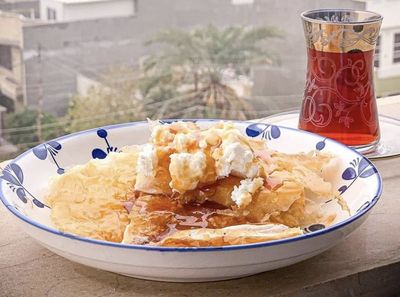
Kahi
A simple flour-and-water dough rests for 30 minutes. Stretches paper-thin on an oiled surface (filo-style). Brushed with melted samna; folded into a long strip; coiled into a flat round; rolled flat. Pan-baked or oven-baked at 200°C until darkly gold. Plunged briefly into hot saffron-cardamom-rose sugar syrup. Topped with thick clotted cream (geymar, or substitute Devonshire / Cornish clotted cream).
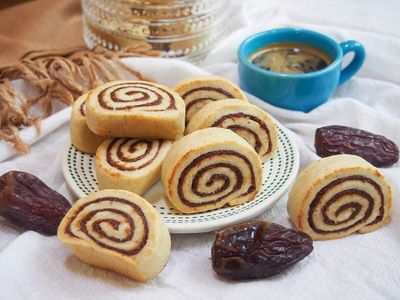
Klaicha
A buttery cardamom-scented dough enriched with milk and a touch of yeast (gives a tender bite without rising). Date paste sweetens with cardamom, cloves and a pinch of cinnamon. Each cookie wraps a teaspoon of filling, then gets pressed into a patterned mould or scored on top. Bakes pale gold; the surface stays soft, the inside spice-heavy.
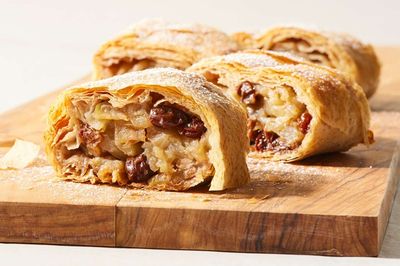
Apfelstrudel
A simple flour-egg-oil dough kneads until silky, rests so the gluten relaxes, then stretches over a floured cloth until you can read newsprint through it. A filling of grated and sliced tart apples, sugar, cinnamon, raisins, lemon zest and butter-toasted breadcrumbs spreads across the dough. The cloth helps roll the whole thing into a long log. Bakes brushed with butter until shatteringly crisp.
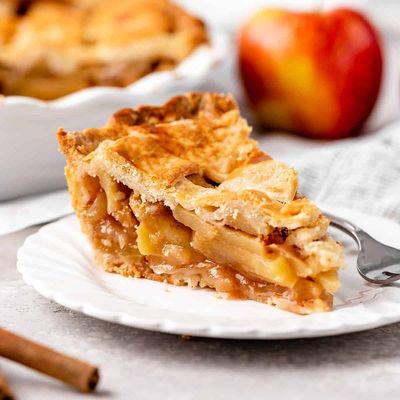
Apple Pie
All-butter pie pastry rests in two discs. The filling, a mix of apples (Bramleys for tartness and break-down, Granny Smith and Braeburn for hold), brown sugar, cinnamon, lemon, cornflour, pre-cooks slightly to release water and keep the crust from going soggy. Bottom crust lines a pie dish; filling piles in tall (it sinks); top crust seals on, vented. Egg-washed and sugar-dusted; baked until deep gold.