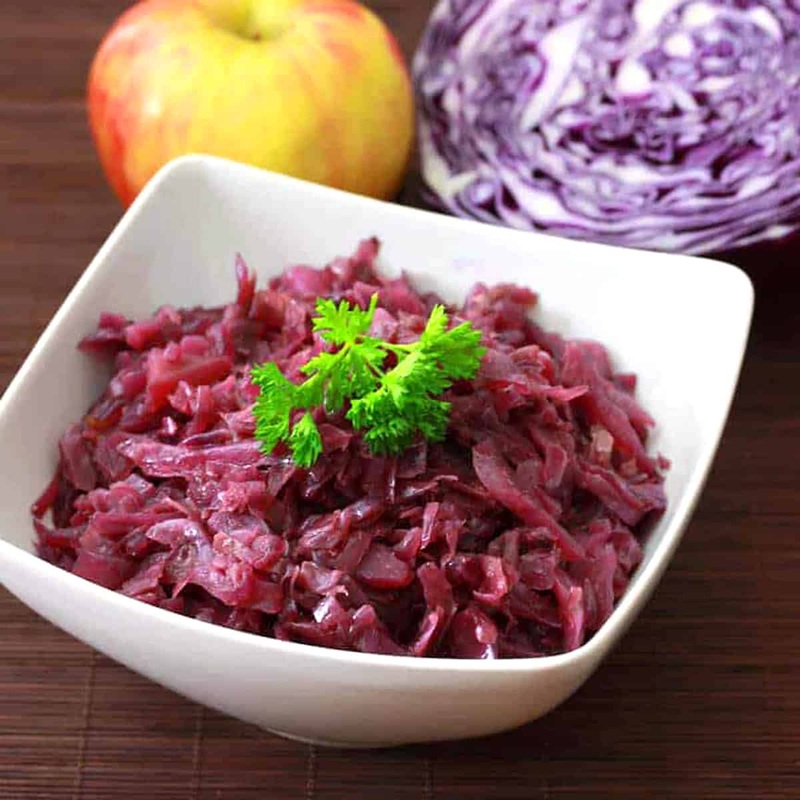
Rotkohl
German braised red cabbage: shredded red cabbage cooked slowly with apple, vinegar, sugar and warm spices until glossy and sweet-sour. The non-negotiable side for Sauerbraten, roast goose, pork knuckle and Christmas dinner. Better the next day.
Overview
Red cabbage shreds fine, then braises low and slow with grated apple, red wine vinegar, a splash of red wine and sugar. Cloves, bay and a cinnamon stick perfume the pot. The cabbage stays vivid purple thanks to the vinegar (acid keeps the colour), softens completely, and tastes sweet, sour and warmly spiced all at once.
Ingredients
Cabbage
- 1 kg red cabbage (about 1 small head; quartered, cored and finely shredded)
- 2 tart apples (Bramley or Granny Smith; peeled, cored, coarsely grated)
- 1 onion (large, finely chopped)
- 50 g unsalted butter (or 3 tablespoons goose fat)
Braising liquid and aromatics
- 4 tablespoons red wine vinegar
- 150 ml dry red wine
- 200 ml water (or apple juice)
- 3 tablespoons caster sugar (or 2 tablespoons redcurrant jelly)
- 1 cinnamon stick
- 4 whole cloves
- 2 bay leaves
- 6 juniper berries (lightly crushed; optional)
- 1 teaspoon salt
- Freshly ground black pepper
Method
Stage 1 - Soften the onion
- Melt the butter in a heavy non-reactive pot (enamelled cast iron is ideal; aluminium will react and dull the colour).
- Add the onion; cook on medium-low for 8 minutes until translucent and soft.
Stage 2 - Build the pot
- Add the shredded cabbage, grated apple, sugar, vinegar, wine and water.
- Tuck in the cinnamon stick, cloves, bay and juniper.
- Season with salt and a few grinds of pepper.
- Stir well; the cabbage will look like a mountain but will collapse.
Stage 3 - Braise
- Cover and bring to a simmer.
- Cook on the lowest heat for 1 hour, stirring every 15 minutes so nothing catches.
- Uncover for the final 15 minutes if it looks watery; you want it glossy, not soupy.
- Fish out the cinnamon stick, cloves and bay before serving.
Stage 4 - Taste and balance
- Taste. It should be sweet-sour with a clear vinegar lift.
- Adjust: more sugar if too sharp, a splash more vinegar if too sweet, salt to finish.
Notes
- Acid keeps the colour: Without vinegar (or another acid), red cabbage cooks dull blue-grey. Don't skip it.
- Better the next day: Make a day ahead. The flavours marry, the cabbage relaxes. Reheat gently with a splash of water.
- Goose fat for a Christmas roast: If you're cooking goose anyway, render some fat and use it instead of butter. Adds depth.
Variations
With bacon: Render 100 g diced smoked bacon at the start; cook the onion in the fat. A Bavarian touch. With pear: Swap one apple for a ripe pear; gives a softer sweetness.
Serving
Serve with: Sauerbraten, roast pork, goose, duck, pork knuckle, sausages, or with Spätzle for a vegetarian plate.
Storage
- Keeps 4 days refrigerated. Improves over the first 2.
- Freezes 3 months.
More like this
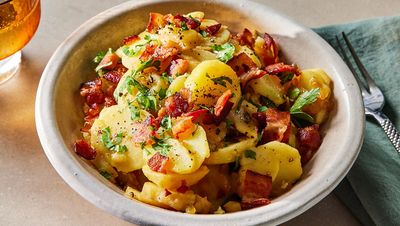
German Potato Salad
Waxy potatoes boil in their skins, peel while still warm and slice into thick coins. A hot dressing of rendered smoked bacon, onion, stock, vinegar, mustard and a little sugar pours over them. The warm potatoes soak the dressing up. Eats warm or at room temperature, never fridge-cold.
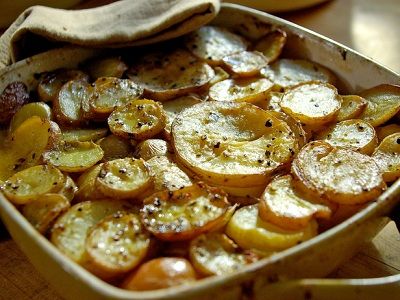
Boulangère Potatoes
Boulangère potatoes are a classic French gratin of thinly sliced potatoes and softened onions baked slowly in stock until tender, with a golden, crispy top. Unlike dauphinoise, they use stock rather than cream, making them a lighter accompaniment that absorbs all the savoury cooking liquid beautifully.
Bratwurst with Sauerkraut
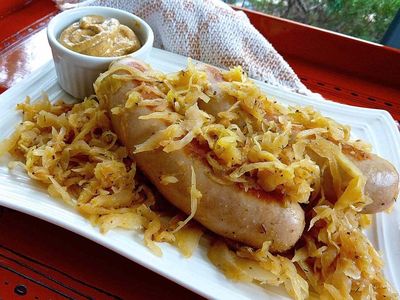
Bratwurst is less a single sausage than a whole family of them, with each German region defending its own version: long thin Nürnberger, plump Thüringer, the white veal Weisswurst of Bavaria, the smoked Frankfurter that became the American hot dog. What unites them is a fine grind of pork (often with veal), gentle seasoning of marjoram, white pepper, mace and a little caraway, and traditional natural casings. Authentic preparation matters: a raw bratwurst should never be slapped onto a screaming grill, because the high fat content scorches the outside before the inside cooks and the casing splits losing all the juice. The German method is a gentle two-stage cook: poach the sausages in barely simmering water or weak beer for 8-10 minutes until the inside is just set, then finish on a medium-hot grill for 3-4 minutes per side to colour the casing and add a touch of smoke. The accompanying sauerkraut is not the cold pickle from the jar but a warm braise: jarred kraut squeezed, then simmered with onion, bacon fat or butter, caraway seed, a bay leaf and a splash of white wine or apple juice for 25 minutes until soft and mellow. Difficulty is low; the only thing to get right is not boiling the sausages (a hard boil makes them swell and burst) and not impaling them on a fork (every puncture is a juice leak). Mustard is non-negotiable: sweet Bavarian süßer Senf for Weisswurst, sharp medium Düsseldorf or Löwensenf for everything else.
Frikadellen
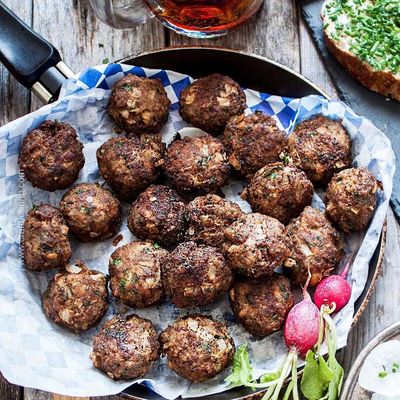
A bread roll soaks in milk, squeezes out and mixes with minced pork and beef, finely chopped onion sweated soft, an egg, mustard, marjoram and plenty of pepper. Shaped into flat patties (frikadellen are flat, not round like meatballs) and pan-fried in butter. The bread keeps them tender; the flat shape gives more crust.