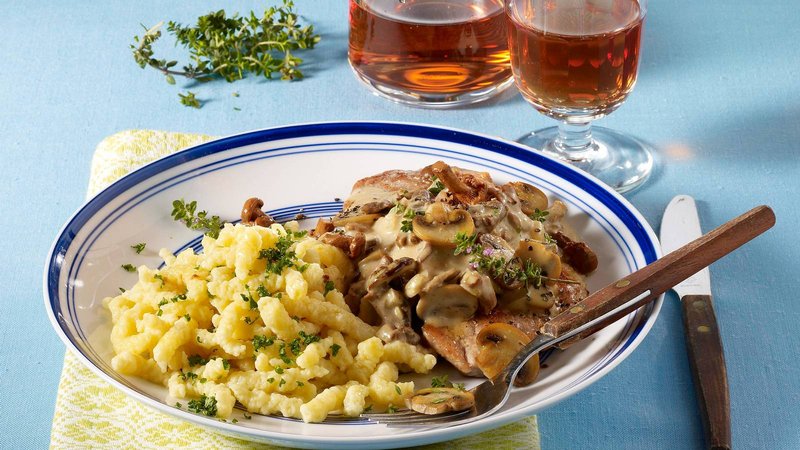
Jägerschnitzel
"Hunter's schnitzel": pork (sometimes veal) schnitzel served under a creamy mushroom-and-onion sauce. Less Austrian, more German; the dish you'd eat at a forest restaurant after a winter walk. The mushroom sauce makes it; everything else is foundation.
Overview
Pork loin escalopes pound thin, bread, and shallow-fry. While they crisp, a sauce of bacon, onion, mushrooms, white wine, stock and cream reduces in another pan. The schnitzel plates with the sauce on top (or alongside, if you want the crumb to stay crisp), with spätzle or boiled potatoes underneath.
Ingredients
Schnitzel
- 4 pork loin escalopes (about 150 g each)
- 100 g plain flour
- 3 eggs (large, beaten)
- 200 g fine breadcrumbs
- salt
- pepper
- 4 tablespoons vegetable oil
- 30 g butter
Mushroom sauce
- 100 g smoked bacon lardons
- 1 tablespoon vegetable oil
- 1 onion (small, finely chopped)
- 2 garlic cloves (crushed)
- 400 g mixed mushrooms (chestnut, oyster, etc.; sliced)
- 100 ml dry white wine
- 250 ml chicken stock
- 200 ml double cream
- 1 teaspoon Dijon mustard
- 1 teaspoon fresh thyme leaves
- A small bunch of flat-leaf parsley (chopped)
- salt
- pepper
To serve
- Spätzle (or boiled new potatoes)
Method
Stage 1 - Sauce
- Heat the oil and butter in a wide heavy pan; cook the lardons until the fat renders and they're crisp.
- Add the onion; cook 5 minutes.
- Add the garlic and mushrooms; cook 6-7 minutes until any liquid has evaporated and the mushrooms are golden.
- Pour in the wine; let it reduce by half.
- Add the stock; reduce by half again.
- Stir in the cream, mustard and thyme; simmer 3-4 minutes until thickened.
- Season; keep warm.
Stage 2 - Pound and bread
- Bash each pork escalope to 5 mm thick between cling film.
- Season with salt and pepper.
- Set up flour, beaten egg, breadcrumbs.
- Coat each escalope in flour, egg, then breadcrumbs.
Stage 3 - Fry
- Heat the oil and butter in a wide pan over medium-high heat.
- Fry the schnitzels for 2-3 minutes a side until deep golden.
- Drain briefly on a wire rack; salt.
Stage 4 - Plate
- Place each schnitzel on a warm plate over spätzle or potatoes.
- Spoon the mushroom sauce over (or to the side, if keeping the crumb crisp matters).
- Scatter parsley.
Notes
- Mixed mushrooms: A monoculture of one type is fine; a blend (chestnut, oyster, shiitake) is better.
- Don't oversauce: A heavy sauce-blanket softens the crumb fast. Drizzle generously but leave some bare crumb visible.
- Pork or veal: Veal is the original; pork is the everyday version. Both work; pork tastes more like the German pub version.
Storage
- Sauce keeps 3 days refrigerated, freezes 2 months.
- Schnitzel best fresh; reheat at 180°C for 6 minutes.
More like this
Beef Wellington
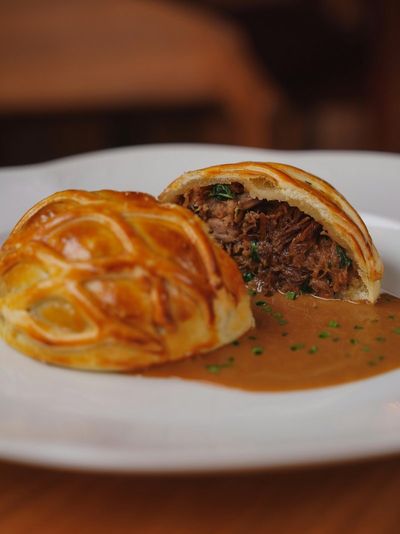
The defining British dinner-party showpiece, somewhere between French haute cuisine and English roast tradition, made famous in the modern era by Gordon Ramsay even if the Iron Duke himself probably never ate it. You sear a centre-cut beef fillet hard for colour, smear it with English mustard, wrap it in a tight blanket of mushroom duxelles and prosciutto, then encase the lot in all-butter puff pastry and roast at high heat. The pastry insulates the beef so it cooks gently to medium-rare while the crust crisps to deep mahogany above. The one technical trick the recipe insists on is drying the duxelles thoroughly so the pastry stays crisp underneath rather than going soggy from leaking mushroom water. Sliced at the table into thick rosy rounds, with a red-wine jus and roasted root vegetables on the side, the kind of plate that makes the evening feel like a special occasion before anyone says it.
Chả Giò
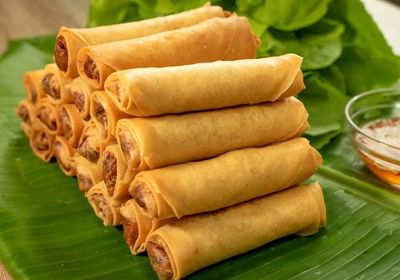
A pork and prawn filling is bound with shredded carrot, glass noodles and reconstituted wood-ear mushrooms, then rolled tightly in moistened rice paper and fried twice for maximum crunch. The double-fry technique gives chả giò their characteristic bubbled, blistered crust. Served with cool lettuce leaves, herbs and a punchy nước chấm dipping sauce.
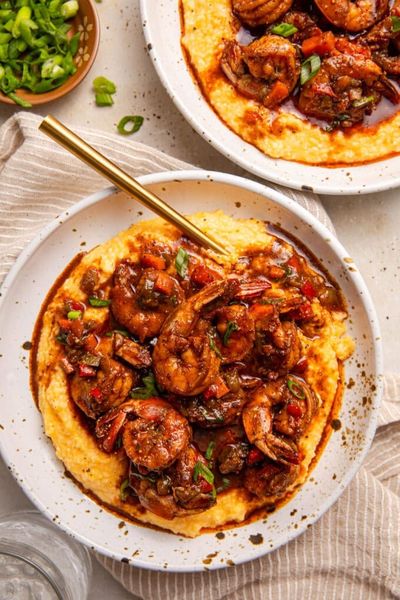
Brown Stew Shrimp and Sweet Potato Grits
A Caribbean-Southern crossover that works because both traditions cook in a similar register: butter, peppers, alliums, slow heat, savoury depth. The brown stew base on top of the dish is Jamaican, bell peppers, carrot, Scotch bonnet, ginger, browning sauce, that mahogany-coloured gravy with the unmistakable allspice-and-thyme signature, and the bed underneath is from Lowcountry Charleston, where sweet potato grits enriched with butter, half-and-half and gouda are a long-running modern Southern restaurant standard. The shrimp themselves are quick-cooked and sweet, picking up the brown stew sauce. Two textures stacked: silky-rich grits, brothy stew on top with bite from the diced peppers and carrot. Smell is sweet-onion-and-browning-sugar over the corn-sweet base of the grits. Not difficult but it's two pans running at once, so timing matters; the grits hold on a low warm setting while the shrimp cook quickly. A modern fusion rather than a traditional dish, popularised by Black American chefs in the 2010s exploring the points of overlap between Lowcountry and Caribbean cookery.
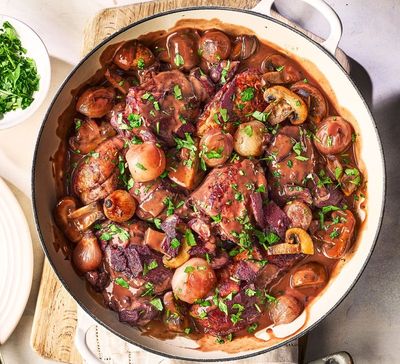
Coq au Vin
Lardons rendered, chicken pieces browned in the fat, then simmered in red wine with brandy, stock, garlic, herbs and tomato purée. Mushrooms and pearl onions are sautéed separately and added at the end so they keep their shape and texture.