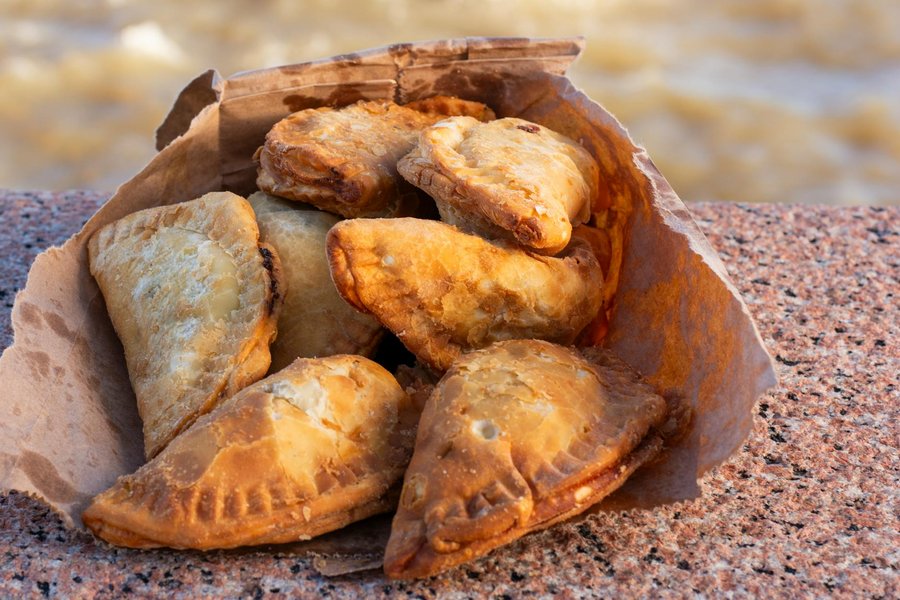
Pastelitos
Cuba's bakery pastry: small flaky puff-pastry squares filled with guava paste and cream cheese, baked till the pastry is shatteringly gold.
Overview
All-butter puff pastry (homemade if you've the patience, shop-bought all-butter if you don't) is rolled out, cut into squares, topped with a slab of guava paste and a chunk of cream cheese, then sealed into a parcel or topped with a second pastry square. Brushed with egg wash, baked at high heat until golden and puffed. While hot, brushed with a simple sugar syrup for the shiny finish.
Ingredients
Pastry
- 500 g all-butter puff pastry (one block, shop-bought is fine; ideally rolled to 3 mm thick)
Filling
- 250 g guava paste (Spanish: "pasta de guayaba"; sold in slabs in Latin shops or supermarket "World Foods" aisle)
- 250 g full-fat cream cheese (cold; the firm block kind, not whipped)
Egg wash and finish
- 1 egg (large, beaten with 1 teaspoon water and a pinch of salt)
- 50 g caster sugar
- 50 ml water
- ½ teaspoon vanilla extract
Method
Stage 1 - Prep the fillings
- Slice the guava paste into 12 rectangles, roughly 5 × 3 cm × 5 mm thick.
- Slice the cream cheese (cold from the fridge) into 12 similar rectangles.
- Keep both in the fridge while you prep the pastry.
Stage 2 - Cut the pastry
- Heat the oven to 200°C (180°C fan). Line two baking sheets with parchment.
- Unroll or roll the pastry on a lightly floured surface to a rectangle roughly 36 × 24 cm and 3 mm thick.
- Cut into 12 even squares of about 12 × 6 cm (or 24 squares of 6 × 6 cm if you prefer the smaller topped-and-bottom style).
Stage 3 - Assemble
- Method A (folded parcel, 12 pastelitos): Place a piece of guava paste and a piece of cream cheese side by side on one half of each 12 × 6 cm rectangle. Brush the border with egg wash. Fold over to a 6 × 6 cm square; press edges to seal with the back of a fork.
- Method B (top-and-bottom, 12 pastelitos): Lay a guava-and-cream-cheese stack on 12 squares of 6 × 6 cm pastry. Brush the edges with egg wash. Top with another square; press the edges with a fork to seal.
- Place on the prepared sheets, leaving 4 cm between each.
- Cut a small steam vent in the top of each with the tip of a knife.
- Brush the tops with egg wash.
- Chill 15 minutes (cold pastry going into a hot oven rises best).
Stage 4 - Bake
- Bake 18-22 minutes until deep gold, fully puffed and visibly flaky.
- Lift the parchment with the pastelitos onto a wire rack.
Stage 5 - Glaze and serve
- While the pastelitos bake, combine the sugar, water and vanilla in a small pan.
- Bring to a simmer; cook 2 minutes until slightly syrupy. Take off the heat.
- Brush the warm pastelitos generously with the warm syrup; this gives the bakery-style shine.
- Cool 5 minutes (the guava paste is napalm-hot straight from the oven).
- Eat warm, with strong sweet coffee.
Notes
- All-butter puff: Margarine-based puff has the wrong flavour. Spend the extra; brands like Carrême or Jus-Rol All Butter are reliable.
- Cold filling: Guava paste and cream cheese both stay neater if cold going in. The cream cheese needs to be the firm block sort, not the whippable tub kind, or it leaks.
- Don't overfill: A small slab of each is enough. Too much guava and it bubbles out and burns on the tray.
- Steam vent: Critical. Without it, the pastry won't rise evenly and may burst at a random edge.
- Sugar glaze: This is what separates home pastelitos from bakery ones. Don't skip.
Variations
Carne (beef): Fill with cooled, dry picadillo (Cuban ground beef with olives, raisins and capers) instead of guava and cream cheese. Savoury, equally classic. Coco (coconut): Fill with dulce de coco (sweet shredded coconut cooked with condensed milk). Guava only: Some traditional bakeries make a pure guava version with no cream cheese. Sweeter, lighter. Ham and cheese: Fill with thinly sliced cooked ham and grated Gruyère; the breakfast version.
Serving
Serve warm with strong sweet coffee (café cubano) or a glass of cold milk. Best eaten the day they're baked, within an hour or two of the oven.
Storage
- Best within hours of baking.
- Keep at room temperature in a sealed tin 1 day; refresh in a 170°C oven for 4 minutes to revive the crisp.
- Unbaked, assembled pastelitos freeze 1 month; bake from frozen, adding 4-5 minutes.
More like this
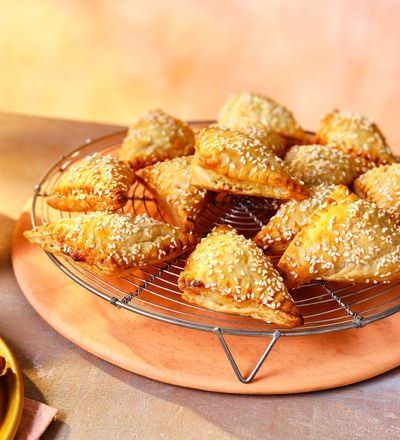
Bourekas
Ready-rolled all-butter puff pastry cuts into 12 squares (about 12 × 12 cm). Cheese filling: feta + ricotta + egg + parsley + nutmeg + pepper, mashed to a thick paste. Filling spoons onto each square; corners fold across to a triangle; edges crimp with a fork. Brushes with egg wash; sprinkles with sesame and nigella seeds. Bakes for 25 minutes at 200°C till deep gold and puffed.
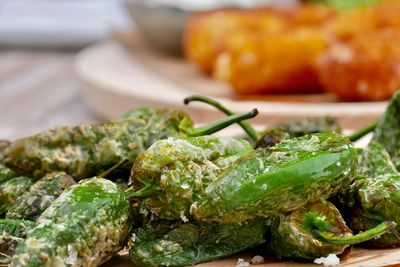
Croquetas
A thick bechamel cooks with finely diced ham or cooked chicken until it pulls away from the pan in a glossy mass. Chilled overnight (or at minimum 4 hours) until firm enough to shape into small cylinders. Each croqueta is breaded twice for a crisp shell that holds the soft, almost-pourable filling inside. Shallow-fried, not deep-fried, at moderate heat.
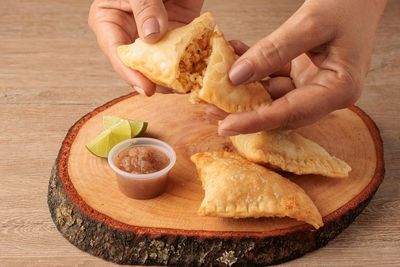
Empanadas Cubanas
A simple yellow dough (flour, lard or butter, water, salt, annatto or paprika for colour) rests cold while a picadillo-style ground beef filling cooks: sofrito, beef, tomato, olives, raisins, capers, cumin. Filling and dough chill separately. Rounds get filled, sealed with a crimped edge, and deep-fried until golden, blistered and hollow-sounding. Hot is best.
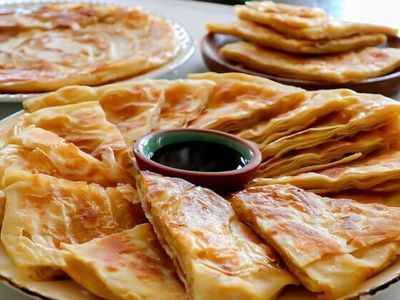
Feteer Meshaltet
A soft elastic dough rests; divides into 2 balls. Each ball stretches paper-thin on a heavily-oiled / ghee-buttered surface (similar to msemen or yufka, translucent dough). Layered with melted ghee between folds: stretch → ghee → fold into thirds → quarter-turn → stretch → ghee → fold. Repeated 3 times per ball. The two folded packets place stacked on top of each other in a buttered round dish (about 24 cm). Baked at 220°C 25-30 minutes until amber, golden, and the layers have separated dramatically. Served warm with honey, soft cheese, or molasses-and-tahini (the Egyptian classic dip).