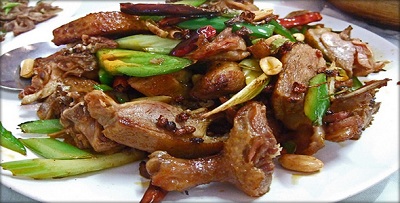
Crispy Sichuan Duck
Sichuan's crispy duck: duck legs marinated in Sichuan peppercorn and five-spice, steamed till tender.
Overview
In China, duck is a special occasion treatment reserved for banquets and celebrations. Don't be intimidated by the preparation, most steps are straightforward and can be done a day ahead. The technique is masterful: steaming renders out most of the fat, leaving meat moist and succulent, while deep-frying creates a shatteringly crisp skin. The result is elegant, restaurant-quality dinner.
Serves: 4-6 Prep Time: 5 minutes
Cook Time: 2 hours
Ingredients
Duck & Seasonings
- 1 whole duck
- 2 tablespoons five spice powder
- 2 tablespoons salt
Aromatics & Finishing
- 4 slices fresh ginger
- 4 spring onions
- 1 litre oil (for deep frying)
Method
Stage 1 - Season & Marinate
- Rub the inside and outside of the duck with the five spice powder and salt, ensuring it's rubbed on evenly.
- Wrap the duck in cling-film and place in the refrigerator for at least 3 hours, preferably overnight, to allow flavours to infuse.
Stage 2 - Stuff & Prepare
- Cut the ginger and spring onions into thin slices.
- Stuff them into the cavity of the duck.
- Place the duck on a heatproof plate.
Stage 3 - Steam
- Set up a steamer or put a rack into a wok or deep pan.
- Pour about 5 cm of water into the pan and bring to the boil.
- Put the duck and plate into the steamer, cover with a lid and steam gently for 2 hours.
- Replenish the water from time to time to keep the steam constant.
- Remove the duck and pour off all fat and liquid that has accumulated.
- Discard the ginger and spring onions.
- Keep the duck on a platter in a cool, dry place for about 2 hours until thoroughly dried and cooled. (At this point, the duck can be refrigerated for up to 24 hours.)
Stage 4 - Deep-Fry
- Cut the duck into quarters.
- Heat the oil in a deep-fat fryer or large wok.
- When the oil is almost smoking, deep-fry the duck quarters in 2 batches until each is crisp and warmed through.
- Drain the quarters on kitchen paper and chop into smaller serving pieces.
Notes
- Two-stage cooking: Steaming then deep-frying is the secret, it renders fat while maintaining succulence and achieves the ideal crispy exterior.
- Five spice powder: Essential for authenticity. Ensure even coating for balanced flavour.
- Drying time: The 2-hour cooling and drying period is crucial for achieving crispy skin in the fryer.
- Make-ahead friendly: Nearly all preparation can be done a day ahead; only deep-fry just before serving.
Serving
Serve with: Mandarin pancakes, hoisin sauce, shredded cucumber and spring onions (Peking duck style), or simply with steamed rice
Storage
- Best served immediately for optimal crispness
- Keeps 1-2 days refrigerated (skin will soften)
- Can be partially prepared (through steam stage) 1 day ahead, then deep-fried before serving
- Freezing not recommended (skin becomes tough upon thawing)
More like this
Five-Spice Beef (Wuxiang Niurou)
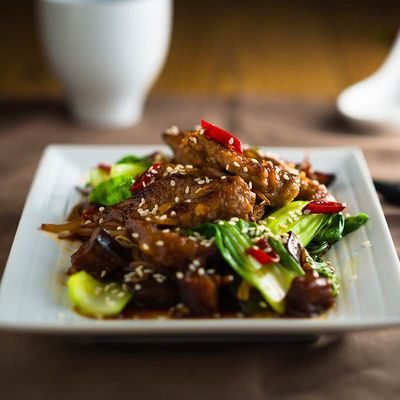
Wuxiang niurou is one of China's great deli meats, descended from the spiced braised meats of the Hui Muslim community that travelled along the Silk Road and settled into the cuisines of Beijing, Xi'an and Nanjing. The legend traces the modern dish to Ma Qingrui's Yue Sheng Zhai restaurant in Beijing in the 1700s, which still operates today as a halal state enterprise. Originally made with mutton, the recipe shifted to beef shank as the dish moved into the mainstream Han diet: shank is lean, gelatinous and full of connective tissue that turns silky after a long simmer. The flavour is dark, sweet and savoury with a slow warmth from Sichuan peppercorn and the woody perfume of cassia and star anise. Difficulty is low but the timeline is long: salt overnight, braise an afternoon, cool overnight in the liquid so the meat tightens and the spices penetrate. Sliced thinly across the grain the next day, the beef shows off the marbled cross-section of muscle and tendon that makes shank the right cut. Eat as part of a cold meze with pickles and peanuts, layer into a bowl of lanzhou lamian, or fold into bing flatbreads with cucumber.
Cantonese BBQ Chicken
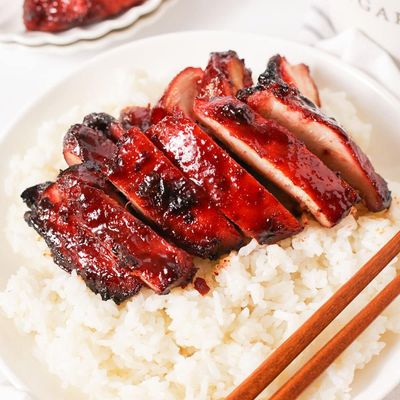
This is summer-BBQ adaptation of the lacquered red roast meats that hang in the windows of Cantonese siu mei shops. The marinade borrows from char siu (hoisin, soy, Shaoxing wine, five-spice, fermented bean curd, garlic, ginger) but pulls back on the sugar slightly because chicken does not need as much sweetness as pork shoulder. Bone-in skin-on thighs are the right cut: they stay juicy on the grill, the skin renders down and crisps, and the bones give the meat shape. A two-stage glaze does the rest. The thighs cook over indirect heat first to render the fat and set the meat, then move directly over the coals for the last few minutes while a honey-maltose mixture is brushed on repeatedly. Every brush of glaze caramelises, blackens slightly at the edges, then gets brushed again. The result is sticky-shiny with a smell that is half five-spice, half woodsmoke. Difficulty is low if you control your heat. A two-zone fire (one side coals piled high, the other side empty) is the only real requirement; on a gas grill, two burners on full and one off does the same job. Serve sliced over plain rice with sliced cucumber and a spoon of chilli oil, or stuffed into bao with hoisin and spring onion.
Roujiamo (Xi'an Chinese Hamburger)
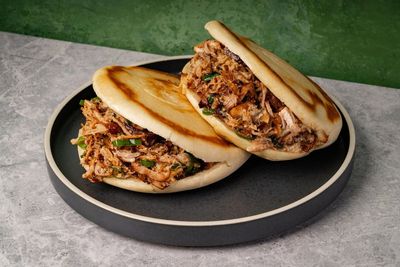
Roujiamo is often, lazily, called the Chinese hamburger, but it is older than the burger by perhaps a thousand years and structurally quite different. The bread is a flat, lightly leavened, sometimes laminated wheat round, with the layered Tongguan style (flaky and croissant-like) considered superior to the softer baijimo. The filling is rich braised pork, shoulder or belly, simmered with rock sugar, soy and warming spice until it shreds under a knife, then chopped fine on a board with raw onion and cilantro and a spoonful of its own dark cooking liquid. The whole assembly is then crammed inside the freshly fried-and-baked bun while everything is still hot. Roujiamo is a quintessentially Xi'an dish, the product of a city that for centuries sat at the eastern terminus of the Silk Road; the bread tradition comes from the Hui and Uyghur Muslim communities of the northwest, while the braised pork belongs to the Han Chinese kitchen. Difficulty for a home cook is moderate to high, the lamination of the bread takes practice, and there are multiple components on timed tracks, but the result is one of the great street foods of China, and the buns and meat can both be made ahead.
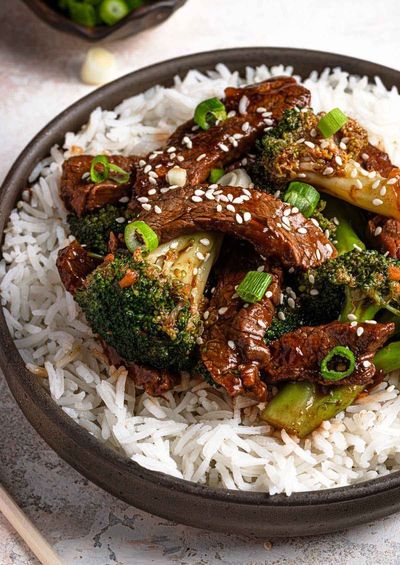
Beef and Broccoli
Sliced beef velvets briefly in cornflour and soy, broccoli florets blanch to bright green, and the lot stir-fries hard with garlic and ginger in a soy-oyster-rice-wine sauce. Served over steamed rice.