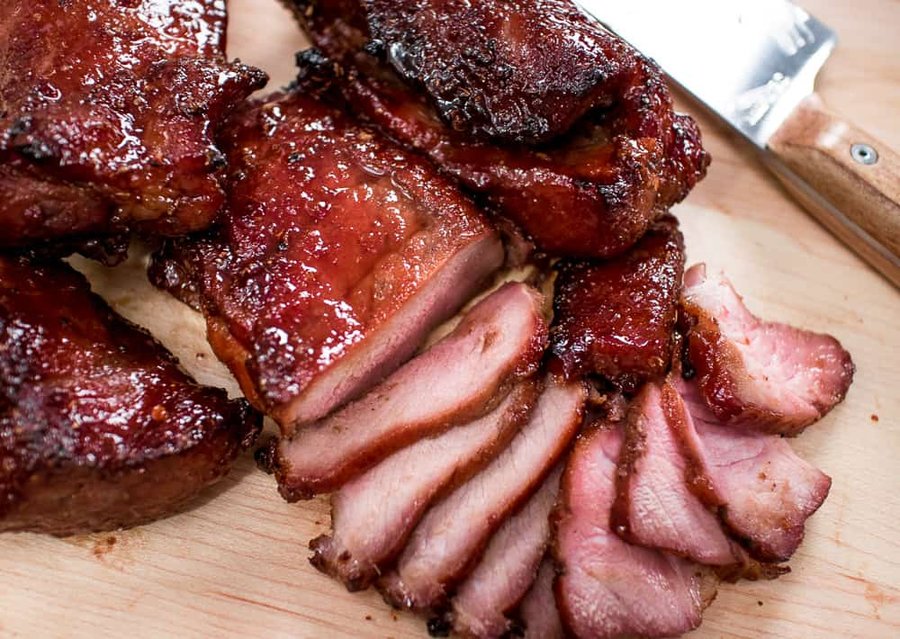
Char Siu
Lacquered strips of pork the colour of dark cherry wood, edges blackened where the honey-maltose glaze has caramelised against the heat. The smell is unmistakable: five-spice, rose wine, fermented bean curd, and pork fat sizzling onto coals.
Overview
Char siu, literally "fork-roasted" in Cantonese, is the lacquered red barbecue pork that hangs in the windows of siu mei shops across Hong Kong, Guangzhou and any Cantonese diaspora neighbourhood worth knowing. Traditionally long strips of pork are skewered on hooks and lowered into vertical ovens or charcoal pits, where the marinade caramelises into a shimmering, almost brittle crust while the inside stays juicy and pink at the edges. The marinade is a careful balance: hoisin sauce for sweetness and body, light and dark soy for salt and colour, Shaoxing wine for aromatics, five-spice for warmth, fermented red bean curd (nam yu) for the deep umami funk that distinguishes shop-quality char siu from home attempts, and a final glaze of maltose syrup thinned with honey for that characteristic glossy finish. Pork shoulder is the cut of choice because the marbling keeps the meat moist through high-heat roasting; lean cuts like loin go dry and stringy. The classic colour comes from a small amount of red yeast rice or, in modern home recipes, a touch of red food colour, though the dish tastes the same without it. Difficulty is moderate. The marinade needs overnight, and the roasting needs your attention for the final glazing turns under high heat, but the technique itself is straightforward. Serve over rice with greens, in a soft bao bun, or chopped onto wonton noodles.
Ingredients
Pork
- 1.2 kg pork shoulder, cut into long strips 5 cm thick
Marinade
- 3 tbsp hoisin sauce
- 2 tbsp light soy sauce
- 1 tbsp dark soy sauce
- 2 tbsp Shaoxing rice wine
- 2 tbsp oyster sauce
- 2 cubes red fermented bean curd (nam yu), mashed
- 2 tbsp brown sugar
- 1 tsp Chinese five-spice powder
- 4 garlic cloves, grated
- 1 thumb fresh ginger, grated
- 1 tsp sesame oil
- ½ tsp white pepper
- Optional: ¼ tsp red yeast rice powder for colour
Glaze
- 3 tbsp maltose syrup (or runny honey)
- 2 tbsp honey
- 1 tbsp hot water
Method
Stage 1 - Marinate
- Combine all marinade ingredients in a bowl and stir until smooth.
- Pat the pork strips dry and lower them into the marinade, turning to coat. Reserve 3 tablespoons of marinade in a separate jar for basting.
- Cover and refrigerate at least 12 hours, ideally 24.
Stage 2 - Bring to room temperature
- Take the pork out of the fridge 45 minutes before cooking.
- Heat the oven to 220 degrees fan. Line a deep roasting tray with foil and pour in 250 ml water to catch drips and prevent smoking.
- Place a wire rack over the tray.
Stage 3 - First roast
- Arrange the pork strips on the rack with space between them.
- Roast for 15 minutes, then flip and roast another 15 minutes.
Stage 4 - Glaze
- While the pork roasts, warm the maltose, honey and hot water together in a small pan, stirring until smooth.
- Pull the pork out after the first 30 minutes. Brush all surfaces with reserved marinade.
- Return to the oven for 5 minutes, then flip, brush with glaze, and roast 5 more minutes.
- Repeat the glazing turn one more time, watching closely. The surface should look glassy and start to char in patches.
Stage 5 - Final char and rest
- Switch the oven to grill (broil) at high for the last 2 to 3 minutes to deepen the char, turning once. Do not walk away; the sugars burn fast.
- Rest the pork on a board for 10 minutes before slicing across the grain into 1 cm pieces.
Notes
- Maltose vs honey: maltose is traditional and gives the proper sticky lacquer. Honey alone works but is thinner. You can find maltose in any Chinese supermarket.
- Nam yu: the red fermented bean curd is the secret. Without it the marinade tastes generic; with it the dish gains its proper depth.
- Cut the strips long: long, thick strips give you the contrast of caramelised crust against tender centre. Cubes overcook.
- Charring: the dark patches on the edges are the point. Slightly burnt corners are prized, not a mistake.
Storage
- Char siu keeps 4 days refrigerated, wrapped tightly. It slices well cold for fried rice or noodles. Freezes 2 months. Reheat covered with a splash of water at 160 degrees to keep it from drying.
More like this
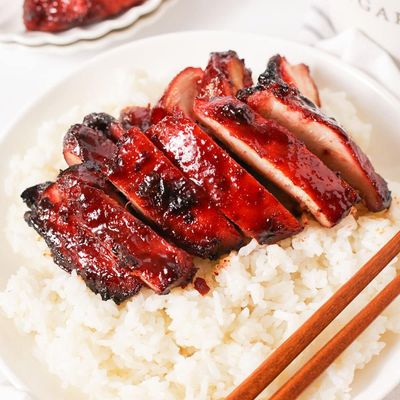
Cantonese BBQ Chicken
This is summer-BBQ adaptation of the lacquered red roast meats that hang in the windows of Cantonese siu mei shops. The marinade borrows from char siu (hoisin, soy, Shaoxing wine, five-spice, fermented bean curd, garlic, ginger) but pulls back on the sugar slightly because chicken does not need as much sweetness as pork shoulder. Bone-in skin-on thighs are the right cut: they stay juicy on the grill, the skin renders down and crisps, and the bones give the meat shape. A two-stage glaze does the rest. The thighs cook over indirect heat first to render the fat and set the meat, then move directly over the coals for the last few minutes while a honey-maltose mixture is brushed on repeatedly. Every brush of glaze caramelises, blackens slightly at the edges, then gets brushed again. The result is sticky-shiny with a smell that is half five-spice, half woodsmoke. Difficulty is low if you control your heat. A two-zone fire (one side coals piled high, the other side empty) is the only real requirement; on a gas grill, two burners on full and one off does the same job. Serve sliced over plain rice with sliced cucumber and a spoon of chilli oil, or stuffed into bao with hoisin and spring onion.
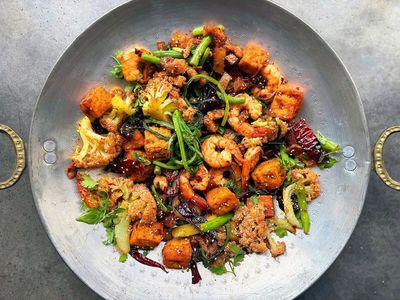
Mala Dry-Pot (Ganguo)
Ganguo, literally "dry pot", is the dry sister of hotpot. Where hotpot is a communal soup simmered at the table, dry pot is a wok composition: each ingredient pre-cooked separately, then everything tossed together at the last moment in a fragrant mala sauce based on Pixian doubanjiang, fermented black beans and chilli oil. The result lands somewhere between a stir-fry, a casserole and a giant heap of bar snacks. The dish is usually credited to Chongqing in the 1990s and exploded into nationwide popularity in the 2000s; it now anchors the menu of countless ganguo restaurants where you point at ingredients on a fridge and they appear minutes later in a single-handled wok at your table. Difficulty for a home cook is low if you accept the rhythm: blanch the vegetables, sear the proteins, then build the final dish from already-cooked components. The trick is restraint with the sauce, generous heat under the wok, and the willingness to commit to a long ingredient list. The recipe is endlessly flexible: lotus root, potato, cauliflower, mushrooms, squid, chicken wings, beef, fish balls, tofu skin, whatever you have, in any combination, totalling 1-1 ½ kg.
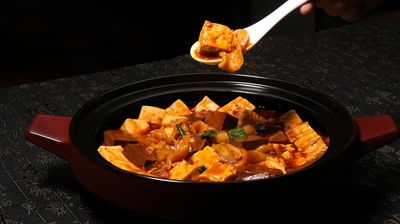
Mapo Tofu
Silken tofu cubes are blanched briefly in salted water (firms slightly and seasons). Pork mince is fried hard in oil; doubanjiang and douchi join, cooking to release oil; garlic, ginger, chilli flakes and ground Sichuan peppercorn are toasted briefly. Stock is poured in; tofu is slipped in; gentle simmer for 5 minutes; cornflour slurry thickens. Spring onions and a final dusting of ground Sichuan peppercorn finish.
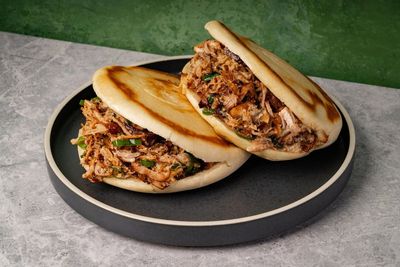
Roujiamo (Xi'an Chinese Hamburger)
Roujiamo is often, lazily, called the Chinese hamburger, but it is older than the burger by perhaps a thousand years and structurally quite different. The bread is a flat, lightly leavened, sometimes laminated wheat round, with the layered Tongguan style (flaky and croissant-like) considered superior to the softer baijimo. The filling is rich braised pork, shoulder or belly, simmered with rock sugar, soy and warming spice until it shreds under a knife, then chopped fine on a board with raw onion and cilantro and a spoonful of its own dark cooking liquid. The whole assembly is then crammed inside the freshly fried-and-baked bun while everything is still hot. Roujiamo is a quintessentially Xi'an dish, the product of a city that for centuries sat at the eastern terminus of the Silk Road; the bread tradition comes from the Hui and Uyghur Muslim communities of the northwest, while the braised pork belongs to the Han Chinese kitchen. Difficulty for a home cook is moderate to high, the lamination of the bread takes practice, and there are multiple components on timed tracks, but the result is one of the great street foods of China, and the buns and meat can both be made ahead.