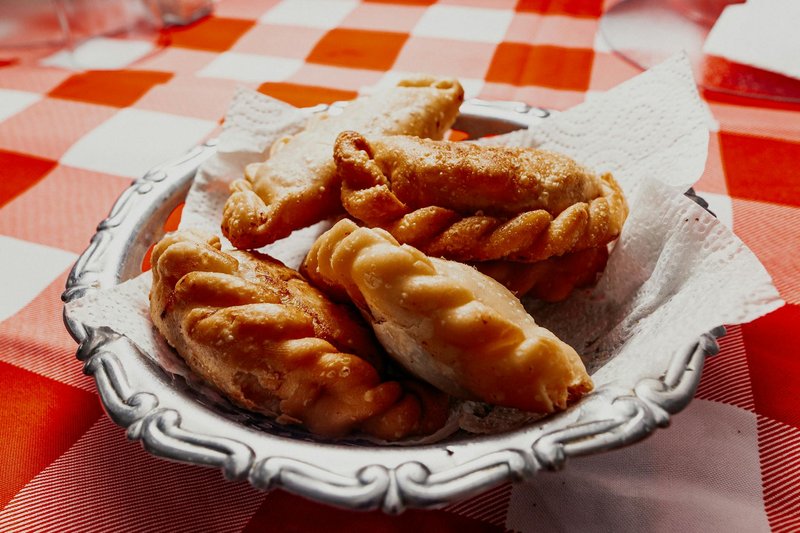
Empanadas de Queso
Chile's cheese empanadas: half-moons of butter-rich dough wrapped around melting queso fresco, deep-fried golden. The stretchy bite at every party.
Overview
Chile's cheese empanadas, the parties-and-snacks half-moon that's the lighter, quicker cousin of empanadas de pino. You knead a dough of flour, salt, butter, warm milk and an egg to a smooth pliable ball and rest it for thirty minutes. The filling is simplicity itself: cubes of queso fresco or mozzarella about a centimetre across, with a sprinkle of oregano. Divide the dough, roll each ball to a ten-centimetre disc, place a cube of cheese in the centre, fold into a half-moon, crimp the edges with a fork. Deep-fry in moderately hot oil for three minutes per side until deep gold. Drain briefly, eat hot before the cheese sets - the stretchy bite is half the pleasure.
Ingredients
Dough
- 400 g plain flour
- 1 ½ teaspoons salt
- 80 g unsalted butter (melted)
- 200 ml warm milk
- 1 egg (large)
- 1 tablespoon white vinegar
Filling
- 350 g mozzarella OR queso fresco (cut into 1 cm cubes)
- 1 teaspoon dried oregano
- ½ teaspoon ground black pepper
Frying
- 800 ml neutral oil
Egg wash (for sealing)
- 1 egg (beaten)
Method
Stage 1 - Dough
- In a wide bowl, whisk flour and salt.
- Make a well; pour in the melted butter, warm milk, egg and vinegar.
- Mix to a shaggy dough; knead 6 minutes till smooth and supple.
- Rest in a covered bowl 30 minutes.
Stage 2 - Filling
- Toss the cheese cubes with oregano and pepper.
Stage 3 - Roll and fill
- Divide the dough into 16 balls (about 45 g each); keep covered.
- Roll each ball to a 10 cm disc on a lightly floured surface.
- Place 3-4 cheese cubes in the centre.
- Brush the edge with egg wash.
- Fold in half to a half-moon.
- Crimp the edge firmly with the tines of a fork.
Stage 4 - Fry
- Heat oil to 175°C.
- Lower 4 empanadas at a time; fry 3 minutes per side till deep gold.
- Lift onto a wire rack.
Stage 5 - Serve
- Eat hot; the cheese pulls in strands.
Notes
- Crimp firmly: any gap and the cheese leaks into the oil during frying.
- Don't overfill: too much cheese and the empanadas burst. 3-4 cubes is the sweet spot.
- Hot oil, not just warm: below 170°C the dough absorbs oil and the empanadas are greasy.
Storage
- Best within 10 minutes of frying.
- Unfried empanadas freeze on a tray, then bag; fry from frozen + 1 minute per side.
- Cooked: reheat 5 minutes in a 200°C oven.
More like this
Baked Börek with Khandrajo Filling
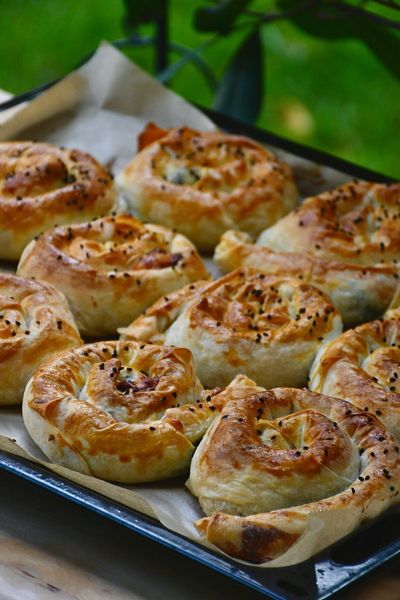
Börek are Turkish pastry packages filled with various ingredients: meat, cheese, or vegetables. This vegetarian version uses khandrajo, a concentrated eggplant ragù heavily reduced until jammy and concentrated. Traditional börek-making uses thin, hand-rolled dough (yufka), but modern versions use readily available filo pastry. The key to success is preparing the khandrajo well ahead; it must be completely cool before filling (otherwise it creates soggy börek). The eggplant roasts down to deep mahogany richness through high-heat cooking, creating a sweet-savory filling. Baked börek develop shatteringly crisp exteriors through careful pastry handling and high-temperature baking.
Coco Bread
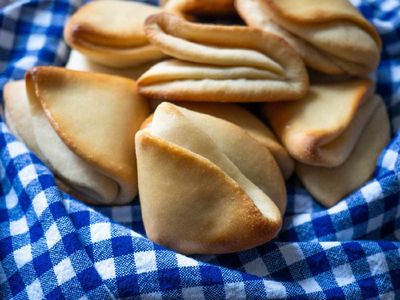
An enriched yeast dough made with coconut milk, butter, sugar and a little salt. Risen once, divided, rolled into rounds, brushed with butter and folded in half so the baked roll opens like a clamshell. Baked at moderate heat until lightly golden and soft. The folded shape is purposeful: it tears cleanly into two leaves, ideal for stuffing with a beef patty or jerk pork.
Feteer Meshaltet
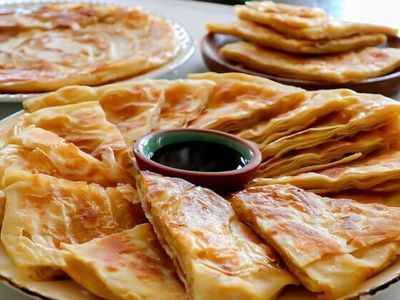
A soft elastic dough rests; divides into 2 balls. Each ball stretches paper-thin on a heavily-oiled / ghee-buttered surface (similar to msemen or yufka, translucent dough). Layered with melted ghee between folds: stretch → ghee → fold into thirds → quarter-turn → stretch → ghee → fold. Repeated 3 times per ball. The two folded packets place stacked on top of each other in a buttered round dish (about 24 cm). Baked at 220°C 25-30 minutes until amber, golden, and the layers have separated dramatically. Served warm with honey, soft cheese, or molasses-and-tahini (the Egyptian classic dip).
Goghal
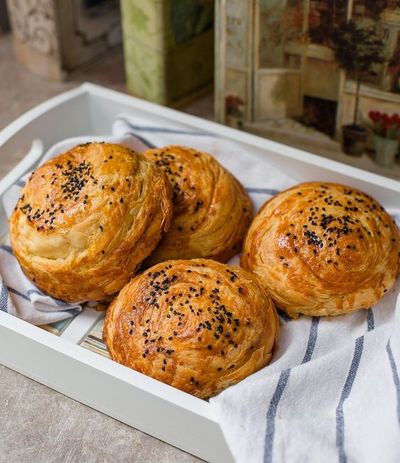
A spiced flaky pastry from Azerbaijan's tea table, traditionally baked for Novruz alongside pakhlava and shekerbura, eaten with strong sweet tea any time of year. You make a yeasted milk-and-egg dough and let it rest for an hour, while you build a savoury-sweet spice mix from black pepper, caraway, fennel, saffron and a hard cheese-like crumble (Azerbaijani gurut, or a substitute). The dough rolls thin, brushes with butter, gets a scatter of spice; folds, rolls, sprinkles again, repeated three times in the same lamination motion you'd use for puff pastry. The final dough rolls to a centimetre thick, cuts into rounds with the rim of a glass, takes an egg wash for shine, and bakes at 180°C for twenty-five minutes until deep golden. Eaten with sweet black tea and a small dish of jam on the side.