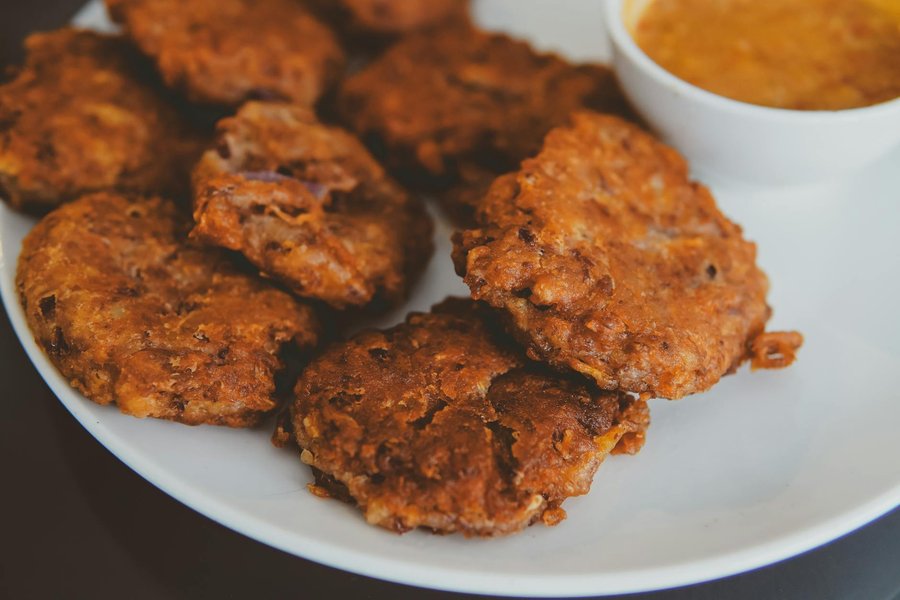
Bean Akyaw
Burma's everyday teashop fritter: a craggy disc of soaked yellow split peas with turmeric, onion and coriander, deep-fried shatter-crisp.
Overview
The Burmese yellow split-pea fritter, sold by street vendors in hot oil-spattered cones of newspaper across Yangon's evening markets. You soak yellow split peas overnight until they're softened but not mushy, then blitz to a coarse sandy paste with shallot, garlic, ginger, turmeric and coriander. No flour, no binder; the natural starch in the peas holds the fritters together as they fry. Tablespoonfuls drop into hot oil and fry until they're deep gold and craggy at the edges. Eaten hot from the cone with a sour-sweet tamarind dipping sauce, a wedge of lime, and whatever you can carry while you walk on through the evening crowds.
Ingredients
Fritters
- 250 g yellow split peas (dried; soaked in cold water 6-8 hours, drained)
- 2 shallots (roughly chopped)
- 3 garlic cloves
- 2 cm ginger (peeled, sliced)
- 1 long green chilli (deseeded; or to taste)
- ½ teaspoon ground turmeric
- 1 ½ teaspoons salt
- ¼ teaspoon ground white pepper
- 2 tablespoons coriander leaves (chopped)
- 2 spring onions (finely sliced)
- 2-4 tablespoons cold water (only if needed)
- 750 ml neutral oil (sunflower or rapeseed; for deep-frying)
Tamarind dipping sauce
- 2 tablespoons tamarind paste
- 3 tablespoons hot water
- 1 tablespoon palm sugar (or soft brown sugar)
- 1 tablespoon fish sauce
- 1 garlic clove (small, grated)
- ½ teaspoon dried chilli flakes
Method
Stage 1 - Soak and drain
- Cover the split peas with plenty of cold water; soak 6-8 hours or overnight. They should be soft enough to crush easily between thumb and finger.
- Drain thoroughly and shake dry in a sieve for 5 minutes. Wet peas will splatter in the oil.
Stage 2 - Blitz the batter
- Tip the drained peas into a food processor with the shallot, garlic, ginger, chilli, turmeric, salt and white pepper.
- Pulse to a coarse, sandy paste. You want visible grain, not a smooth puree. Scrape down the sides once or twice.
- If the mixture won't bind when squeezed in your palm, add cold water 1 tablespoon at a time, pulsing briefly between additions. Avoid making it wet.
- Tip into a bowl; stir through the coriander and spring onions.
Stage 3 - Dipping sauce
- Whisk the tamarind paste with the hot water until smooth.
- Stir in the palm sugar until dissolved.
- Add the fish sauce, grated garlic and chilli flakes. Taste; balance sour, salt and sweet. Set aside.
Stage 4 - Fry
- Heat the oil in a wok or deep saucepan to 170°C. A pinch of batter should rise and sizzle steadily.
- Take a heaped tablespoon of batter; press it into a flat disc about 6 cm wide and 1 cm thick using wet hands or two spoons.
- Slide gently into the oil. Fry 3-4 fritters at a time so the oil temperature holds.
- Cook 3-4 minutes, turning once, until deep gold and crisp all over.
- Lift onto kitchen paper. Repeat with the rest of the batter, letting the oil come back to 170°C between batches.
Stage 5 - Serve
- Pile the hot fritters onto a plate; serve immediately with the tamarind sauce alongside.
Notes
- Soak, don't boil: The peas must stay raw. Boiled peas turn the fritters into mash. If you forget to soak overnight, a 2-hour soak in hot (not boiling) water gets you most of the way.
- Coarse paste, not smooth: Over-processing makes a gummy batter that fries dense. Pulse, don't run the motor.
- Oil temperature matters: Below 165°C the fritters absorb oil and turn greasy. Above 180°C they brown before the centre cooks. A thermometer is worth it.
- Tamarind paste: Concentrated dark paste from Asian grocers. If you only have block tamarind, soak 30 g in 50 ml hot water for 10 minutes and strain.
Variations
Onion akyaw: Replace half the split peas with thinly sliced onion and add 2 tablespoons rice flour to bind. A different texture: lacier, crisper, more pakora-like. Spicier version: Add a teaspoon of chilli powder to the batter and a pinch more to the dipping sauce.
Serving
Serve with: a pot of strong milk tea (lahpet yay), or alongside Burmese coconut noodle soup (ohn no khao swe) as a crunchy side. Garnish with: extra coriander leaves and a wedge of lime.
Storage
- Best eaten within an hour of frying. The crisp surface softens fast.
- Re-crisp leftovers in a 200°C oven for 5 minutes. Don't microwave.
- Raw batter keeps 24 hours covered in the fridge; stir before frying.
More like this
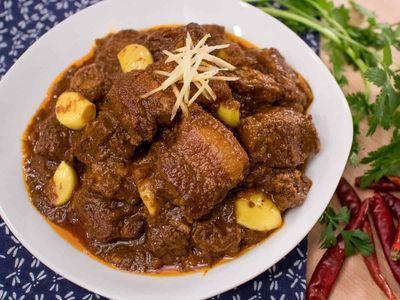
Wet Tha Hin Lay
The Burmese pork curry, the simplest of the country's red-oil-slick curries and the dish that turns up in every household's lunch rotation. You marinate pork briefly in turmeric, salt and a splash of fish sauce, then cook onions hard in oil until they're deep golden brown - this is the colour and depth of the curry, and rushing it leaves the dish pale. The pork browns in the same oil, then garlic, ginger, paprika and chilli powder go in, then tomato softens. Water covers the meat and the curry simmers covered for an hour until tender, then uncovers for the se-byan stage that returns the oil to the surface in the characteristic red-orange slick. Served with white rice, a side of balachaung, and a green vegetable.
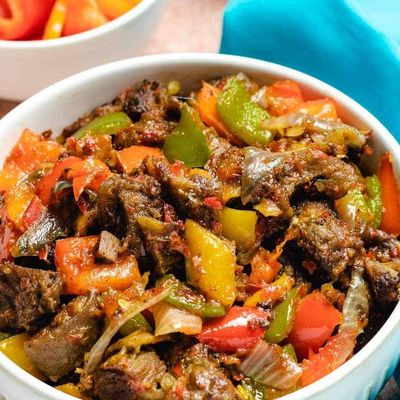
Asun (Spicy Smoky Goat Meat)
Goat meat (bone-in pieces, ideally) simmers in water with onion, garlic, bay, salt and bouillon till tender (45 min). Lifts out; pats dry; grills over high heat (or under a hot grill / on a griddle pan) till charred (8-10 min). Pepper base: scotch bonnet, red pepper, onion, garlic blitz to paste; sautés in oil with curry powder, thyme, ginger till fragrant. Charred meat tosses in the pepper paste; cooks for 5 minutes more; tops with fresh chopped onion. Eats hot.
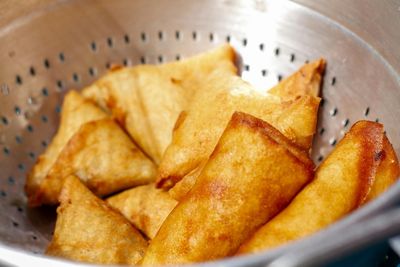
Burmese Samosa
The Burmese take on the South Asian samosa, with a thinner, crisper pastry and a milder filling than its Indian cousin. You make a hot-water dough that rolls out very thin so the fried shell ends up glassy and crisp rather than bready. The filling is mild by Indian standards: turmeric, ginger, fried onion and a whisper of cumin folded into mashed potato and peas, finished with crushed peanuts for the nuttiness that marks the Burmese version. The triangles fry at moderate heat until amber and crackling, the pastry blistering as it goes. Eaten hot dipped in tamarind sauce, or torn into chunks for a samusa-thoke salad later.
Octopus Curry (Cari Ourite)
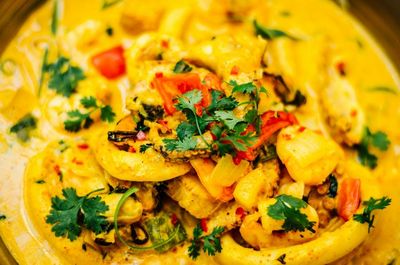
Cari ourite is the dish that turns up at every Mauritian fisherman's Sunday lunch, and at every Creole restaurant on the south coast. The technique is to braise octopus low and slow in a tomato-and-onion masala that leans on fresh thyme and a finishing pinch of garam masala instead of the heavier dried-spice masalas you find in cari boeuf or cari poulet. Octopus has a sweet, slightly mineral flavour that needs space, so the seasoning is restrained: thyme for aroma, tomato for body, ginger and garlic for the base, mild curry powder for depth, garam masala right at the end for top-note warmth. The tentacles cook for around 45 minutes (small octopus) to an hour (larger). The biggest variable is the octopus itself; small frozen octopus, sold cleaned at most fishmongers and many supermarkets, is reliable and the freezing actually helps tenderise the flesh. Difficulty is moderate; the cook is mostly passive once the masala is built. Serve with plain steamed rice and a satini cotomili (coriander chutney) or a spoon of pickled chilli. A simple green salad with vinaigrette on the side keeps it honest.