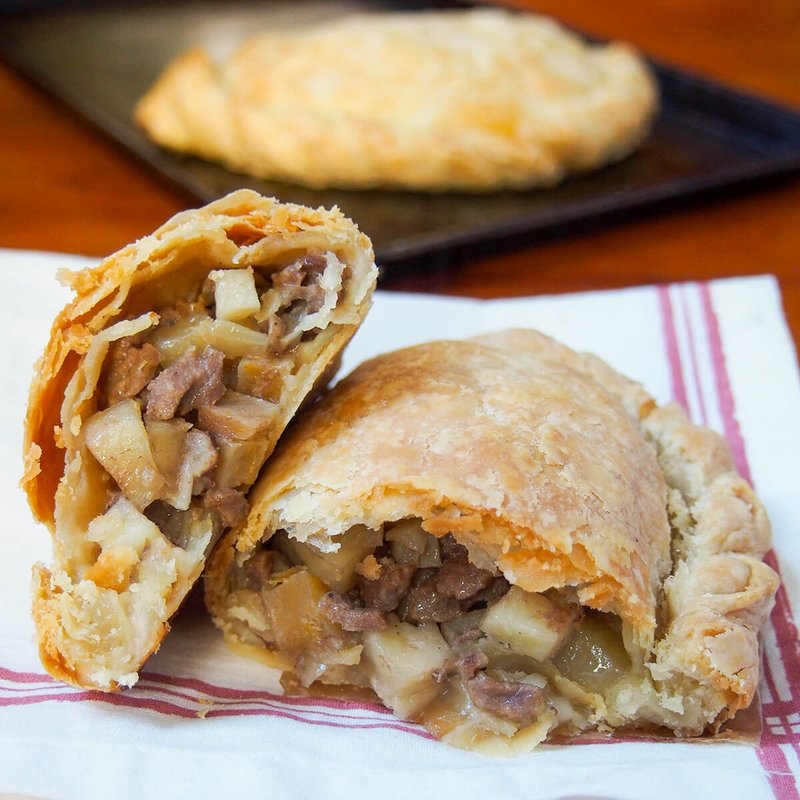
Cornish Pasty
The Cornish tin miner's lunch: beef, potato, swede and onion sealed raw in shortcrust pastry and baked till the steam cooks it through.
Overview
Shortcrust pastry uses a mix of lard and butter for the right sturdy-but-flaky texture; chilled, rested for 30 minutes, rolled to 4 mm thick, and cut into 22 cm discs (a small plate works as a guide). Filling: beef skirt (cut into 5 mm cubes, never minced), potato (5 mm dice), swede (5 mm dice) and onion (5 mm dice), seasoned generously with salt and pepper. The filling is piled on half of each pastry disc, leaving a 1 cm border. The pastry is folded over; edges are crimped firmly with thumb-and-forefinger pressed-and-twisted rope crimps along the curved edge. Egg-washed; baked at 200°C for 15 min, then 180°C for 35-40 min until deep golden.
Ingredients
Pastry
- 500 g plain flour
- ½ teaspoon salt
- 125 g cold butter (cubed)
- 125 g cold lard (or vegetable shortening, cubed)
- 1 egg
- 150 ml ice water (more if needed)
Filling
- 400 g beef skirt steak (or chuck - cut into 5 mm dice, NEVER minced)
- 400 g potato (peeled, cut into 5 mm dice - Maris Piper or other floury)
- 250 g swede (peeled, cut into 5 mm dice - known as "turnip" in Cornwall)
- 1 onion (large, cut into 5 mm dice)
- 1 ½ teaspoons salt (be generous; the meat is raw and needs seasoning to flavour through)
- 1 teaspoon black pepper (coarsely ground)
- 30 g butter (cubed - 8 small cubes, one per pasty fold)
Glaze
- 1 egg yolk (beaten with 1 tablespoon water)
Method
Stage 1 - Pastry
- In a wide bowl, whisk flour and salt.
- Rub in the cold butter and lard with fingertips until the mixture looks like coarse breadcrumbs with some pea-sized lumps remaining.
- Whisk the egg into 100 ml of ice water.
- Pour into the flour; bring together with a fork. Add more ice water 1 tablespoon at a time if needed.
- Knead briefly (5 squeezes) into a smooth ball - don't overwork.
- Divide into 4 equal portions; wrap; refrigerate 30 minutes.
Stage 2 - Filling
- Cut beef into 5 mm dice (smaller is wrong; minced is wrong). Spread on a board.
- Cut potato, swede and onion to similar 5 mm dice.
- In a wide bowl, combine all 4 ingredients with salt and pepper.
- Mix thoroughly with your hands - the salt and pepper should coat everything.
Stage 3 - Roll and cut
- Heat oven to 200°C (180°C fan).
- Line a baking tray with paper.
- Working with one pastry portion at a time, roll on a lightly floured surface to a circle 22-23 cm across, 4 mm thick.
- Use a 22 cm plate as a guide; trim any uneven edges with a knife.
Stage 4 - Fill
- Lay the pastry disc flat.
- Pile about a quarter of the filling onto half the disc (leaving a 1 cm border).
- Drop a small cube of butter (~7 g) on top of the filling.
- Brush the entire pastry rim with water (helps the seal).
Stage 5 - Fold and crimp
- Lift the empty half of the pastry over the filling to meet the other edge.
- Press the edges together gently to seal.
- Crimp the curved edge: pinch a small portion between thumb and forefinger; press-and-twist; move along; repeat. The result is a rope-like crimp along the entire curve.
- The traditional Cornish crimp is along the SIDE (the long curve), not the top.
- Transfer to the baking tray.
- Repeat for all 4 pasties.
Stage 6 - Glaze
- Brush each pasty all over with egg yolk wash.
- Cut a small (1 cm) steam slit in the top of each.
Stage 7 - Bake
- Bake at 200°C for 15 minutes.
- Reduce heat to 180°C (160°C fan); bake another 35-40 minutes.
- The pasties should be deep golden brown all over; the internal temperature of the filling should reach 80°C (probe through the steam hole).
Stage 8 - Rest
- Cool on a rack for 10 minutes (the filling is volcanic straight from the oven).
Stage 9 - Serve
- Eat warm or cold.
- Traditional accompaniment: a mug of tea, or Cornish ale.
Notes
- Beef skirt, chopped not minced: This is the protected/traditional rule. Beef skirt (also called flank or hanger) has the right texture and beef flavour. Chuck works as substitute. Minced beef gives a wrong texture entirely.
- Crimp along the curve, not the top: Real Cornish pasties have the crimp along the curved long edge, with the flat side facing up. (Devon pasties have the crimp along the top; they're a separate cousin.) Either works; only one is true to Cornwall.
- Don't pre-cook the filling: Cornish pasties cook from raw. The filling steams inside the pastry. Pre-cooking gives a different (and worse) texture - drier meat, mushier veg. The raw assembly is the technique.
Storage
- Refrigerate 3 days; reheat at 180°C 12 minutes.
- Freeze cooked 2 months; reheat from frozen at 180°C 25 minutes.
- Freeze raw (assembled but unbaked) 2 months; bake from frozen at 180°C 65 minutes.
More like this
Nigerian Meat Pie
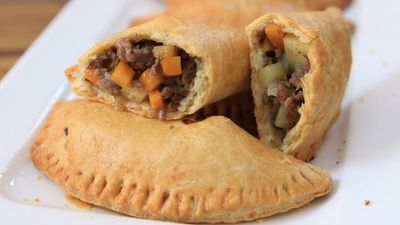
A short pastry of plain flour, butter, margarine (the mix gives Nigerian pies their distinctive texture, flakier than all-butter, sturdier than all-margarine), a pinch of baking powder, salt and cold water is made and rested. The filling: minced beef browned with onion, garlic, curry powder, thyme and a stock cube, then a small dice of carrot and potato added and cooked through with a splash of stock and a touch of cornflour to give a thick gravy. Pastry rolls out 4 mm thick, cuts into 15 cm rounds; filling goes on half; egg-wash glues; crimp; egg-wash on top. Bake at 200°C 30-35 minutes until deep gold.
Lamb Pasties
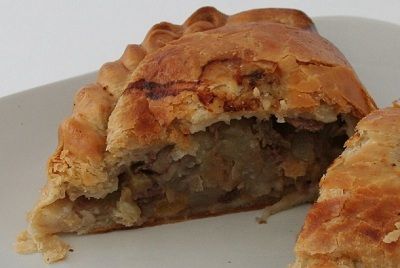
A Cornish-inspired pastry parcel filled with seasoned lamb, tender vegetables, and a rich, savory gravy. These hand-held pastries are perfect for portable meals, picnics, or as a sophisticated starter. The flaky shortcrust pastry encloses a deeply flavorful filling, a British classic that's remarkably easy to prepare at home.
Pork Pie
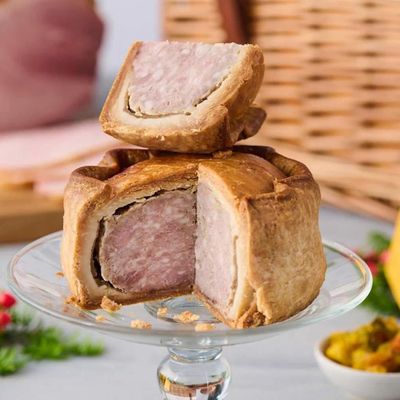
Pork shoulder (uncured, fatty) and a small amount of bacon are chopped into 5 mm dice (not minced, the texture is key). Mixed with white pepper, mace, sage, salt and a touch of anchovy paste for umami. The hot-water-crust pastry: flour is mixed with hot water-and-lard mixture, kneaded warm into a pliable dough. Two-thirds of the dough lines a tall round tin (or is moulded freestanding around a glass jar); the filling is packed in tight; a lid of remaining dough is laid over the top with a 1 cm steam hole punched. Baked at 200°C for 30 min, then 160°C for another 60-75 min. Left to cool. A rich pork stock (made from trotters or with gelatin sheets) is poured through the steam hole while the pie is still warm. Refrigerated overnight to set the jelly. Sliced and eaten cold.
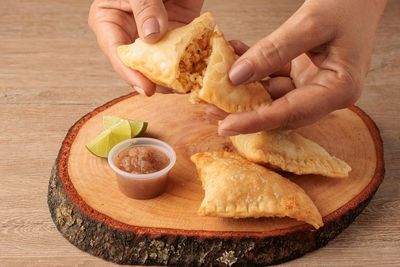
Empanadas Cubanas
A simple yellow dough (flour, lard or butter, water, salt, annatto or paprika for colour) rests cold while a picadillo-style ground beef filling cooks: sofrito, beef, tomato, olives, raisins, capers, cumin. Filling and dough chill separately. Rounds get filled, sealed with a crimped edge, and deep-fried until golden, blistered and hollow-sounding. Hot is best.