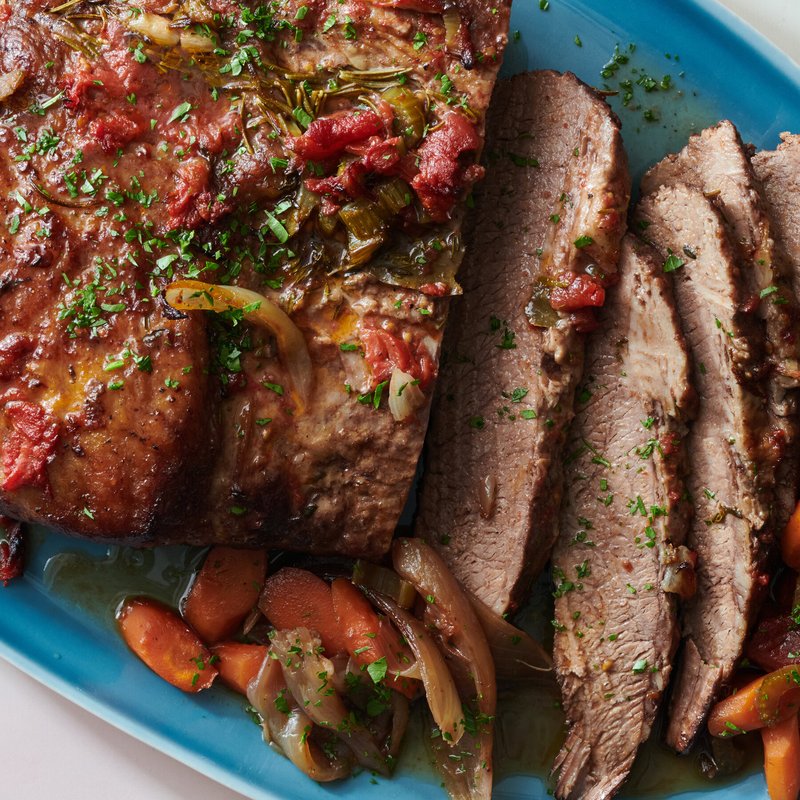
Jewish Brisket
Slow-braised beef brisket in a sweet-savoury onion-and-tomato sauce, the meat cooked until it can be cut with a fork. The defining holiday main of Ashkenazi Jewish cooking - served at Rosh Hashanah, Passover, Shabbat, weddings. Best made the day before so it slices cleanly and the flavours deepen.
Overview
This is the brisket that anchors every Ashkenazi holiday table - Rosh Hashanah dinner, the Passover seder, a Friday-night Shabbat. You sear the meat hard until the surface is mahogany, then build a slow braise on its rendered fat: onions caramelised down to gold, garlic and tomato paste deepened with paprika and brown sugar, wine and stock pulling the lot together. The brisket goes back in fat-side up and the pot disappears into a low oven for three hours plus, until a fork meets no resistance. The trick almost every recipe insists on is the overnight rest. You cool the meat in its sauce, slice it cold against the grain (warm brisket shreds, cold brisket slices clean), then reheat the slices in the sauce before serving. Spoon the onion-rich gravy generously over mashed potato, kasha or buttered egg noodles.
Ingredients
- 2 kg beef brisket (point or flat; trimmed of excess fat but leaving a thin cap)
- 2 tablespoons vegetable oil
- salt
- pepper
Braise
- 4 onions (large, sliced)
- 8 garlic cloves (smashed)
- 3 tablespoons tomato paste
- 2 tablespoons brown sugar
- 1 tablespoon sweet paprika
- 1 teaspoon ground black pepper
- 250 ml dry red wine (or 250 ml extra stock)
- 750 ml beef stock
- 4 carrots (cut into 4 cm chunks)
- 4 celery sticks (cut into 4 cm chunks)
- 3 bay leaves
- 4 sprigs fresh thyme
- 2 tablespoons cider vinegar
- 1 teaspoon salt
Method
Stage 1 - Sear
- Heat the oven to 160°C (140°C fan).
- Pat the brisket dry; salt and pepper generously on all sides.
- Heat the oil in a large heavy oven-proof pot over high heat.
- Sear the brisket 4-5 minutes per side until deeply browned. Lift out.
Stage 2 - Onions
- Reduce the heat to medium.
- Add the onions to the pot (use the rendered fat); cook 12-15 minutes, stirring, until soft and golden.
- Stir in the garlic; cook 1 minute.
Stage 3 - Build the braise
- Stir in the tomato paste, brown sugar, paprika and black pepper; cook 2 minutes.
- Pour in the wine; let it bubble vigorously 2 minutes (deglaze the pot).
- Add the stock, bay, thyme, vinegar and salt.
Stage 4 - Braise
- Return the brisket fat-side up; the liquid should come about ⅔ up the meat. Top up with stock if needed.
- Cover with the lid; transfer to the oven.
- Cook 2 ½ hours.
- Add the carrots and celery around the meat; return to the oven; cook 1-1 ½ hours more, until the brisket is fork-tender (a fork goes in with no resistance).
Stage 5 - Cool overnight
- Lift the brisket onto a board; cool 1 hour.
- Wrap and refrigerate the meat overnight (or at least 4 hours).
- Refrigerate the sauce separately; the fat will rise and solidify.
Stage 6 - Reheat and serve
- Skim the solid fat off the cold sauce; discard.
- Slice the cold brisket against the grain into 1 cm slices (warm meat shreds; cold slices clean).
- Lay the slices in a baking dish; pour the sauce and vegetables over.
- Cover; reheat at 160°C for 30-40 minutes until hot through.
Stage 7 - Plate
- Lift slices onto plates with vegetables; spoon sauce generously over.
- Serve with mashed potato, kasha or noodles.
Notes
- Cook the day before: The two essential techniques - slicing cold for clean slices, and skimming the fat - both need overnight rest. Same-day brisket falls apart unevenly.
- Against the grain: Brisket has very long muscle fibres. Slice perpendicular to the grain or every bite is chewy.
- Don't trim all the fat: Some fat cap renders into the sauce and bastes the meat. Trim the thick parts; leave a 5 mm cap.
Storage
- Keeps 5 days refrigerated; arguably best on day 2-3.
- Freezes 3 months in its sauce.
More like this
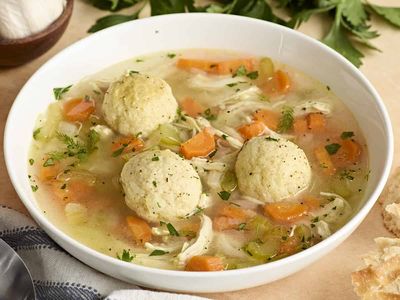
Matzo Ball Soup
Two parallel jobs: a long-simmered chicken broth made from a whole bird with onion, carrot and celery, skimmed clean and finished with dill; and the matzo balls themselves, made from matzo meal, eggs, schmaltz and seltzer, rested in the fridge for the gluten to relax. The balls poach in salted water (never the broth, or the broth clouds), then sit in the hot broth at serving time. Light, comforting, traditional.
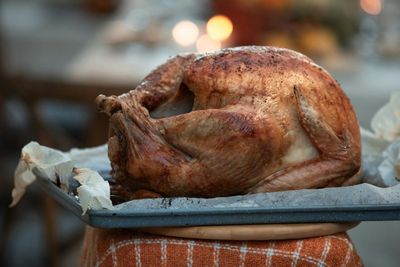
Roast Turkey
A whole roast turkey is the centrepiece of the American Thanksgiving table and most American Christmas tables too. It is one of the simplest large roasts to cook well as long as you accept two truths: a turkey breast is done at 65°C internal while a turkey thigh is done at 75°C, so you cannot cook them both to perfection by clock alone, and the bird benefits enormously from being dry-brined the day before so the skin dries out and the meat seasons through. The recipe below is the standard American home approach: a 24-hour dry brine with salt, then a herb butter loaded under and over the skin, then roasted at moderate heat (initially low to gently cook the thighs, finished hot to crisp the skin and bring the breast up to temperature). The pan drippings become a quick gravy at the end. This version specifically fills a manifest gap on the Thanksgiving editorial collection where Sunday Roast Chicken has been standing in. Use a 5-6 kg bird for 8-10 people with leftovers; scale brine and butter proportionally for a larger or smaller turkey. Difficulty is moderate; the active work is short but you must commit to the overnight brine and to using a meat thermometer.
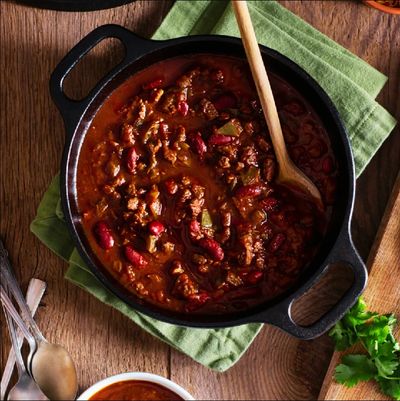
Beef Chili
The American household chili, sitting somewhere between Texas-style "no beans" purism and Cincinnati-style "chili over spaghetti" eccentricity, this one has beans, isn't sweetened with cinnamon, and lands solidly in the middle of the bell curve. The flavour is a Tex-Mex spice rack working in concert: chili powder (the broad warmth), cumin (the earthy backbone), smoked paprika (the deep smoke), chipotle powder (the slow-burn heat), brown sugar (a quiet balance), garlic powder (the savoury underline). Fire-roasted tomatoes are the technical detail that lifts this above a generic chili, charring the tomatoes before canning adds a roasted note that ordinary diced tomatoes can't supply. Texture is chunky and brothy rather than thick-and-pasty (this isn't a chili-mac chili), with kidney beans giving substance and pieces of bell pepper still holding their bite. Smell is cumin and smoked paprika on browned beef. Genuinely easy and incredibly forgiving, chili is one of the few dishes that's better the day after it's made, so it tolerates a longer simmer if you have it. American cold-weather bowl food, eaten across every state from Texas to New York, with regional toppings (sour cream, cheese, raw onion, cornbread, oyster crackers) that say more about the cook than the dish.
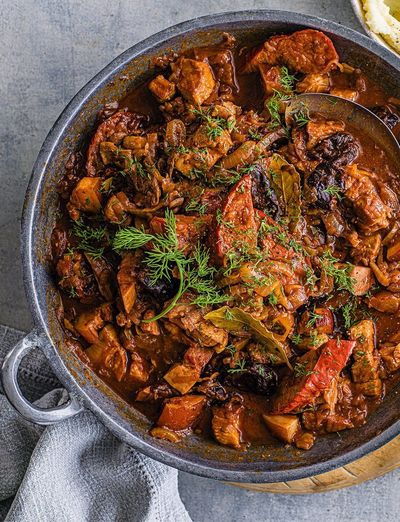
Bigos
Pork shoulder, beef, smoked sausage and bacon all brown separately, then meet sauerkraut, fresh cabbage, dried porcini, prunes, tomato and red wine in a heavy pot. Simmers for 3 hours minimum; reheats over 2-3 days, getting better each round.